Commercial pilots Capt. Dharav Gosalia (left) and Capt Machchhar pose for a selfie inside an aircraft cockpit in this undated photo.
Capt. Smit Machchhar, flydubai hero pilot, was always 'two steps' ahead: ex-colleague
Capt. Gosalia says Capt. Machchhar’s training and instinct saved 174 passengers
Last updated:
4 MIN READ
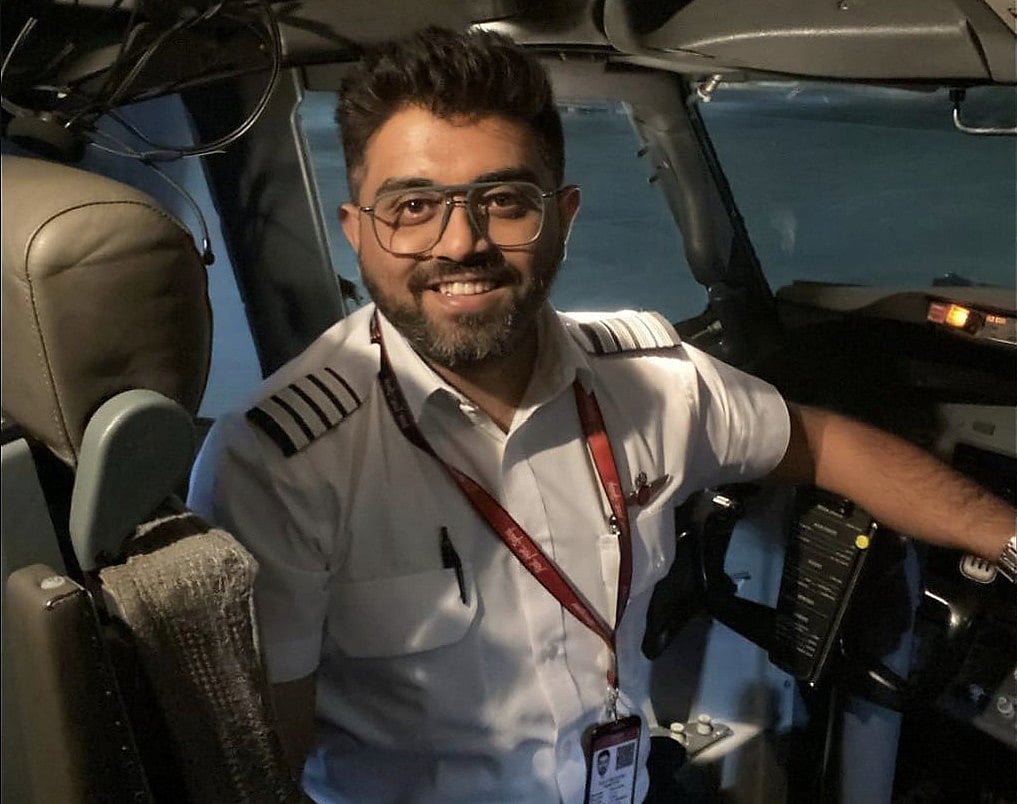
An undated photo shows Indian Capt. Smit Machchhar in the cockpit of a plane in an unknown location. Machchhar was at the controls of a flydubai flight FZ1073 that was diverted to Tabuk in northwestern Saudi Arabia for an emergency landing on Wednesday, Sept. 30, 2026.
AP
Capt. Smit Machchhar’s experience and instinct to prepare for any eventuality helped prevent what could have been an “unimaginable” disaster, a former colleague said.
The flydubai captain is credited for helping save the lives of 174 passengers when he opened the cockpit door despite suffering life-threatening injuries in an attack by his co-pilot.
The incident began several hours into flydubai Flight FZ1073 from Dubai to Tel Aviv on September 30.
The co-pilot allegedly attacked Capt. Machchhar inside the cockpit midflight with a crash axe and attempted to take control of the aircraft.
Passengers and off-duty crew members then overpowered the attacker after the injured captain managed to open the cockpit door.
According to Capt. Dharav Gosalia, a former colleague and longtime friend of Capt. Machchhar, his ability to anticipate potential problems was central to his response.
“When you’re in the cruise phase all you have to do is ensure that the flight is being monitored, but Smit always had the habit of staying at least two steps ahead of the aircraft,” Capt. Gosalia, 33, told The National.
“He would prepare for what could happen to the aircraft, or what could happen to the weather, or what is the situation at the runway,” Capt. Gosalia told the Abu Dhabi-based daily.
Thinking ahead
“This is instilled within you when you have been flying for so many years – to think a little ahead of the aircraft because it's a fast-flying machine and whatever can go wrong goes wrong in a fraction of a second. He had this habit of staying ahead, ready with a prompt reaction.”
‘Land safely with all souls on board’
Capt. Machchhar and Capt. Gosalia grew up in Mumbai’s Ghatkopar suburb. They trained at the same flight academy in New Zealand and later flew Boeing 737 aircraft for India’s SpiceJet.
Capt. Machchhar served as a SpiceJet commander for 11 years before moving to Dubai to join flydubai four years ago. Capt. Gosalia later joined Air India.
“It was a miracle that he came out of this,” Capt. Gosalia said. “It was because of his presence of mind. It all boils down to all the experience and intuition built over the last 15 years of flying.
“One thing is very clear for Smit or any captain – no matter what happens, the aircraft has to land safely with all the souls present on board. That would have been the only thing in his mind, that's what we have been taught.”
Capt. Gosalia, however, said that no amount of routine preparation could fully prepare a pilot for an attack by the person seated beside him in the cockpit.
“We have been trained for hijack protocols, incapacitation, security threats or abnormal scenarios, but an attack from a first officer sitting next to you who is your trusted wingman, it’s impossible,” he said. “I don’t think in all years of flying anybody would have thought of this.”
Rehearsing emergency procedures
Capt. Gosalia said emergency preparation, visualisation and the right attitude were essential parts of a captain’s training.
“It all boils down to those small ‘chair flying’ or visualisation techniques, your nature before the flight that makes you the best in the cockpit,” he said.
“Chair flying is about going through a sequence of actions during maybe an engine failure or depressurisation. This is useful for an abnormal situation in the cockpit.
“When your motor skills and muscle memory are good, it helps rehearse procedures and your hands automatically move to the right direction, like automatically putting in the right squawk [emergency] code.”
The attack on Flight FZ1073 unfolded in circumstances far outside the normal emergency scenarios rehearsed by commercial pilots.
While initial reports focused on a cockpit altercation, prosecutors later stated that the co-pilot attempted to carry out a terrorist act by assaulting the captain with a crash axe and attempting to seize flight controls.
UAE judicial authorities maintain jurisdiction over the matter because the aircraft is registered in the UAE and flies the UAE flag, meaning local laws apply to crimes committed on board even outside the country’s territory.
Treating the crew as a team
Capt. Machchhar’s approach to leadership was to treat everyone working on the aircraft as part of one team, his friend said.
“People want to fly with him,” Capt. Gosalia said. “Whether it’s a crew member, loader or engineer he never treated anyone differently, he is that kind of person. He would carry the whole crew as a unit, as a team. Nobody felt left out. Smit is humble, warm and jovial.”
The two men also remained close outside the cockpit. While working for SpiceJet, they played cricket in a Mumbai suburb during their breaks and sometimes arranged to meet during overseas layovers.
“We used to fly a lot together. Apart from flying, we would check the roster to see where we could do our layovers and we would also meet for sports at home,” Capt. Gosalia said.
‘Time to heal’
Capt. Gosalia said his friend and Machchhar’s family needed time and privacy to recover from the ordeal.
“For other people, this is a story but not for him,” Capt. Gosalia said. “For him, it’s a real thing that happened. His family needs space. What he went through inside the cockpit is just unimaginable.
“The aircraft plunging with a heavy rate of descent, it’s almost vertical, he is trying to reach the door while completely wounded. Hats off to what he pulled off. He will definitely come out strong. And every one of us is proud to know him.”
Capt. Machchhar is now recovering in Abu Dhabi.
Sheikh Hamdan bin Mohammed bin Rashid Al Maktoum, Crown Prince of Dubai, Deputy Prime Minister and Minister of Defence of the UAE, and Chairman of The Executive Council of Dubai, had visited the captain in hospital and praised him for demonstrating "the highest degrees of courage, responsibility and care for human life."
UAE authorities are investigating the incident.
Counsellor Dr Hamad Saif Al Shamsi, UAE Federal Prosecutor, announced that investigations into the incident revealed that the co-pilot had attempted to carry out a terrorist act.
Sign up for the Daily Briefing
Get the latest news and updates straight to your inbox
Network Links
GN StoreAbout Gulf NewsTerms & ConditionsReach by GNSitemapContact usPrivacy PolicyGN FocusHave your sayWork with usAdvertise with usGulf News epaperPrinting Services
Download our app
© Al Nisr Publishing LLC 2026. All rights reserved.