Schengen travel update: EU activates fully digital Entry/Exit System
New digital border checks to log non‑EU travellers across 29 Schengen countries
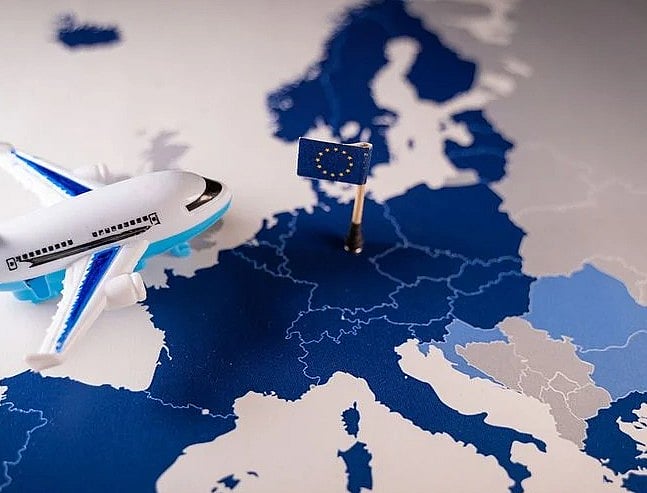
The European Union announced on Friday that the Entry/Exit System is now fully operational across all Schengen Area countries, marking a key step in strengthening border security.
In a statement, the European Commission said the system is an advanced digital framework designed to record the entry and exit of non-EU nationals travelling to 29 European countries for short stays.
The move marks a significant upgrade in external border management across the bloc.
Get updated faster and for FREE: Download the Gulf News app now - simply click here.
EU officials highlight security benefits
Executive Vice-President of the European Commission for Technological Sovereignty, Security and Democracy, Henna Virkkunen, said the system marks a significant step in strengthening the security of the European Union and its citizens. She noted that the new framework equips external borders with advanced technology capable of identifying potential risks in real time and improving the monitoring of overstays.
Commissioner for Internal Affairs and Migration Magnus Brunner described the rollout as a major milestone in modernising and reinforcing the EU’s external border management. He said the system allows authorities to track who enters and exits the bloc, as well as when and where crossings occur, emphasising that protecting citizens remains a top priority.
The fully functioning Entry/Exit System is the major milestone in modernising and enhancing the security of Europe’s external borders. By digitally tracking who enters and leaves the Schengen area, we are well equipped to identify overstayers, prevent irregular movements, and combat document and identity fraud.Commissioner for Internal Affairs and Migration Magnus Brunner
How the system functions
The Entry/Exit System (EES) records the movements of non-EU nationals staying for up to 90 days within any 180-day period. Instead of passport stamps, border authorities now collect facial images, fingerprints and travel details, which are stored in a centralised digital database.
On first arrival, travellers provide full biometric and personal information. On subsequent visits, identity verification is quicker, as existing records are already available for reference.
Once entry is granted, free movement within the Schengen Area remains unchanged. Some member states may also use e-gates, self-service kiosks or pre-registration systems to speed up border processing.
Security and system benefits
The system replaces traditional passport stamping with digital tracking of entries and exits. It improves data accuracy on border crossings, helping authorities detect overstays and identify cases of document fraud and identity misuse. Since its phased introduction in October 2025, the system has logged more than 52 million crossings.
Over the same period, more than 27,000 travellers were denied entry, including around 700 flagged for security-related concerns.
It is now active at all external Schengen border checkpoints.
Processing efficiency
The European Commission says initial registration takes about 70 seconds per traveller. Subsequent entries are expected to be quicker due to reuse of stored biometric data.
Impact on travel flow
Additional digital checks have changed procedures for non-EU visitors at entry points.
Authorities and aviation bodies have cautioned that peak travel periods could see longer queues, particularly at major airports.
Who comes under the system
All non-EU nationals entering the Schengen Area for short stays fall under the framework, including tourists and business visitors.
Indian passport holders are included, with every entry and exit logged electronically.
EU citizens, Schengen residents and long-term visa holders remain outside its scope.
Key border changes
Passport stamps replaced with digital tracking
Biometric data collected on first entry
Faster verification on return visits
Potential longer processing times during initial rollout
Why the EU introduced it
Officials say the EES is designed to modernise border controls by replacing manual processes with automated records.
It improves accuracy in travel histories, reduces administrative errors and strengthens monitoring of overstays and irregular movement.
Rollout timeline
The system was introduced in October 2025 and expanded gradually over six months, operating alongside traditional stamping during the transition phase.
Full deployment was completed in April 2026, marking the final shift to a fully digital border system across Schengen external frontiers.
Network Links
GN StoreDownload our app
© Al Nisr Publishing LLC 2026. All rights reserved.