In this photo released by Iran's Supreme Leader's office, Iran's paramilitary Revolutionary Guard Gen. Ahmad Vahidi sits alongside Iran's Supreme Leader Ayatollah Ali Khamenei casket as it lies in a mourning hall adjacent to the Imam Khomeini Hussainiya within the Supreme Leader's compound before his funeral in Tehran, Iran, late Thursday, July 2, 2026. (Office of the Iranian Supreme Leader via AP)
Three ships, one funeral, and the collapse of command: What Iran's attacks may reveal
Gulf attacks amid display of unity in multi-day funeral exposes Iran’s fractured command
Last updated:
5 MIN READ
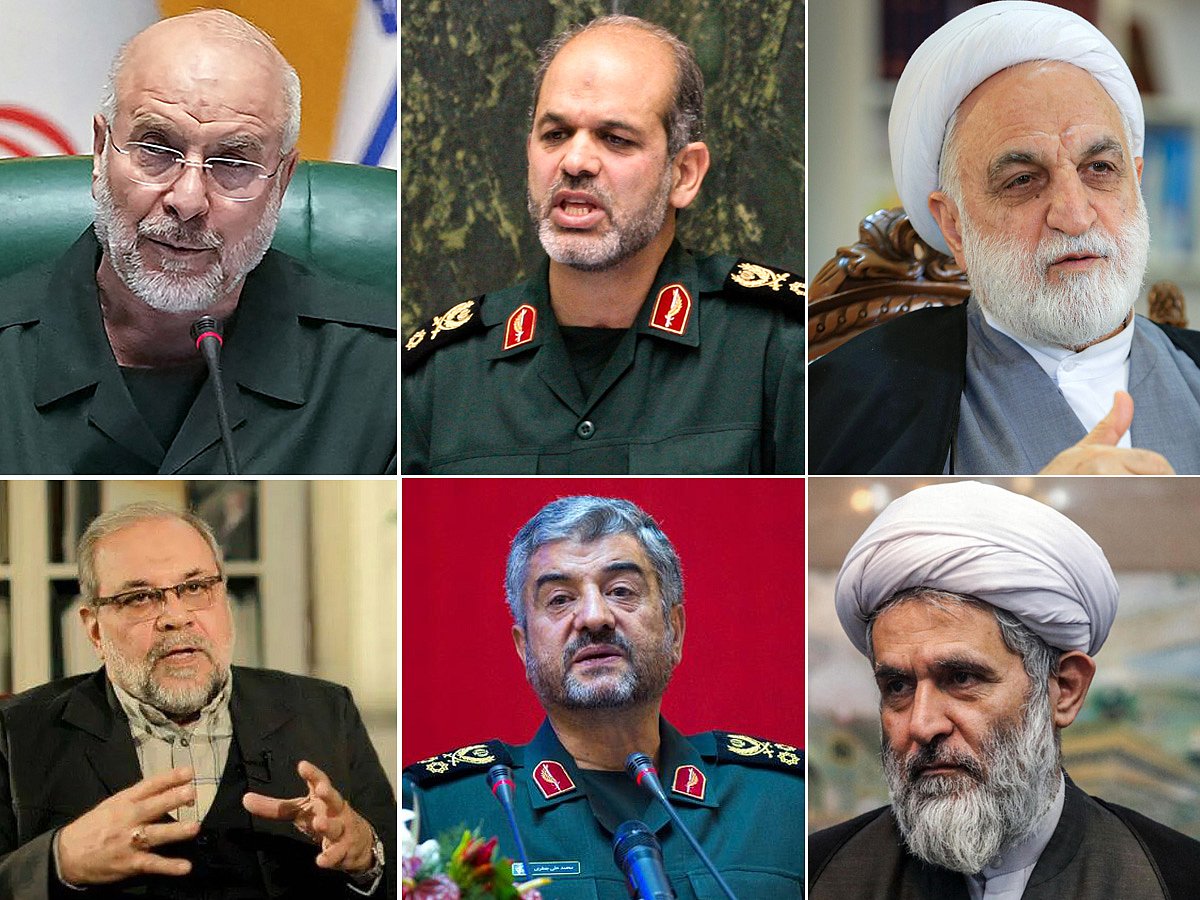
From top left: Iran Parliament Speaker and Iran's chief negotiator Mohammad-Bagher Ghalibaf, 64; IRGC commander Gen. Ahmad Vahidi, 67; Iran's Chief Justice Gholam-Hossein Mohseni-Ejei, 69; Hossein Taeb, 63 (ex-head of the intelligence of the IRGC); Major General Mohammad Ali Jafari, 68, (ex-commander of the IRGC, 2007 to 2019), and Mohammad Bagher Zolghadr, 72 (secretary of the Supreme National Security Counci).
AFP file
As millions of Iranians lined the streets to mourn their slain Supreme Leader, Ayatollah Ali Khamenei, the country's political leadership projected an image of solemn unity.
The elaborate funeral procession, broadcast across state television, was meant to reassure both domestic and international audiences that the Islamic Republic remained firmly in control despite one of the greatest shocks in its history.
Yet hundreds of miles away, another story was unfolding.
Commercial vessels transiting the Gulf of Oman reported a series of attacks in what Western officials say were coordinated assaults on three commercial tankers within a single day.
The incidents shattered the fragile US-Iran ceasefire and triggered an immediate American military response, including strikes around Hormuz and Iran's southeastern port of Chabahar.
If the reported sequence of events is accurate, it raises one of the most consequential questions about Iran today: Who is actually in command?
There are two broad possibilities.
The first is that Tehran deliberately violated the ceasefire.
That would suggest the Iranian leadership calculated that attacking international shipping would raise the costs for Washington while stopping short of provoking a full-scale war.
Such a strategy would fit decades of Iranian doctrine, which has often relied on calibrated pressure in the Gulf to strengthen its bargaining position without crossing thresholds that invite overwhelming retaliation.
The second possibility is arguably more unsettling.
The attacks may indicate that elements within Iran's military establishment acted with considerable operational autonomy while the country's civilian and clerical leadership was consumed by an unprecedented succession crisis.
Iran is not a conventional state with a single chain of command.
Power is distributed across overlapping institutions:
The Islamic Revolutionary Guard Corps (IRGC),
The IRGC Navy,
The elected government,
The regular armed forces (Artesh),
Intelligence organisations,
Network of regional proxy groups.
These institutions often share objectives but not always methods or timing.
The IRGC, in particular, has historically exercised significant independence in operational matters.
While major strategic decisions ultimately require political approval, commanders on the ground have frequently demonstrated latitude in implementing tactics, especially in the Gulf's crowded maritime environment.
That does not necessarily mean the attacks were "rogue operations."
The Institute for the Study of War (ISW), noted that the IRGC may have acted under "standing authority", not necessarily direct political orders.
The think-tank notes that the US-Iran memorandum required negotiations over future administration and security arrangements in the Strait of Hormuz. It argues the maritime attacks reflected Iran's insistence that ships comply with "Iranian-approved transit mechanisms".
ISW says the attacks fit Iran's interpretation of the agreement -- rather than random indiscipline. That suggests the attacks may have been carried out under pre-existing operational authorities given to IRGC naval commanders rather than explicit orders from Iran's civilian negotiators.
Military organisations rarely conduct coordinated assaults on multiple commercial vessels without at least some institutional authorisation.
A cargo ship is pictured off coast along the Gulf of Oman on June 28, 2026.
Political calculation vs operational decisions
But it does raise the possibility that operational decisions outpaced political calculations — or that different factions within the Iranian system held different views about whether the ceasefire remained worth preserving.
Iran has signaled that it will continue to use force to compel vessels to exclusively use the Iranian traffic separation scheme in Hormuz as part of its broader effort to assert its claimed control of the strait.
Iran’s top operational military headquarters, the Khatam ol Anbia Central Headquarters, warned on July 2 that Iran will deliver a “decisive and swift” response to any US interference in Iranian efforts to manage the strait.
The timing of the attacks on as many as five vessels is striking.
The attacks reportedly occurred while Iran was publicly displaying national mourning and continuity following Khamenei's death.
At precisely the moment when political leaders had the strongest incentive to project stability, military actions instead accelerated the country's return to open confrontation with the US.
Washington interpreted the attacks as evidence that the ceasefire had effectively collapsed, as US President Donald Trump declared "the deal is over".
The US response was swift.
Rather than limiting operations to the Strait of Hormuz, American forces expanded strikes to Chabahar on Iran's southeastern coast — the first known military operation there since the April truce.
Unmistakable message
The US message was unmistakable: no part of Iran's strategic coastline would be considered off limits if maritime attacks continued.
The implications, however, extend well beyond Iran and the Gulf.
Global shipping companies, insurers and energy markets depend less on political statements than realities on the ground — as well as in the air and the water.
Every tanker diverted, every insurance premium increased and every naval escort deployed reflects confidence — or lack thereof — that governments can control their own armed forces.
Whether Tehran intentionally ordered the attacks or merely failed to prevent them, the outcome is largely the same.
International confidence in Iran's command-and-control structure has been weakened.
Future ceasefires become far harder to negotiate
That perception may prove almost as damaging as the attacks themselves.
Diplomatic agreements rely on a simple assumption: that political leaders can deliver what they promise.
If foreign governments begin to doubt that Iran's civilian leadership can reliably restrain the military — or if they conclude that the military itself has become the dominant decision-maker — future ceasefires become far harder to negotiate.
And even harder to trust.
There is, however, an important caveat. Public evidence remains incomplete.
Governments involved in the conflict have strong incentives to shape the narrative.
Independent verification of who ordered what is limited.
While it's too early to conclude that the Iranian military is institutionally "disjointed" from Tehran's political leadership, one strategic reality stands out: perception often shapes geopolitics as much as proof.
Reported attacks on commercial ships during a state funeral transformed what had been a fragile ceasefire into renewed conflict.
Whether born of deliberate strategy or fractured command, they sent the same message to the world: Iran's ability — or willingness — to control escalation is now in serious doubt.
And in the Gulf, uncertainty has always been one of the most dangerous weapons of all.
Network Links
GN StoreAbout Gulf NewsTerms & ConditionsReach by GNSitemapContact usPrivacy PolicyGN FocusHave your sayWork with usAdvertise with usGulf News epaperPrinting Services
Download our app
© Al Nisr Publishing LLC 2026. All rights reserved.