Trump says Iran ceasefire is ‘over’: What happens now?
Trump’s comments cast fresh doubt on diplomacy. Eight key questions answered
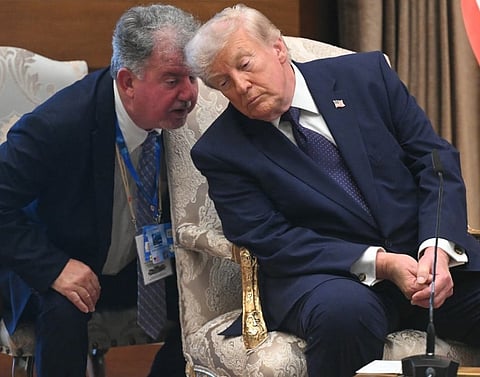
Dubai: President Donald Trump said on Wednesday that he believes the ceasefire between the United States and Iran is "over", signalling that the three-week-old Memorandum of Understanding (MoU) that halted weeks of fighting may be unravelling.
His remarks came after a dramatic overnight escalation in which the United States struck Iranian targets and Tehran retaliated by attacking US military sites in Bahrain and Kuwait.
The renewed military exchanges have reignited fears of a wider regional conflict, sent oil prices sharply higher and raised fresh doubts over the future of diplomacy.
While Washington accuses Tehran of violating the agreement through attacks on commercial shipping and US forces, Iran insists the United States effectively undermined the deal by launching fresh strikes and reimposing oil sanctions.
Trump said he still expects his negotiators to continue talking with Tehran, but questioned whether diplomacy could achieve anything. What was the Memorandum of Understanding meant to accomplish? Why does Trump believe it has failed? And what could the latest escalation mean for the Strait of Hormuz, oil markets and regional stability? Here are eight key questions answered.
1. Why did Trump suddenly say the Iran deal is ‘over’?
President Donald Trump said he believes the Memorandum of Understanding (MoU) agreed with Iran just three weeks ago has effectively collapsed after both countries exchanged military strikes across the Gulf.
Speaking at the Nato summit in Turkey, Trump said:
“To me, I think it’s over.”
He accused Iran of repeatedly violating the agreement by attacking commercial vessels in the Strait of Hormuz and targeting US military facilities.
Calling negotiations “a waste of time,” Trump described Iranian leaders as “evil, sick people,” “dirty players and “cuckoo.”
He also declared:
“We have to rid their cancer... You’ve got to cut out cancer early.”
2. What was the Memorandum of Understanding?
The preliminary agreement, signed in Switzerland last month after months of fighting, was designed to stop hostilities and create space for broader negotiations.
Its main objectives included:
reopening the Strait of Hormuz to commercial shipping;
suspending some US restrictions on Iranian oil exports;
reducing military tensions across the Gulf;
beginning negotiations on Iran’s nuclear programme within 60 days.
The agreement was never intended to be the final peace deal but rather a framework for reaching one.
How the Trump-Iran deal unravelled
Three weeks ago: US and Iran signed a Memorandum of Understanding (MoU) in Switzerland to halt hostilities.
Key promises: Reopen the Strait of Hormuz, ease some sanctions, resume limited Iranian oil sales and negotiate a broader agreement within 60 days.
This week: Commercial vessels were attacked near the Strait of Hormuz, prompting fresh accusations.
US response: Washington struck more than 80 targets in Iran and reimposed sanctions on Iranian oil sales.
Iran’s retaliation: Tehran launched missiles and drones at US military sites in Bahrain and Kuwait, saying it had also shot down a US MQ-9 drone.
Trump’s verdict: “To me, I think it’s over.”
3. What triggered the latest crisis?
The immediate trigger was a new round of attacks on commercial vessels transiting the Strait of Hormuz.
The United States blamed Iran for attacks on three commercial ships, including a Saudi oil tanker and a Qatari liquefied natural gas carrier.
In response, US Central Command launched strikes on more than 80 Iranian targets, including military facilities and fast boats it said were being used to threaten international shipping.
Washington also revoked a sanctions waiver that had allowed Iran to continue limited oil exports under the temporary agreement.
Iran has not claimed responsibility for the attacks on the commercial vessels.
4. How did Iran respond?
Iran described the US strikes as an “overt act of aggression.”
The Islamic Revolutionary Guard Corps (IRGC) said it launched missiles and drones against 85 US military targets across Bahrain and Kuwait.
Iran also claimed it shot down an American MQ-9 drone.
The Khatam Al Anbiya Central Headquarters warned that it would deliver “a crushing response” and declared:
“All US bases in the region will be legitimate targets.”
Iran’s military also warned that:
“The only safe corridor for the passage of commercial vessels and oil tankers through the Strait of Hormuz is the route designated by the Islamic Republic of Iran.”
5. Why does Iran say the agreement has failed?
Tehran argues that Washington — not Iran — destroyed the agreement.
Iran’s Foreign Ministry said US air strikes, the restoration of oil sanctions, interference in the Strait of Hormuz and continuing Israeli military operations in Lebanon had rendered “important and fundamental parts” of the agreement ineffective.
Parliament Speaker Mohammad Bagher Ghalibaf accused Washington of repeated violations, writing:
“The era of bullying and extortion is over. It leads nowhere. We don’t fold.”
In other words, both governments now accuse each other of breaking the same agreement.
6. What are Gulf countries saying?
The latest escalation has drawn unusually strong reactions from Gulf capitals.
Dr Anwar Gargash, Diplomatic Adviser to the UAE President, said Iran’s reported attacks on commercial vessels and repeated strikes against Bahrain and Kuwait showed that Tehran was unwilling to move beyond conflict.
He wrote that the incidents were: “A clear indication that Tehran is incapable of adhering to the requirements of de-escalation and turning the page on war.”
He added: “The Gulf Arab states cannot continue to be the target of Iran’s oscillation between the logic of escalation and the path of rationality, stability and peace.”
Saudi Arabia, Qatar and Kuwait also condemned the latest attacks, warning that they threatened regional security and global energy supplies.
7. What does this mean for the Strait of Hormuz and oil markets?
The renewed fighting has again put the world’s most important oil shipping route under pressure.
According to maritime data, only 36 ships passed through the Strait of Hormuz on Monday, compared with more than 100 vessels a day before the conflict began.
Only three ships reportedly used the safer Omani route, while Iran continues to insist that vessels follow routes designated by Tehran.
The renewed uncertainty pushed Brent crude above $78 a barrel, its highest level in more than two weeks, while US benchmark crude climbed above $74.
8. Is diplomacy completely dead?
Not necessarily.
Although Trump repeatedly declared that he believes the ceasefire agreement is effectively over, he stopped short of formally ending negotiations.
He said: “I’ll let my negotiators keep talking if they want.”
That leaves open the possibility of further diplomatic contacts.
However, with fresh military strikes, renewed sanctions, attacks on US bases and both governments accusing each other of violating the agreement, prospects for reaching the broader 60-day deal now appear far more uncertain than they did only a few days ago.


