Philippine Senator Ronald dela Rosa speaks to reporters at the Philippine Senate in Pasay, Philippines on Tuesday, May 12, 2026.
Rigged for the powerful: How political theatre leaves ordinary Filipinos paying the price
From flood funds to power plays, Filipino lawmakers face scrutiny over impunity
Last updated:
5 MIN READ
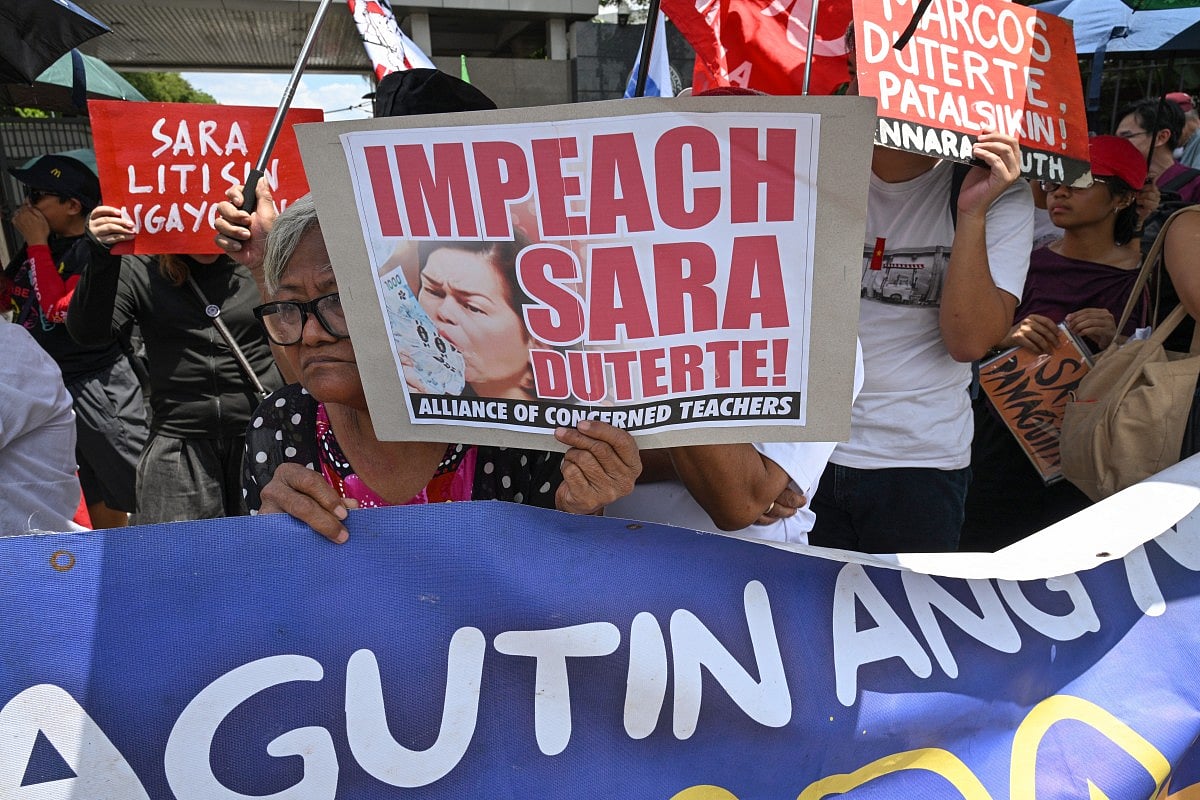
Protesters from progressive groups hold placards during a protest in support of the impeachment of Philippine Vice-President Sara Duterte in front of the Congress building in Quezon City, Metro Manila on May 11, 2026.
AFP
Manila: Politics in the Philippines often feels stacked against ordinary citizens, who bear the brunt of the impunity enjoyed by those in power.
Nothing illustrated this more starkly than the back-to-back drama that unfolded Monday, May 11, in both the Senate and the House.
Inside the Senate, the country watched a scene that felt less like lawmaking and more like live drama: a senator returning after months of absence, investigators at the doors, a leadership coup unfolding by roll call, and corridors captured on CCTV as officials hurried past one another.
Outside the chamber, millions of Filipinos scrolled through clips and commentaries, asking a simple question: who is this system really for?
For critics, the answer is painfully familiar.
They point to how power seems to bend rules depending on who stands accused.
They remember how Leila de Lima was arrested within Senate grounds years ago on charges later widely questioned (and dismissed), and how Antonio Trillanes IV once faced arrest while the chamber was in session.
Now, they watched as Ronald "Bato" dela Rosa was placed under “protective custody” by the very institution where law enforcement sought to reach him.
Selective due process
To many ordinary citizens, the sequence of events did not look like due process. It looked like selective force — swift when aimed at critics, cautious when aimed at allies.
The dual political drama may go down as one of the most consequential — and disturbing — days in recent Philippine politics.
In a span of hours, the country witnessed a dramatic dual spectacle: the House of Representatives overwhelmingly voted to impeach Vice President Sara Duterte over allegations that include unexplained wealth and misuse of public funds, while the Senate underwent a stunning leadership coup, with Bato's dramatic entrace, that immediately reshaped the fate of that impeachment trial.
The timing was too perfect to ignore.
Senate coup
As the House voted 257-25 to hold the Vice President accountable, senators allied with the Duterte bloc orchestrated the ouster of Senate President Tito Sotto and installed Alan Peter Cayetano in his place.
Among those who supported the shakeup were Senators Ronald “Bato” dela Rosa, Jinggoy Estrada, Francis “Chiz” Escudero, Joel Villanueva, Mark Villar, Robin Padilla, Bong Go, and Imee Marcos.
Senate coup to protect Duterte
To many Filipinos, the message was unmistakable: before the impeachment trial could even begin, the Senate had already been "secured".
This matters because the Senate is supposed to act as an impeachment court — impartial, credible, guided by evidence, imbued by conscience.
Instead, what unfolded looked less like constitutional duty and more like political self-preservation.
Critics now fear that Vice President Duterte, despite serious allegations hanging over her office, may receive the softest possible treatment from senators whose own political fortunes are tied to their hope for the Duterte bloc.
Consolidating power
What makes the situation even more infuriating: several of the senators now consolidating power have faced intense public scrutiny over controversial flood-control spending.
In the House, the Duterte bloc cried foul: why were the impeachment proceedings prioritised over the flood control mess?
Under the Philippine Constitution, the House of Representatives holds the exclusive power to initiate all cases of impeachment, acting as a grand jury to investigate and formulate charges, with a 1/3 vote.
The Senate holds the sole power to try and decide these cases, acting as an impeachment court to convict or acquit, with a 2/3 threshhold.
More importantly, however, both chambers hold the nation's purse strings, scrutinising expenses and itemising their pet projects to the tune of billions.
₱6.793 trillion ($110 billion) 2026 Philippine national budget, up 7.4% from the 2025 budget of ₱6.326 trillion.
This setup, representing the ideals of "common good", is now in question. When Filipino taxpayers are ripped off via "ghost" or subpar infrastructure, and their tracks are covered by colleagues in the chamber that's supposed to expose and demand receipts, it only adds insult to the injury.
That's what happens when the impeachment process gets scuttled or delayed, using technicality as a lame excuse to help friends or allies evade accountability.
Congressional inquiries and public debate in recent months have questioned how billions of pesos were allocated to flood-control projects while devastating floods battered communities.
While no court has convicted these lawmakers of wrongdoing, and all remain entitled to due process, the public is impatient for results.
From floods to political disaster
So far, the political optics are disastrous: officials linked by critics to questionable infrastructure spending are now positioned to influence the impeachment process, one of the country’s biggest accountability trials.
When political leaders gang up against the truth, hide behind the skirt of technicalities – then, Houston, we have a problem.
This is why President Ferdinand "BBM" Marcos Jr. now faces a defining test of political will.
For months, his administration tried balancing confrontation and coexistence with the Duterte bloc.
The bloc joined a chorus of condemnation, highlighting the "foul" way law agents tried to grab and enforce the ICC arrest warrant against Bato, who had been in hiding for the last 7 months.
His colleagues rued the process as undignified.
The balancing act may now be over.
Balancing act
Monday’s Senate coup, the dramatic entrance of Senator Bato, whose vote was crucial for the leadership change in the Senate, was not merely procedural manoeuvring.
It was a declaration that the Duterte camp intends to protect itself at all costs. Marcos still holds powerful cards.
His administration controls key institutions, law enforcement agencies, and much of the House coalition.
If the government truly wants to restore public trust, and drive reforms, then investigations into flood-control anomalies must continue aggressively and independently — no matter whose names emerge.
Likewise, legal processes involving Senator Bato and the International Criminal Court must be handled according to both Philippine law and international obligations, free from political theatre or selective enforcement.
Impunity
The most alarming part of Monday’s events: hearing politicians invoke “sovereignty” and “the future of the nation” while appearing primarily concerned with protecting allies from accountability.
This is problematic: the country cannot survive on impunity dressed up as patriotism. Sovereignty means nothing if public funds vanish while citizens drown in floods.
Impunity is the exemption from punishment, harm, or the negative consequences of one's actions.
Democracy means nothing if impeachment courts are rigged before trials even begin.
Amidst this drama, everyday Filipinos are left on the sidelines to grapple with inflation, transport woes, poor infrastructure, hospital queues, tuition fees, and taxes that never seem to translate into relief.
The contrast was jarring: while the public struggles to make ends meet, those in power appear able to rearrange the rules of the game in real time, on national television.
May 11 exposed the raw truth about Philippine politics: impeachment is no longer just about Sara Duterte.
It is about whether the system we have is one that builds a just and humane society, or one that only protects the powerful.
It is now a battle over whether accountability itself still exists in the Philippine Republic.
Network Links
GN StoreAbout Gulf NewsTerms & ConditionsReach by GNSitemapContact usPrivacy PolicyGN FocusHave your sayWork with usAdvertise with usGulf News epaperPrinting Services
Download our app
© Al Nisr Publishing LLC 2026. All rights reserved.