Shenaz Treasurywala
Shenaz Treasurywala at Sharjah Book Fair: 'My mother says I don't have a husband or home'
At Sharjah International Book Fair, the former MTV VJ and actress gets candid about life
Last updated:
10 MIN READ
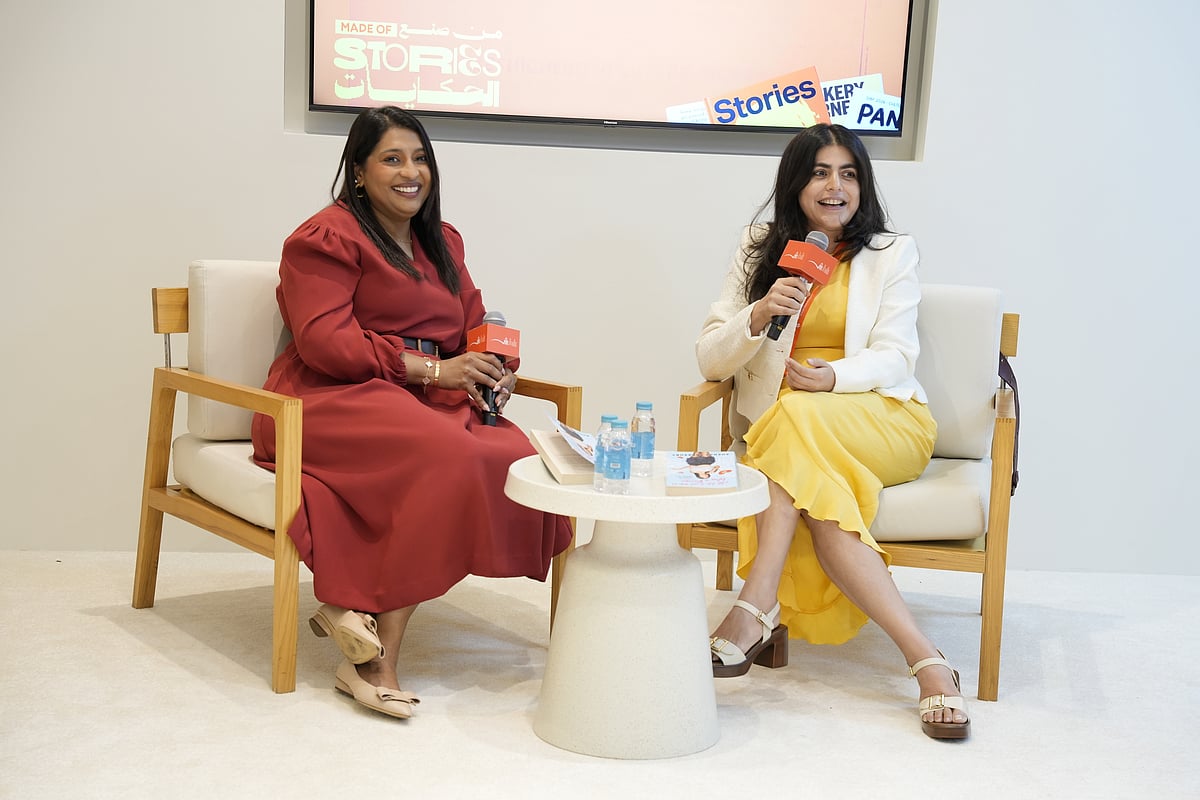
Shenaz Treasurywala at the recently-concluded Sharjah International Book Fair 2026 in a session moderated by Manjusha Radhakrishnan, Entertainment, Lifestyle and Sport Editor of Gulf News
Dubai: Shenaz Treasurywala has a confession to make. She's still making questionable choices in men, and writing an entire book about romantic misadventures hasn't necessarily made her any wiser.
When I ask if age, experience and a string of colourful relationships have finally sharpened her judgment, her answer is an emphatic “Not at all.”
Her defence is even better: “But he was so hot.”
It's the kind of deliciously unapologetic response you would expect from Treasurywala, the former MTV VJ, actress, travel influencer and now author, who seems spectacularly uninterested in pretending that she has cracked the code to love. For the record, her definition of hotness isn't restricted to a handsome face or a sculpted body.
“Hot is actually chemistry,” she explains. “It doesn't have to be looks. It's like, you know, that charm.”
Welcome to the wonderfully messy world of Treasurywala, whose book, All He Left Me Was a Recipe, reads like Bridget Jones's Diary with an Indian twist, a generous helping of emotional baggage and enough romantic red flags to make a dupatta.
At the Sharjah International Book Fair, where I was moderating a lively session with Treasurywala about her book, the former MTV star was in her element as we discussed everything from disastrous dating decisions and emotionally unavailable men to marriage, motherhood and the pressure on women to settle down. The audience, which included married couples, singles and even a few children, became willing participants in a conversation that was equal parts relationship therapy and comedy.
If you grew up watching Treasurywala on MTV, you will remember her infectious energy, quick wit and irreverent personality. Decades later, that bubbly woman hasn't disappeared. She's simply collected more stories, lived in more cities and developed an appetite for discussing the uncomfortable truths about relationships that most people would rather keep buried.
'I don't have a husband or a home'
In a society where women are routinely expected to tick the boxes of marriage, motherhood and home ownership by a certain age, Treasurywala cheerfully admits that she hasn't followed the prescribed script. Her mother, however, continues to remind her of the missing milestones.
“My mom keeps telling me you don't have 2h's: husband and home,” she says, prompting laughter from the audience.
But behind that funny observation lies a more complicated conversation about the way women are conditioned to measure their happiness against somebody else's checklist. When I ask whether she is happier for having resisted those expectations, Treasurywala refuses to turn her unconventional life into a competition with married women.
“Happier means happier than who? I don't know. I'm happy. I'm at peace,” she says, before acknowledging that independence doesn't mean she has stopped wanting companionship or romantic love.
“I feel like my life is an adventure, and I'm having fun. And so, you know, of course, I love companionship and I love love, and there's many times when I'm like, oh my God, I just want one person, but then maybe I haven't met that person, or I have met people, and then it didn't work out.”
There's something refreshing about a woman who can admit that she enjoys her freedom while occasionally wishing she had someone to share her life with. Treasurywala isn't selling singledom as a superior lifestyle, nor is she treating marriage as the ultimate prize. She simply refuses to believe that one relationship status should define whether a woman has succeeded or failed in life.
She also acknowledges that friendships change when people marry and have children, particularly when their daily routines and priorities no longer overlap. But she has discovered that those friendships can come full circle when children grow older and married friends suddenly begin envying the freedom they once thought she should surrender.
Red flags? She made a dupatta out of them
One of the funniest lines in Treasurywala's book involves the protagonist declaring that she has made a dupatta out of her red flags. It's a wonderfully Indian way of describing a universal romantic weakness: the extraordinary ability to ignore warning signs when attraction gets in the way of common sense.
“When you like somebody, you keep telling yourself like, okay, this is fine. This is not such a big red flag,” Treasurywala explains, before offering an outrageous example of how someone might rationalise dating a man who had spent 11 months in jail.
But Treasurywala isn't particularly interested in reducing every difficult man to a villain or portraying women as helpless victims of their romantic choices. She believes that relationships are rarely as straightforward as the red-flag and green-flag culture on social media would have us believe.
“Nobody's black and white. Everyone has shades of gray,” she says, acknowledging that she, too, has made mistakes. “I've done some terrible things. We all have flaws.”
That admission is important because All He Left Me Was a Recipe isn't simply about men behaving badly. Its protagonist has agency, makes questionable decisions and occasionally ignores perfectly sensible advice because the prospect of excitement seems more appealing than playing safe.
Treasurywala is also careful to distinguish herself from the fictionalised woman at the centre of the book, whose experiences span the ages of four to 40. While the stories draw heavily on real-life incidents, she insists they aren't necessarily all hers.
Shenaz Treasurywala at Sharjah International Book Fair 2026 with moderator Manjusha Radhakrishnan, Entertainment, Lifestyle and Sport Editor
“Everything in there has really happened,” she says, explaining that some experiences come from friends rather than her own romantic history. When pressed to reveal exactly how much of the book is autobiographical, she refuses to provide a percentage, preferring to let readers work that out for themselves.
Why successful women can intimidate men
Beyond its entertaining catalogue of romantic encounters, the book also raises uncomfortable questions about gender dynamics, particularly what happens when a woman becomes more financially successful than her partner.
One chapter explores a woman who pays the bills for a man, only to discover that the generosity he initially welcomed eventually becomes a source of resentment. It's an interesting contradiction in modern relationships, where men may celebrate independent women in theory but struggle when traditional expectations of masculinity are challenged.
“A lot of times, like, if you are actually earning more than the guy, or maybe the guy doesn't have a job, or sometimes you're paying for him, you think you're doing something nice,” Treasurywala explains.
But she believes that the arrangement can become complicated when a man begins to feel inadequate because his girlfriend or wife is financially stronger.
“After a while, the guy may, because of this whole gender thing, the guy doesn't feel good enough,” she says.
Treasurywala suggests that some men may even lose attraction to financially successful partners because they no longer feel like the dominant provider in the relationship. Instead, they may gravitate towards women who allow them to reclaim the traditional role of protector or saviour.
It's a revealing observation about the contradictions that continue to shape modern romance. Women are encouraged to become financially independent, ambitious and successful, yet may still encounter men who feel threatened by precisely those qualities.
The trouble with being a 'good girl'
Another interesting strand in Treasurywala's book explores why women are sometimes attracted to rebellious men, particularly when they have grown up in households where being obedient, respectable and agreeable is considered the ultimate feminine virtue.
During our conversation, we discussed whether the attraction to bad boys could be a form of rebellion against the pressure to be perpetually good. Treasurywala believes that cultural conditioning has a role to play in shaping those romantic preferences.
“In like Indian households, we are told girls are told be good, smile, be nice, you know, always be pretty,” she says. “So then, when you grow up, you just want to rebel.”
The discussion became particularly animated when audience members began debating whether women were drawn to emotionally unavailable men because they believed they could change them. One woman admitted that the desire to fix a troubled partner could make a relationship feel strangely rewarding, especially when it created the illusion of being the transformative force in somebody else's life.
The men in the audience weren't spared either. One gentleman candidly admitted that while rebellious women might appeal to men when they were younger, some eventually gravitated towards more traditional, or sanskari, partners as they grew older.
It was an observation that deserved to be challenged. After all, why should men be allowed to enjoy their adventurous years before deciding that the ideal wife must conform to a completely different set of expectations?
Treasurywala, however, seemed more amused by the contradictions than interested in issuing moral judgments. Her book is ultimately less about prescribing the correct way to love and more about acknowledging that human beings are wonderfully inconsistent creatures.
'I don't believe there's just one person in this world for you'
Perhaps Treasurywala's most provocative argument is her rejection of the idea that everybody has one destined soulmate, a belief that might sound almost sacrilegious to a generation raised on Bollywood romances and grand declarations of everlasting love.
“I really don't believe there's just one person in this world for you,” she says.
For Treasurywala, love can happen more than once, and the failure of one relationship doesn't necessarily mean that a person's romantic story is over. She believes that heartbreak, however painful, can become another experience that shapes a person rather than an event that permanently defines them.
When an audience member spoke about the difficulty of recovering from a disappointing relationship, Treasurywala responded by explaining why resilience is central to her book.
“Sometimes you have a heartbreak, and then you can't just be heartbroken your whole life,” she says.
Her philosophy is rooted in the idea that people must eventually find the courage to participate in life again, even when their previous experiences have left them disappointed or emotionally bruised.
Interestingly, Treasurywala is equally sceptical of the social-media obsession with self-love, particularly the motivational declarations about becoming your own greatest romance.
When I ask whether she has reached a point where she considers herself her first love, she offers an answer that is refreshingly free of Instagram-friendly wisdom.
“It is nice to see on Instagram Reels and all, I am a first love. I mean, I don't know. I don't love myself that much,” she says, before adding, “I do like myself. I think I'm cool.”
Her approach to emotional recovery is similarly practical. Rather than waiting for a grand revelation about self-worth, she believes in getting dressed, stepping outside and allowing life to surprise you again.
“You have to get up and brush your hair and wear some lipstick and get out of the house,” she says.
From MTV to Bridget Jones
For those who remember Treasurywala from her MTV days, her transition into writing may seem unexpected, but storytelling has remained a constant thread through a career that has taken her across several countries and creative industries.
After her MTV years, she lived in places including Singapore, Hong Kong, Bangkok, New York and Los Angeles before returning to India. She recalls that during her time as a VJ, she wasn't always aware of how popular she had become because social media hadn't yet transformed the relationship between celebrities and their audiences.
“We didn't even know like how, you know, popular we were or what because there was no social media or anything,” she says.
When Instagram eventually emerged, Treasurywala embraced the platform and built another audience through her videos and travel content. Her love of storytelling also found an outlet in writing, although her literary influences reveal that she has always had a soft spot for women who make romantic mistakes without losing their sense of humour.
“Bridget Jones Diary was like my all-time favorite, the first one, and I was so inspired by that,” she says. “I always saw myself as a Bridget Jones.”
She also acknowledges the influence of Sex and the City, whose frank exploration of relationships and female friendships helped redefine how women's romantic lives could be portrayed on screen.
Her own book follows a protagonist through encounters with men who are given colourful nicknames, including Burj Khalifa, a particularly tall romantic interest whom Treasurywala describes as one of the best.
Each chapter begins with a question about relationships and ends with a lesson, followed by three thank-yous and one apology. The structure reflects her belief that even disappointing encounters can leave behind something meaningful, whether that's greater self-awareness, a memorable experience or simply a story worth telling.
Writing the book also became a deeply therapeutic experience.
“I wrote this book just for just to have like closure,” she says, adding that revisiting those experiences helped her process difficult emotions. “I felt so good after writing this book. I felt free.”
Her next adventure: 'But He Was So Hot'
Treasurywala isn't finished exploring the romantic adventures of her fictional alter ego. At Sharjah, she revealed that she is developing a six-episode television series titled But He Was So Hot, inspired by the world of her book.
Unlike the novel, which follows its protagonist from childhood into her 40s, the proposed show would concentrate on a woman in her 40s navigating relationships, attraction and the complicated business of making romantic choices.
Treasurywala is actively looking for producers to help bring the project to life.
“I'm actually shopping for producers for this book,” she says.
She also floated the possibility of moving to Dubai someday, joking that a Golden Visa might persuade her to make the city her next home.
But whether she settles in Dubai, returns to New York or finds herself somewhere entirely unexpected, Treasurywala seems determined to continue living on her own terms.
When I ask whether she would make the same romantic choices again, knowing what she knows today, she doesn't hesitate.
“Yeah, I think so because I had a lot of fun,” she says, acknowledging that her adventurous life has included spectacular highs as well as difficult lows.
“I just wanted to enjoy and experience life. I feel like that's what life is about: experiencing different things.”
Perhaps that is the most compelling takeaway from All He Left Me Was a Recipe. Treasurywala isn't arguing that marriage is overrated or that relationships are destined to disappoint. She's simply challenging the assumption that every romance must end in marriage to be meaningful, or that a woman without a husband, children or a home of her own has somehow failed to build a fulfilling life.
Network Links
GN StoreAbout Gulf NewsTerms & ConditionsReach by GNSitemapContact usPrivacy PolicyGN FocusHave your sayWork with usAdvertise with usGulf News epaperPrinting Services
Download our app
© Al Nisr Publishing LLC 2026. All rights reserved.