Tamil Nadu Chief Minister J Jayalalithaa being garlanded by her cabinet colleagues in 2012.
How Vijay’s TVK is rewriting Tamil Nadu politics beyond the DMK-AIADMK duopoly and will his win define a new political era
Screens, slogans and social justice: Inside Vijay’s bid to rewrite Tamil Nadu politics
Last updated:
3 MIN READ
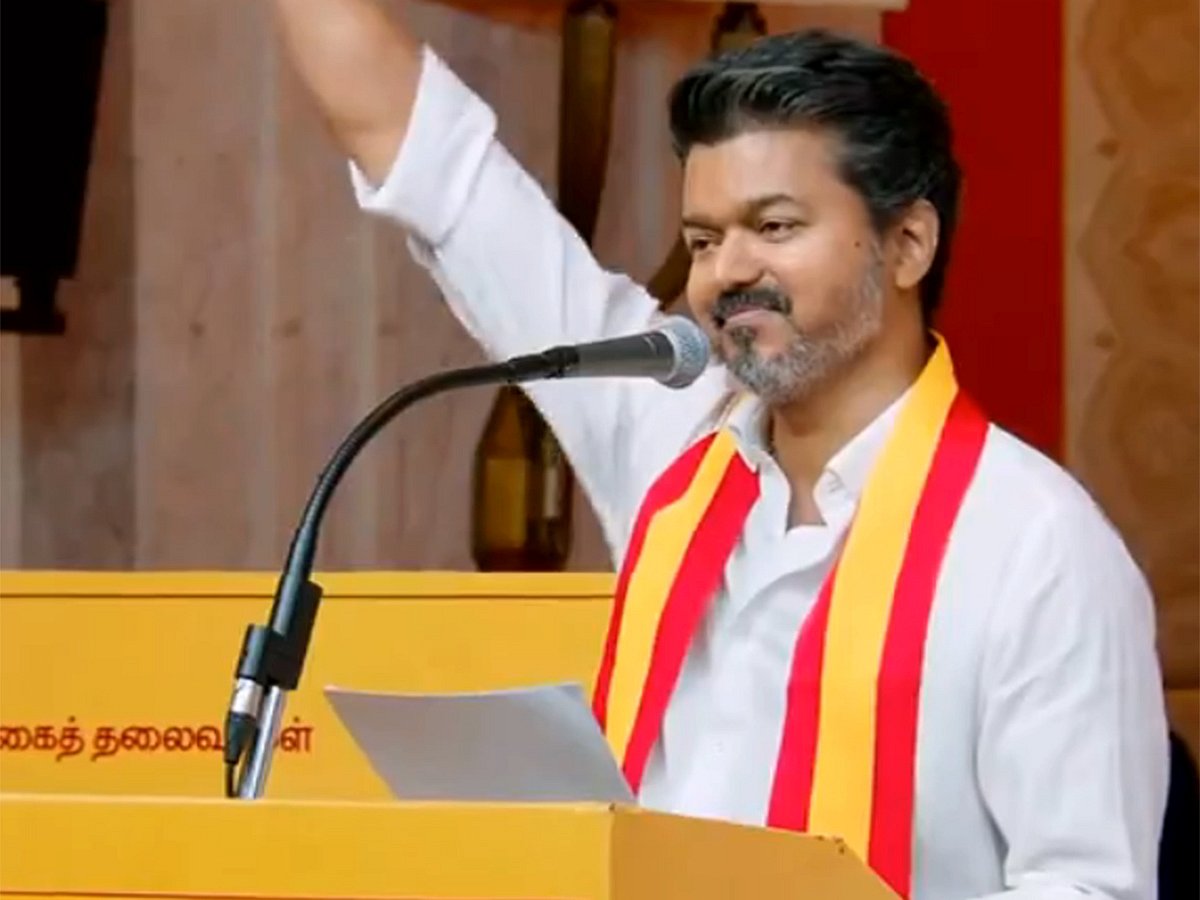
Actor-turned-politician C Joseph Vijay
In Tamil Nadu, cinema isn’t just entertainment, it’s a robust political training ground. For decades, stars haven’t just entertained audiences, they’ve gone on to lead them.
From M.G. Ramachandran to J. Jayalalithaa, the journey from screen idol to political heavyweight is a familiar one here.
If Thalapathy Vijay wins the 2026 Assembly elections, he isn’t breaking the system as much as stepping into a legacy, but doing it on his own terms.
For over 50 years, the state’s politics has largely revolved around the Dravida Munnetra Kazhagam (DMK) and the All India Anna Dravida Munnetra Kazhagam (AIADMK). Governments changed hands, leaders came and went, but the structure stayed the same. It was predictable, almost cyclical. What we’re seeing now feels different.
Get updated faster and for FREE: Download the Gulf News app now - simply click here.
Vijay’s party, Tamilaga Vettri Kazhagam (TVK), is just two years old. Yet it has managed to shake up a system that has been in place for decades. That doesn’t happen easily in Tamil Nadu. But this isn’t just about star power.
Yes, Vijay has a massive fan base. That helps because it gives him reach, visibility, and a ready audience. But fans don’t automatically become voters. What they do bring is momentum. They create noise, attention, and a sense that something is happening.
And right now, voters seem open to that “something.”
There’s a sense, quiet but growing, that the old DMK-AIADMK binary doesn’t feel as compelling as it once did. Not necessarily rejected, but no longer unquestioned. Vijay has stepped into that space at the right time.
His messaging has also been careful. He hasn’t tried to completely dismantle the Dravidian framework. Instead, he echoes parts of it like social justice and equality, while presenting himself as a fresher alternative. It’s a balancing act, and so far, it seems to be working.
Then there’s the way his support base operates.
This isn’t the old fan club model alone. This is amplified, constantly online, reacting in real time. Every lead, every rumour, every moment gets magnified. It explains the celebrations, but also the intensity. And that intensity matters.
Because if Vijay does win, the shift will be immediate. The expectations will be real, and they will be high. Running a government is very different from running a campaign. Charisma can take you only so far.
Tamil Nadu’s voters are not passive. They expect delivery on jobs, infrastructure, and welfare. They’ve seen strong leaders before, and they know what governance looks like.
So if this moment turns into a victory, it will also turn into a test.
What Vijay’s rise really signals is not just the return of the actor-politician — that story already exists here. It signals a new phase of it. Faster, more media-driven, more emotionally charged.
If he pulls this off, Tamil Nadu won’t just be getting a new leader. It will be adjusting to a new kind of politics, one shaped as much by screens and social media as by ideology and legacy. And that’s where this gets interesting. Because this may not just be a win, itt may be the beginning of something far more unpredictable.
Network Links
GN StoreAbout Gulf NewsTerms & ConditionsReach by GNSitemapContact usPrivacy PolicyGN FocusHave your sayWork with usAdvertise with usGulf News epaperPrinting Services
Download our app
© Al Nisr Publishing LLC 2026. All rights reserved.