In a press briefing held by the Department of Public Works and Highways (DPWH) on December 18, 2025, Secretary Vince Dizon confirmed that ₱150 million were surrendered by a number of individuals involved in the flood control scam. The amount includes ₱110 million returned by ex-DPWH District Engineer Henry Alcantara to the Department of Justice (DOJ) on Nobyembre 28, 2025 and the ₱40 million surrendered by former DPWH Regional Director Gerard Opulencia on December 16, 2025. Dizon said they are expecting more individuals to do the same, while also expecting both Alcantara and Opulencia to surrender bigger amounts.
EXPLAINER
Philippines: Kill ₱1,000 and ₱500 bills to stamp out corruption? Lessons from India's demonetisation
How could AI help curb corruption, and flag suspicious transactions
Last updated:
4 MIN READ
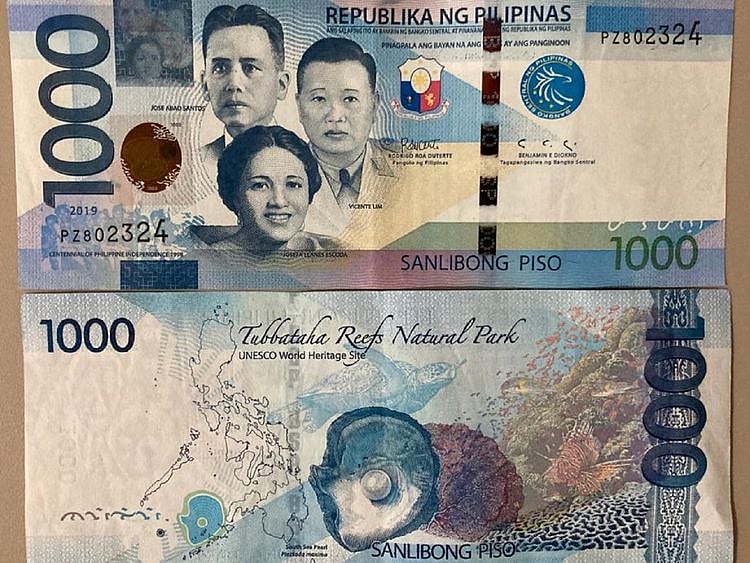
On January 1, 2017, the Philippines demonetised its "New Design Series" ₱1,000 bills after a gradual phase-out period. They were replaced by the "New Generation Currency" (NGC) series paper banknotes. More recently, a new polymer version has been introduced.
Gulf News
Manila: Picture this: crooked officials stuffing suitcases with crisp ₱1,000 bills from the flood scam — poof, gone like rain in a drought.
Should the Philippines demonetise ₱1,000 and ₱500 bills to flush out corruption amid the widespread tongpats (kickbacks) and ghost flood control projects?
The Philippine presidential palace said it would study the proposal.
The Bangko Sentral ng Pilipinas (BSP), weanwhile, said such a move would crush the economy.
Would it, really? Has any other country done it before?
Quick answer: yes.
Even the Philippines did it in the past, as recent as 2017.
Quick background: In 2016, India’s demonetisation move abruptly invalidated 86% of circulating currency — Rs500 and Rs1,000 notes — announced on (November 8, 2016) to curb corruption, “black money”, terror financing, and counterfeit cash.
Debate ensued on the effectiveness of the demonitisation move driven by Indian Prime Minister Narendra Modi.
A number of upsides were seen: it boosted digital payments (allowing for better traceability), activated millions of bank account (better supervision), expanded the tax base (more government revenues) as more business were brought into the formal economy.
True: It resulted in short-term disruption of illegal cash-based activities.
But it also ramped up seriousness about closer scrutiny and cleaner accounting practices. Critics cite it brought India's economy to a standstill, albeit temporarily, and that the black money largely "survived".
Today, India has overtaken Japan as the world’s fourth-largest economy – and officials hope to pass Germany within three years, as per Delhi’s end-of-year economic review. International Monetary Fund (IMF) data suggests India is set to cross over Japan in 2026.
Who proposed BSP demonetising ₱1,000 and ₱500 bills?
Former Finance Secretary Cesar Purisima proposed demonetising ₱1,000 and ₱500 peso bills in September 2025 to combat corruption, after flood-control scandals erupted where large cash bribes were allegedly facilitated by high-denomination notes.
Senator Robin Padilla, echoing a growing anti-corruption drive that has driven public anger and taxpayer backlash, recently urged the Bangko Sentral ng Pilipinas (BSP) to demonetise ₱1,000 bills issued from 2020-2025 via a Senate resolution.
Reasons for proposal
Purisima argued that removing high-value bills would make corruption “much harder to hide”, as billions of pesos in bribes would require hundreds suitcases instead of compact stacks.
This would force exchanges with National ID verification and Anti-Money Laundering Council reporting within six months.
Senator Robin Padilla, elected in 2022, proposed demonetising ₱1,000 bills issued from 2020-2025 via Senate Resolution No. 192, aiming to combat corruption. He claims this would make large hidden cash piles unusable for corrupt officials involved in issues like flood control projects. He acknowledges it's a challenging proposal.
For his part, Senator Padilla targets “dirty money” hoarded illicitly, aiming to flush it into the banking system for scrutiny.
Malacañang said it would study the idea.
Who is opposing it?
There’s a big pushback against the plan. The BSP deems it a “shortcut”, warning any such move woulc inflict “economic harm” like disrupted transactions.
BSP says it would trigger "high costs" for ordinary users reliant on cash.
Instead, the central bank is preparing a paper on the implications, though it's not immediately clear when that paper would come out.
What the BSP is proposing
The BSP prefers AI-enhanced Suspicious Transaction Reports over demonetization.
The BSP’s reason: ₱1,000 notes comprise 83% of circulating value, potentially cutting GDP growth, but without necessarily curbing graft, as per Business World.
Expected outcomes
Demonitisation proponents expect billions in illicit cash to surface, enabling tracing and seizures.
The move is not without precedents even in the Philippines.
The BSP has demonetised old banknotes up to 2015 (fully unusable post-2016 except via banks) and, via Republic Act 1191 (1954), invalidated Treasury certificates and Central Bank notes over ₱100, replacing them with lower denominations.
Other countries: India's 2016 demonetisation invalidated 86% of cash to fight black money but caused chaos—business closures, job losses, 2% GDP hit—and saw 99% of notes return, failing to eliminate illicit wealth. No recent successes noted; BSP cites it as a cautionary failure.
Supporters, opposers
Key supporters
Senator Robin Padilla: Actively pushes via resolution for BSP to demonetize specific P1,000 series to combat illicit hoarding.
No other sitting government officials explicitly endorse; former Finance Secretary Cesar Purisima (non-government) originated the P1,000/P500 idea.
Key opponents
BSP Governor Eli Remolona Jr.: Calls it harmful, like "cutting off your nose to spite your face," due to P1,000 notes' 83% circulation value disrupting economy and honest users.
BSP Assistant Governor Maria Margarita Debuque-Gonzales: Preparing implications paper, favours AI for suspicious reports over demonetisation.
BSP overall views it as “ineffective” against corruption, citing India's 'failed' precedent.
How AI can curb corruption
AI can curb corruption in the Philippines by analyzing vast datasets to detect anomalies in public contracts, flag suspicious financial flows, and automate oversight, directly applicable to scandals like the multi-billion Bulacan flood control graft where ghost projects and kickbacks evaded detection, according to a Metrobank paper.
Key applications
AI excels at real-time risk scoring for transactions, identifying patterns like unusual subcontractor layering or asset spikes post-government payments, as seen in flood control fraud trails.
Platforms like FinCense use machine learning for integrated intelligence across banks, reducing false positives in Anti-Money Laundering (AML) while tracing illicit funds from disbursements to luxury purchases, according to Asian Bank and Finance.
Relevance to flood control scandal
In the multibillion flood-control scandal, AI integrated with blockchain — like DPWH's Integrity Chain — verifies bidding irregularities, satellite imagery for ghost sites, and procurement livestreams, making alterations harder and exposing networks. BSP-supervised institutions deploy AI for fraud/AML patterns, with tools like Trusting Social's “SelfieScore” blocking deepfakes in money muling tied to corruption. PIDS notes AI uncovers fraudulent bids and corrupt links.
However, this requires strong institutions, as well as checks and balances, to avoid misuse.
Network Links
GN StoreAbout Gulf NewsTerms & ConditionsReach by GNSitemapContact usPrivacy PolicyGN FocusHave your sayWork with usAdvertise with usGulf News epaperPrinting Services
Download our app
© Al Nisr Publishing LLC 2026. All rights reserved.