The aircraft, registered A6-EBK, has been converted from a Boeing 777-300ER passenger jet into a Boeing 777-300ERSF (Special Freighter) and has already entered commercial service with Emirates SkyCargo, transporting goods through Dubai to destinations around the world.
Explained: How Emirates turned a Boeing 777 passenger plane into a giant cargo aircraft
Seats removed, giant cargo door added and floors rebuilt to carry tonnes of freight
Last updated:
3 MIN READ
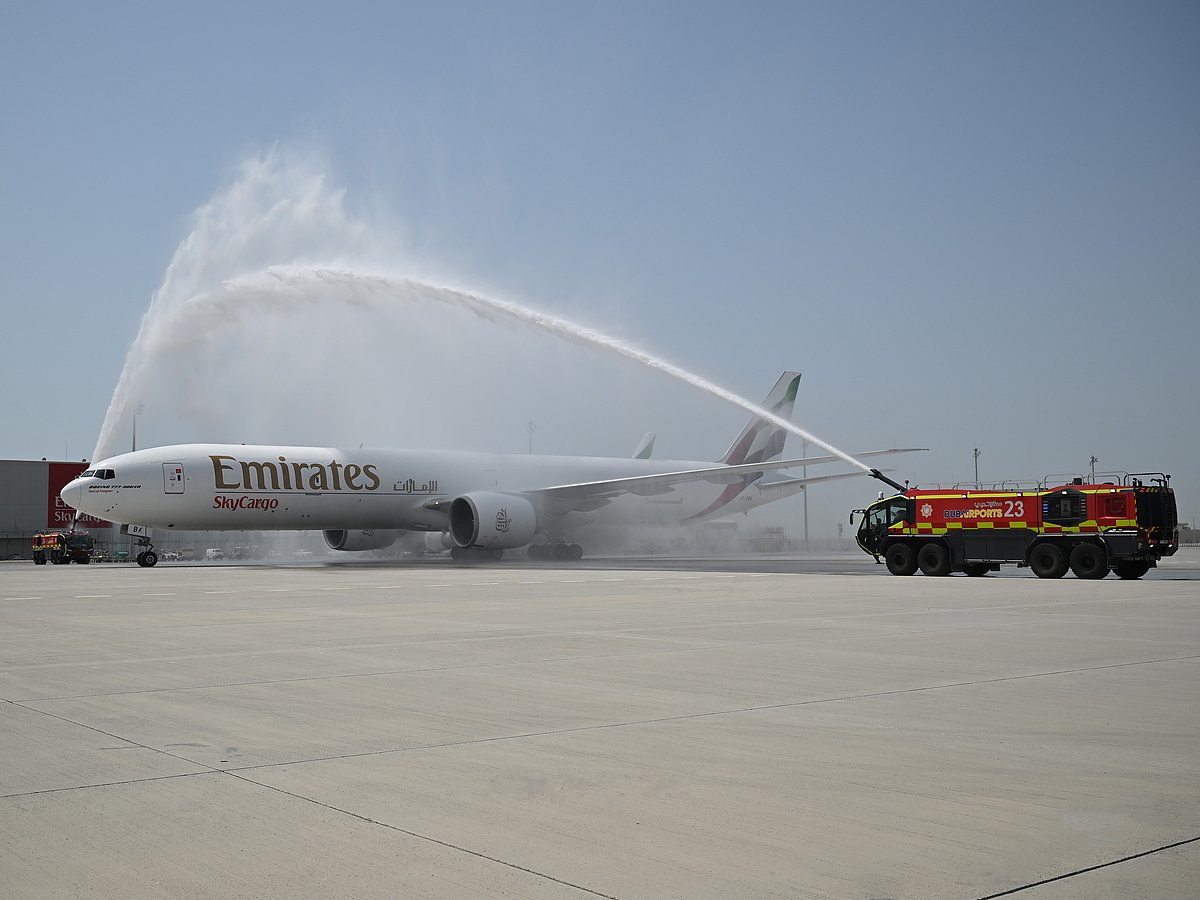
A6-EBK has been converted from a Boeing 777-300ER passenger jet into a Boeing 777-300ERSF (Special Freighter) and has already entered commercial service with Emirates SkyCargo, transporting goods through Dubai to destinations around the world.
Emirates SkyCargo
Dubai: What does it take to turn a passenger aircraft into a cargo plane? For Emirates SkyCargo, the answer isn't as simple as removing the seats.
One of the airline's Boeing 777-300ER passenger aircraft has undergone a complete transformation into a Boeing 777-300ERSF (Special Freighter), which, according to the airline, is a months-long engineering project.
"While maintaining the aircraft’s original aerodynamic performance and structural integrity without compromising operational safety, the conversion introduced extensive modifications to the fuselage, floor structure, loading systems, avionics, environmental controls and other systems within the aircraft," Emirates SkyCargo explained in a statement.
The aircraft was unveiled by Emirates late last month.
The converted aircraft, registered A6-EBK, has already entered commercial service, transporting goods through Dubai as Emirates expands its cargo fleet to meet growing demand from e-commerce and global trade.
Here's how the conversion works.
Step 1: Strip out the passenger cabin
Everything designed for passengers had to go.
Seats, overhead luggage bins, galleys and lavatories were removed, leaving an empty shell that engineers could redesign for cargo operations.
Unlike passenger aircraft, freighters need wide, unobstructed spaces to accommodate large shipping pallets rather than rows of seats.
Step 2: Cut a giant cargo door into the aircraft
Perhaps the biggest change was installing a large cargo door on the side of the aircraft. Creating the opening wasn't simply a matter of cutting through the fuselage.
Large sections of the aircraft's structure had to be reinforced to ensure it retained the same strength and flight performance while carrying significantly heavier loads.
A rigid barrier capable of withstanding forces of up to nine times the force of gravity (9G) was also installed between the cargo area and the flight deck to improve safety.
Step 3: Rebuild the floor
Passenger aircraft floors aren't designed to support heavy freight.
Engineers removed the original floor structure and replaced it with reinforced beams capable of supporting concentrated loads from cargo pallets and loading equipment.
Powered rollers, guide rails and locking systems were then installed, allowing ground crews to load and secure cargo quickly before departure.
Step 4: Make it suitable for medicines and perishables
The aircraft wasn't designed only for boxes as Emirates SkyCargo transports pharmaceuticals, medical products and perishable goods, all of which require carefully controlled temperatures.
To support these shipments, Emirates SkyCargo explained engineers modified the aircraft's environmental control systems so cabin temperatures and airflow could be regulated, with certain cargo transported at temperatures as low as 5°C.
The aircraft also received smoke detection and fire suppression systems designed specifically for cargo operations.
Step 5: Keep space for specialist crews
Although passengers no longer travel on board, the aircraft can still carry a small number of additional personnel.
Crew rest areas and supplementary seating were installed for specialists travelling with certain cargo, such as handlers accompanying thoroughbred racehorses on long-haul flights.
Step 6: Test everything before it flies
Before carrying its first shipment, the converted aircraft had to pass extensive regulatory certification.
The aircraft underwent ground tests and flight evaluations to demonstrate compliance with safety standards covering structural integrity, fire protection, aircraft systems and flight performance.
Only after receiving approval was it repainted in Emirates SkyCargo's latest livery and cleared for commercial service.
A6-EBK has been converted from a Boeing 777-300ER passenger jet into a Boeing 777-300ERSF (Special Freighter) and has already entered commercial service with Emirates SkyCargo, transporting goods through Dubai to destinations around the world.
Why is Emirates doing this?
The conversion comes as demand for air cargo continues to rise, fuelled by cross-border e-commerce, growing international trade, and ongoing regional tensions.
Emirates SkyCargo has been expanding rapidly this year. Since March 2026, it has added six factory-built Boeing 777 freighters to its fleet, alongside this converted aircraft.
The airline expects to receive four more factory-built freighters and another converted Boeing 777 Special Freighter before the end of the year.
The additional aircraft will provide more cargo capacity as demand continues to grow for high-value and time-sensitive shipments, including pharmaceuticals, perishables and e-commerce goods.
Network Links
GN StoreAbout Gulf NewsTerms & ConditionsReach by GNSitemapContact usPrivacy PolicyGN FocusHave your sayWork with usAdvertise with usGulf News epaperPrinting Services
Download our app
© Al Nisr Publishing LLC 2026. All rights reserved.