Rafael Schvartzman, Regional VP, Europe, IATA and Chris Goater, Head Corporate Communications, IATA, at the Europe briefing.
Europe airport queues may worsen this summer, warns IATA over EES system
IATA says Europe’s new border checks could trigger 6-hour airport queues this summer
Last updated:
4 MIN READ
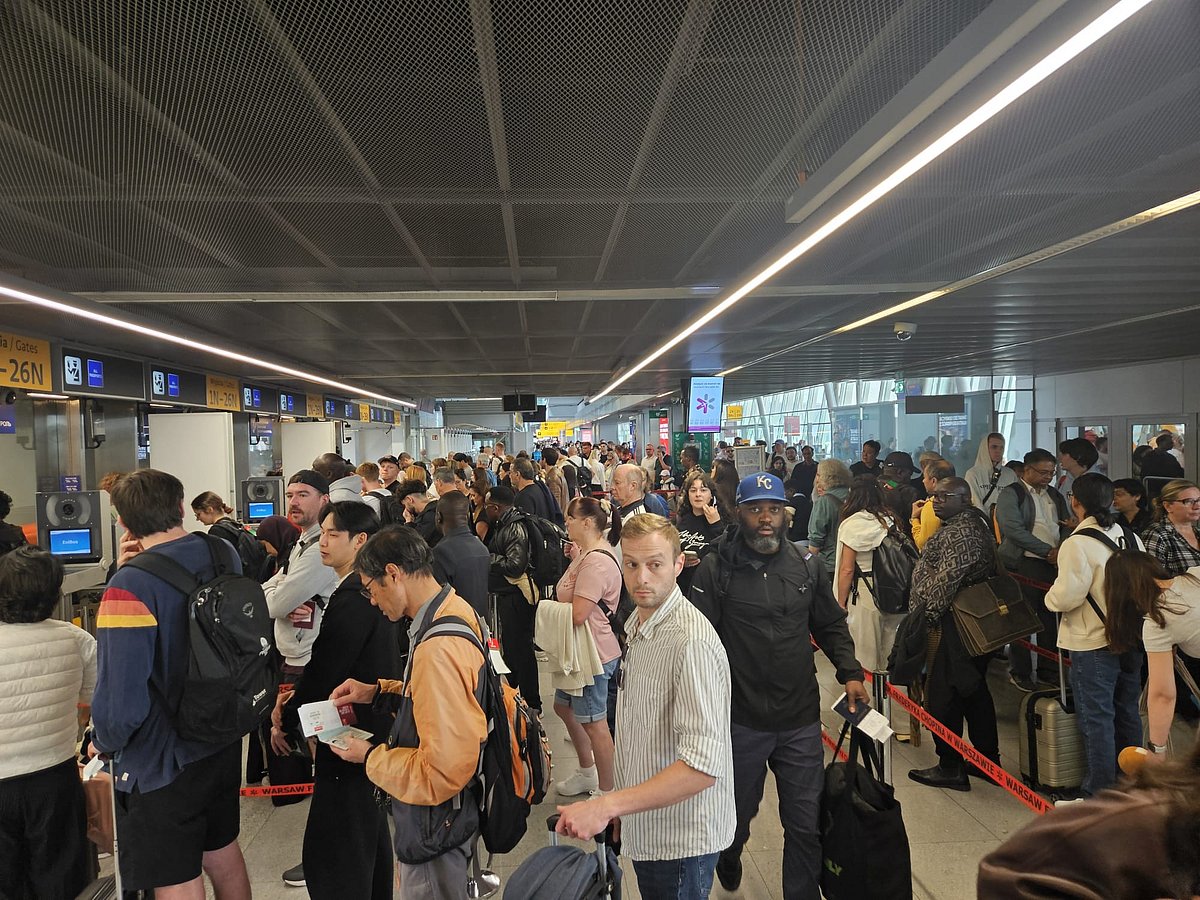
Passengers queue at immigration counters at Warsaw International Airport amid ongoing disruption linked to the EU’s new Entry/Exit System (EES), which has triggered long delays at several European airports.
Gulf News/ Mark Thompson
Rio de Janeiro: Europe’s new border protocol, Entry Exit System (EES), could trigger renewed chaos at airports across the bloc this summer. The airline industry’s top trade association, IATA, said passengers could potentially face waiting times of up to six hours.
Speaking at the International Air Travel Association (IATA’s) 82nd Annual General Meeting (AGM) in Rio de Janeiro, Rafael Schvartzman said delays linked to the system are already happening across several European countries — even before the peak holiday season begins.
“We are already seeing delays and misconnections in Portugal, Spain, Italy, Greece, Belgium, and elsewhere,” he said. “Without action, these problems will worsen over the summer and cause major disruption for passengers.”
The European Union’s Entry/Exit System (EES), which replaces manual passport stamping with digital border registration for non-EU travellers entering the Schengen zone for short stays, is now operational across 29 participating European countries.
It affects travellers from countries including the US, UK, UAE, India and other non-EU states, the Commission confirmed.
Under the new process, passengers must have biometric data and travel details registered electronically at border checkpoints. But airlines and airports say the rollout has exposed serious operational problems.
Airports are already struggling
One of the biggest concerns raised by IATA is that airports are already experiencing disruption before the busiest summer travel period has even started.
Schvartzman said airlines are seeing passengers miss flights and connections because of long waits at border control. “I know for a fact that there are many cases where people have lost flights, or have lost their connectivity,” he said.
He added that some passengers are already having “a very difficult time” entering Europe. The warning is significant because aviation officials are now publicly discussing queue times far beyond earlier estimates.
While previous industry warnings mentioned delays of up to four hours, Schvartzman said expectations are now reaching “three, four, five, six hours”.
Why the delays are happening
According to IATA, the problem is not just one issue — but several problems happening at the same time. The organisation says border checkpoints remain understaffed, some kiosks and technology systems are unreliable, and coordination between airports, airlines and governments is inconsistent. One major issue is processing time.
Currently, a standard passenger check without EES takes about 20 to 25 seconds, according to IATA. “With EES, we are talking about 90 seconds,” Schvartzman said.
That means even if the system works perfectly, passenger processing could take more than three times as long as before.
“If it works, it’s 90 seconds. Then if it doesn’t work, then how long does it take?” he said.
He also pointed to technical glitches and the challenge of linking EU-wide systems with different national border systems across 27 countries.
EU needs to show flexibility
IATA is calling for the suspension mechanisms to remain available beyond September 7, warning that the system may not be fully stable by then.
Schvartzman said changing the current flexibility rules would require legal changes at EU level, adding pressure as summer approaches. “I think Europe needs to be much more honest in the sense of where are we,” he said. “We are already in the summer. This is a bit too late already.”
IATA is now advising passengers travelling to Europe to allow significantly more time at airports. “The advice is simple: allow much more time at the airport than you might be used to,” Schvartzman said. He advised travellers to arrive two to three hours before departure and move airside as quickly as possible.
The industry is also urging wider rollout of pre-registration apps and better staffing during peak periods.
Rising aviation costs
Beyond the EES issue, IATA also raised concerns over rising aviation costs across Europe, warning that higher passenger taxes, airport charges and fuel prices are hurting the competitiveness of the region’s airline industry.
The group also spoke about mounting pressure on airlines from fuel prices and geopolitical instability, particularly linked to tensions in the Middle East and restricted airspace. Schvartzman said fuel costs have jumped from roughly 25 per cent of airline operating costs to as much as 45 per cent in some cases, forcing carriers to look for savings elsewhere.
While he said airlines have become more resilient in handling crises, he warned that Europe must improve the “resilience” of its aviation sector by lowering operational costs, improving air traffic management efficiency and reducing airport charges.
He added that some airlines are already rationalising routes and relying on fuel hedging strategies as uncertainty continues.
Network Links
GN StoreAbout Gulf NewsTerms & ConditionsReach by GNSitemapContact usPrivacy PolicyGN FocusHave your sayWork with usAdvertise with usGulf News epaperPrinting Services
Download our app
© Al Nisr Publishing LLC 2026. All rights reserved.