Spain won $50 million at the World Cup, but who actually gets the money?
Spain earned a record World Cup payout, but FIFA doesn't pay the players directly
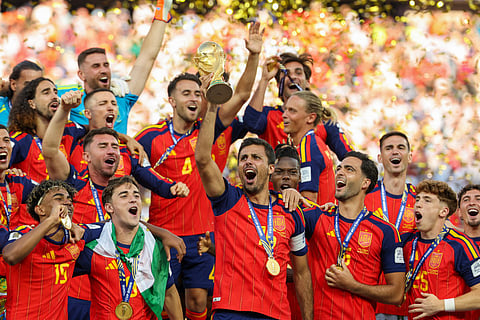
Dubai: Lifting the trophy is the part everyone sees. What happens next, the money, is where things get genuinely interesting, and it's not as simple as one big cheque landing in Spain's federation account.
Here's exactly how much Spain earned tonight, and how it actually reaches the players.
How much Spain just won
Spain's win is worth $50 million in prize money alone, the largest World Cup winner's payout in history. That's up from the $42 million Argentina won in 2022, and a lot more compared to $2.2 million Italy received for winning back in 1982. It comes out of FIFA's total prize pool of $655 million for this tournament, itself part of a broader $871 million overall financial package, a 50 percent jump from the 2022 edition in Qatar.
Spain's total payday is actually larger than the headline figure suggests, once every stage of the tournament is added up. On top of the $50 million winner's prize, teams also collect money for progressing through each round along the way, plus guaranteed qualification and preparation funding available to every participating nation regardless of how they perform. Altogether, that pushes Spain's overall World Cup earnings for this campaign past $63 million.
How the prize money is actually split
Here's the part that surprises a lot of fans: the $50 million doesn't go to the players directly. FIFA pays the prize money to each country's football federation, in Spain's case, the Royal Spanish Football Federation (RFEF). It's the federation, not FIFA, that decides how the money gets divided from there.
In practice, most federations negotiate a bonus structure with players and coaching staff well before the tournament even starts, agreeing on what percentage of FIFA's prize money gets passed down and how it's split among the squad.
The exact terms vary hugely by country and are usually kept private, though the general pattern across most footballing nations is that a meaningful share, often somewhere in the range of a third to half of the federation's winnings, gets distributed among the players and staff as bonuses, with the rest going back into the federation's own operations, youth development, and infrastructure.
Where the rest of the pot goes
FIFA's total distribution isn't just about performance. Every one of the 48 teams, even those knocked out in the group stage, receives a $9 million participation payment.
Every team also gets $2.5 million specifically for preparation costs like travel, accommodation and training camps, along with a further $10 million qualification fee. FIFA has described additional funds beyond that as subsidies to help cover team delegation costs and ticketing allocations, aimed at levelling the financial playing field for nations with fewer commercial resources than the traditional football powers.
Why the World Cup pales next to club football
Even at a record $50 million, the World Cup winner's prize is notably smaller than what's on offer elsewhere in football. The FIFA Club World Cup, which Chelsea won last year, offered up to $125 million to its winning club out of a $1 billion total pool, more than double what international football's biggest prize offers.
FIFA has pointed to the different cost structures behind the two competitions, since clubs carry far higher year-round wage bills than national federations do, as the reason for the gap.