Football's biggest trophy pays less: Why FIFA paid Chelsea more than World Cup winners Spain
The World Cup generates billions, yet its winners earn less than Club World Cup champions
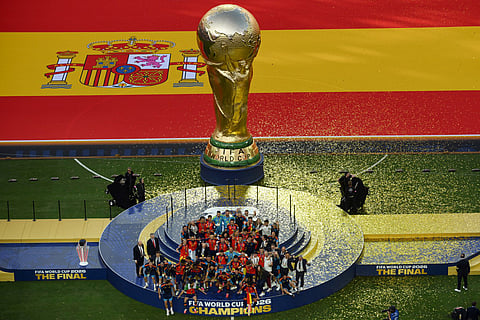
Dubai: Let's talk about why football's biggest trophy pays less than a club competition nobody had heard of two years ago.
It's the kind of stat that stops football fans mid-scroll. Spain just won the World Cup, the single most prestigious trophy in the sport, played once every four years, watched by more than five billion people worldwide, and their $50 million prize for winning it is less than half of the $125 million Chelsea picked up for winning the Club World Cup, a rebooted tournament that didn't exist in its current 32-team form until its first edition in June and July 2025.
Here's what's actually going on, and where all this money comes from in the first place.
Where FIFA's money actually comes from
To understand the prize money, it helps to understand FIFA's business model first. Across its current four-year commercial cycle running through 2026, FIFA is on track to generate roughly $13 billion in total revenue, with around $8.9 billion of that coming directly from the 2026 World Cup itself.
That revenue breaks down into four main streams. Television and broadcasting rights are by far the largest, worth well over $4 billion for this cycle, roughly 39 percent of everything FIFA brings in. Hospitality and ticketing make up the next biggest share, followed by marketing and sponsorship deals with FIFA's roster of global partners like Coca-Cola, Adidas and Visa, who each reportedly pay somewhere between $70 million and $100 million a year for top-tier association with the tournament. Licensing rights and other smaller revenue streams make up the rest.
In short, the World Cup is less a football tournament that happens to make money, and more a global media and advertising event that happens to be organised around one.
So why does so little of it reach the players?
Here's the part that trips people up: FIFA's $655 million prize pool for 2026, the money that eventually reaches players through their federations, is a relatively small slice of that $8.9 billion the tournament generates. The rest goes toward running the tournament itself, FIFA's own operating costs, and, importantly, funding football development programmes across FIFA's 211 member associations worldwide, many of which rely on FIFA funding far more than they rely on prize money from ever reaching a World Cup final.
That's actually by design. FIFA has historically framed the World Cup as a redistribution mechanism as much as a prize competition, taking in revenue from the world's richest football markets and broadcasters, then spreading a portion of it across every member nation, whether they qualified for the tournament or not. It's part of why even teams eliminated in the group stage still walk away with $9 million each.
Why the Club World Cup pays out so much more
The Club World Cup runs on a completely different logic. FIFA expanded it to 32 clubs and pushed its total prize pool to $1 billion, with Chelsea's winning share reaching up to $125 million, more than double what Spain just earned for winning the actual World Cup.
FIFA's own explanation for the gap comes down to cost structure. Clubs carry enormous year-round wage bills, players on multi-million-pound annual salaries, and FIFA has priced the Club World Cup accordingly to make it worth top clubs' time and disruption to their domestic seasons. National teams don't carry those same costs; players aren't drawing club-level salaries for representing their country, so FIFA hasn't needed to match Club World Cup money to get nations to show up.
There's also a simpler commercial explanation underneath that official framing. The Club World Cup is a newer, unproven property that FIFA has had to overpay to legitimise, price it high enough and top clubs like Chelsea, Real Madrid and Manchester City show up and lend it credibility. The World Cup, by contrast, doesn't need that kind of financial persuasion. Every eligible nation on earth already wants to qualify for it. FIFA doesn't have to pay a premium to make the World Cup matter, its prestige was built over nearly a century, long before this kind of prize money economics existed.
The bigger picture
It's worth sitting with the numbers one more time. The World Cup happens once every four years and generates close to $9 billion for FIFA. The Club World Cup, in its very first expanded edition, ran from June to July 2025 and handed out a $1 billion prize pool on its own.
Whether that balance holds as the Club World Cup matures, or whether FIFA keeps adjusting World Cup prize money upward to close the gap, as it already has by 50 percent this cycle, is likely to be one of the more interesting storylines in football's finances over the next few years.