ENOC and Allied Biofuels officials ink SAF pact.
Dubai's ENOC signs deal to explore cleaner jet fuel supply for UAE aviation
Agreement will study long-term supply of SAF, e-SAF from Uzbekistan facility
Last updated:
3 MIN READ
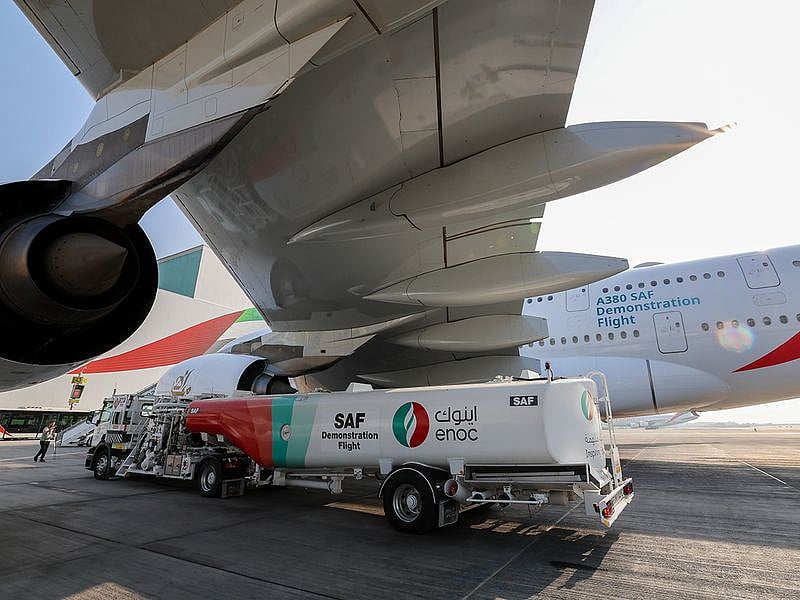
A tanker arrives at DXB to fill sustainable aviation fuel (SAF) in an Emirates Airbus A380 test flight EK2641. One of A380 jumbo jet's engines was powered by SAF. Photo used for illustrative purposes.
Virendra Saklani/Gulf News
Dubai: Emirates National Oil Company (ENOC) Group announced Monday it has signed a Memorandum of Understanding (MoU) with Abu Dhabi-based Allied Biofuels Holding to explore the supply and distribution of Sustainable Aviation Fuel (SAF) and electro-synthetic Sustainable Aviation Fuel (e-SAF) for local, regional and international markets.
The fuels are expected to be sourced from Allied Biofuels’ integrated production facility currently under development in Uzbekistan.
Under the agreement, the two companies will form a working group to assess the commercial feasibility of setting up a long-term distribution pathway for SAF and e-SAF produced at the facility. If the evaluation is successful, both sides will work towards a formal supply agreement before the plant begins operations.
The move comes as aviation companies globally face growing pressure to cut emissions, with SAF widely seen as one of the more immediate options to help reduce the sector’s carbon footprint. Demand for the fuel, however, continues to outpace current production worldwide.
Moreover, the ongoing US-Israel-Iran war has caused a severe shortage of jet fuel globally. European airlines in particular have had to cancel several thousand flights for its summer schedule amid the shortage.
Net Zero 2050
The agreement is aligned with the UAE’s Sustainable Aviation Fuel Roadmap 2030 and the country’s Net Zero 2050 Strategy, which aim to support lower-carbon alternatives for sectors such as aviation.
Hussain Sultan Lootah, Group CEO of ENOC, said: “Developing a national SAF ecosystem requires the full value chain to scale together, from production and certification through to distribution and reliable offtake.”
He added: “We are focused on making Sustainable Aviation Fuel commercially viable, operationally dependable, and central to the UAE’s net-zero aviation transition.”
The ENOC-Allied Biofuels agreement will focus on assessing whether fuel produced in Uzbekistan can be supplied to aviation markets in the UAE and beyond through a long-term commercial arrangement.
Alfred Benedict, Managing Director of Allied Biofuels Holding, said: “This MoU is an important step in developing a credible pathway for SAF and e-SAF from our Uzbekistan facility to local, regional and international markets.”
He added: “Allied Biofuels is focused on building a reliable, scalable and commercially viable supply platform that can support long-term decarbonisation across the sector.”
SAF is made from non-conventional feedstocks and is viewed by the aviation industry as a lower-emission alternative to traditional jet fuel. Electro-synthetic SAF, or e-SAF, is a synthetic version produced using renewable electricity and captured carbon.
Seeking SAF
Recently, ENOC Group and Emirates Petroleum Company (Emarat) signed a deal to ensure uninterrupted jet fuel availability across the country’s airports.
The MOU sets out a structured framework for coordination between the two state-backed energy players, including clear processes to support fuel supply management and the timely coordination of pipeline transfer and truck loading operations.
The plan also includes regular testing, training exercises, and system checks to ensure readiness at all times. UAE airlines are creating pathways to increase the contribution of SAF into the energy mix. Emirates and Etihad have conducted multiple test flights using SAF as well.

Dhanusha is a Chief Reporter at Gulf News in Dubai, with her finger firmly on the pulse of UAE, regional, and global aviation. She dives deep into how airlines and airports operate, expand, and embrace the latest tech. Known for her sharp eye for detail, Dhanusha makes complex topics like new aircraft, evolving travel trends, and aviation regulations easy to grasp. Lately, she's especially fascinated by the world of eVTOLs and flying cars. With nearly two decades in journalism, Dhanusha's covered a wide range, from health and education to the pandemic, local transport, and technology. When she's not tracking what's happening in the skies, she enjoys exploring social media trends, tech innovations, and anything that sparks reader curiosity. Outside of work, you'll find her immersed in electronic dance music, pop culture, movies, and video games.
Sign up for the Daily Briefing
Get the latest news and updates straight to your inbox
Network Links
GN StoreAbout Gulf NewsTerms & ConditionsReach by GNSitemapContact usPrivacy PolicyGN FocusHave your sayWork with usAdvertise with usGulf News epaperPrinting Services
Download our app
© Al Nisr Publishing LLC 2026. All rights reserved.