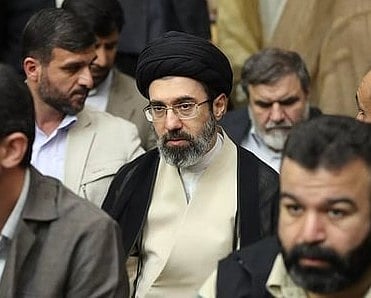
Mojtaba Khamenei, the son of Iran’s slain supreme leader Ayatollah Ali Khamenei, as seen in a handout picture taken in Tehran on October 30, 2024, and provided by the office of Iran's supreme leader. Analysts say Mojtaba cultivated especially strong ties with the IRGC and the Basij paramilitary force, organisations responsible for protecting the Islamic Republic and suppressing internal dissent.
For decades, Mojtaba Khamenei was one of the most powerful yet least visible figures inside the Iranian system — a cleric with deep influence over security forces but almost no public political role.
Despite rarely appearing in public, he is known to have with deep influence over security forces
Mojtaba studied at the religious seminary in Qom, the country’s most influential center of Shiite scholarship
He worked for decades within the leadership apparatus as a gatekeeper controlling access to his father and shaping political decisions.
On Sunday (March 8, 2026), that changed dramatically when the 56-year-old was elevated as the new supreme leader of Iran following the death of his father, Ali Khamenei, in the opening phase of a regional war involving the United States and Israel.
The move marked the first father-to-son succession in the Islamic Republic, a development in a state founded after the 1979 revolution that overthrew Iranian monarchy.
Early life and education
Mojtaba Hosseini Khamenei was born on September 8, 1969, in Mashhad, Iran.
He grew up inside the revolutionary elite as his father rose from cleric to president and eventually supreme leader in 1989.
Like many Iranian clerics, Mojtaba studied at the religious seminary in Qom, the country’s most influential center of Shiite scholarship.
According to reporting cited by CNN, he never developed the public religious stature of leading ayatollahs but steadily built influence inside the political and security establishment.
War veteran and security ties
In the late stages of the Iran-Iraq War, Mojtaba joined the Islamic Revolutionary Guard Corps (IRGC) and fought in several operations.
That experience helped forge close relationships with Iran’s security elite — connections that later became a key pillar of his power.
Analysts say he cultivated especially strong ties with the IRGC and the Basij paramilitary force, organisations responsible for protecting the Islamic Republic and suppressing internal dissent.
The 'shadow power' inside Iran
Despite rarely appearing in public, Mojtaba became an influential political operator inside the office of the supreme leader.
He worked for decades within the leadership apparatus as a gatekeeper controlling access to his father and shaping political decisions.
His influence became especially visible during the disputed 2009 presidential election.
According to analysts cited in international reporting, Mojtaba played a major role in supporting the re-election of hard-line president Mahmoud Ahmadinejad and in coordinating the state response to the mass protests that followed.
The crackdown on the so-called “Green Movement” cemented his reputation as a powerful hard-line figure within Iran’s ruling system.
Rising influence and sanctions
Over the following decade Mojtaba’s role continued to expand behind the scenes.
By the late 2010s Western intelligence agencies and analysts increasingly described him as a potential successor to his father.
In 2019 the United States sanctioned him as part of measures targeting figures close to Iran’s supreme leader and the regime’s security apparatus.
Even without a formal government post, he was widely seen as one of the most influential power brokers in Tehran.
The war that changed everything
The turning point came in February 2026 when large-scale conflict erupted between Iran, Israel and the United States.
During the opening strikes, Ali Khamenei was reportedly killed.
Within days Iran’s clerical leadership moved to fill the power vacuum.
On March 8, Iran’s Assembly of Experts selected Mojtaba as the country’s new supreme leader, signaling strong backing from conservative factions and the Revolutionary Guards.
His appointment placed him at the centre of one of the most dangerous geopolitical crises in the Middle East.
Timeline: Mojtaba Khamenei — From war recruit to supreme leader
1969 – Born (Sept. 8) in Mashhad, Iran, the second son of Ali Khamenei.
1980s – Grows up during the Islamic Republic’s consolidation after the revolution.
1987–1988 – Joins the IRGC and fights in the Iran-Iraq War.
1990s – Studies Islamic theology at the Qom seminary and begins clerical career.
Early 2000s – Gains influence within the office of the supreme leader as a political adviser and gatekeeper.
2009 – Linked to the state crackdown on protests following Iran’s disputed presidential election.
2010s – Builds close ties with the IRGC and Basij militia, becoming a key behind-the-scenes power broker.
2019 – Sanctioned by the United States for ties to Iran’s leadership network.
2022–2025 – Increasingly discussed by analysts as a possible successor to his father.
Feb. 28 2026 – Ali Khamenei killed during wartime strikes amid regional conflict.
March 8, 2026 – Mojtaba Khamenei appointed Iran’s third supreme leader.
Sign up for the Daily Briefing
Get the latest news and updates straight to your inbox
Network Links
GN StoreAbout Gulf NewsTerms & ConditionsReach by GNSitemapContact usPrivacy PolicyGN FocusHave your sayWork with usAdvertise with usGulf News epaperPrinting Services
Download our app
© Al Nisr Publishing LLC 2026. All rights reserved.