Ayatollah Ali Khamenei: Supreme leader dead, Iran TV confirms as 40-day mourning declared
Trump says Khamenei death reports ‘correct’; Tehran TV confirms report on March 1
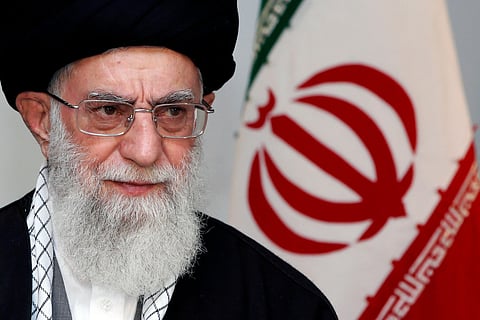
Dubai: Iran's state TV has confirmed on Sunday (March 1, 2026) that Iran's Supreme Iran’s Supreme Leader, Ayatollah Ali Khamenei, is dead.
Khamenei, 86, has been the spiritual and political linchpin of the Islamic Republic for more than three decades.
As the country’s ultimate authority in foreign policy, military strategy and national security, he has shaped Iran’s trajectory since taking over the leadership in 1989.
US President Donald Trump and senior Israeli officials earlier claimed that Ayatollah Ali Khamenei was killed in strikes on Tehran early Saturday (February 28), in a statement made through official channels and social media.
Iran TV confirmed on Monday (March 1) that that the leader Iranian was killed, and that a 40-day mourning has been declared.
As of late Saturday, authorities did not confirm the report, and Tehran officials have indicated the Supreme Leader may still be alive pending further verification.
Earlier report:
These reports remain unconfirmed by Iranian state authorities, who have not issued an official statement on his condition or whereabouts.
Given the gravity of this claim, media organisations are attributing it carefully: “Sources say…” or “Reports indicate…” rather than stating it as verified fact. Until there is official confirmation from the Iranian government or unequivocal independent verification, Khamenei’s status remains a subject of intense speculation.
Growing signs
Israeli officials told media outlets that Khamenei may have been killed when his compound was struck, citing “growing signs.”
US President Donald Trump also said the reports were accurate. In a brief phone interview with NBC News, Trump said, “We feel that that is a correct story,” adding that “a large amount of leadership” in Iran had been killed. He claimed that “most” of Iran’s senior leadership was “gone,” though there has been no independent verification or confirmation from Tehran.
Israel’s military also said its strikes killed Mohammad Pakpour, commander of the Islamic Revolutionary Guard Corps, and Iran’s Defense Minister Aziz Nasirzadeh. Neither Iran nor the United States has independently confirmed those claims.
Who is Khamenei?
Khamenei has served as Iran’s Supreme Leader — the highest office in the country — since the death of Ayatollah Ruhollah Khomeini in 1989. The position places him above the elected branches of government and gives him ultimate authority over the military, judiciary, foreign policy, security services and state media.
He commands:
The armed forces, including the Islamic Revolutionary Guard Corps (IRGC)
Iran’s nuclear and missile strategy
The Guardian Council, which vets election candidates and legislation
The Supreme National Security Council
The president, parliament (Majlis), judiciary and key state institutions operate within the framework he defines.
Reported death: What’s being said
According to several international news organisations, citing unnamed sources:
Reports indicate that Khamenei may have been killed in the aerial strikes carried out by Israel and the United States.
Other senior Iranian officials were also reported as casualties.
Iranian state media has not issued confirmation and continues to broadcast routine programming.
At this stage, these claims are unverified and should be treated with caution.
Why it matters
If Khamenei were indeed killed — and that remains unconfirmed — it would be one of the most significant developments in modern Middle Eastern history:
The Supreme Leader is not just a political figure but the religious authority anchoring the Islamic Republic.
His removal would plunge Iran into a constitutional crisis with uncertain succession procedures.
The Assembly of Experts — the clerical body tasked with choosing the next Supreme Leader — would play a central role, but its members are vetted by bodies loyal to the current establishment.
Even in times of crisis, Iran’s power system is designed to maintain continuity. The IRGC and Supreme National Security Council would likely assume operational control while a new clerical leader is selected.
The IRGC and the power structure
The IRGC is deeply intertwined with Khamenei’s authority. As the elite military body entrusted with both internal security and regional operations, the IRGC answers directly to the Supreme Leader. Its generals have played leading roles in strategy and in suppressing protests at home.
The Quds Force — the IRGC’s external operations arm — commands allied militia networks across the Middle East, from Hezbollah in Lebanon to factions in Iraq, Yemen and Syria.
The Basij, another IRGC branch, enforces regime control within Iran and has been central in quelling anti-government demonstrations.
If the Supreme Leader’s reported death is ever confirmed, the IRGC’s role would likely become even more central during the transition period.
Succession remains unclear
Under Iran’s constitution, the Assembly of Experts is responsible for appointing a new Supreme Leader. But in practice:
The Assembly’s members are vetted by the Guardian Council.
The process is opaque and heavily influenced by the current leadership structure.
There is no clear public line of succession.
Even if official confirmation emerges, the transition could be messy and uncertain, with multiple factions within the elite jockeying for influence.
What comes next
At this stage:
Claims of Khamenei’s death are reported by sources but not confirmed.
Official Iranian channels have not validated these reports.
The situation remains extremely fluid and subject to evolving verification.
Above all, this is a moment where precise, attributed reporting matters more than definitive declarations.


