Maj Gen Mohammad Bagheri and Brigadier Amir Ali Hajizadeh tour a ‘missile megacity’. File photo
Inside Iran’s ‘missile cities’: The secret underground bases powering Tehran’s arsenal
Inside Iran’s fortified ‘missile cities’ anchoring its regional strike power
Last updated:
13 MIN READ
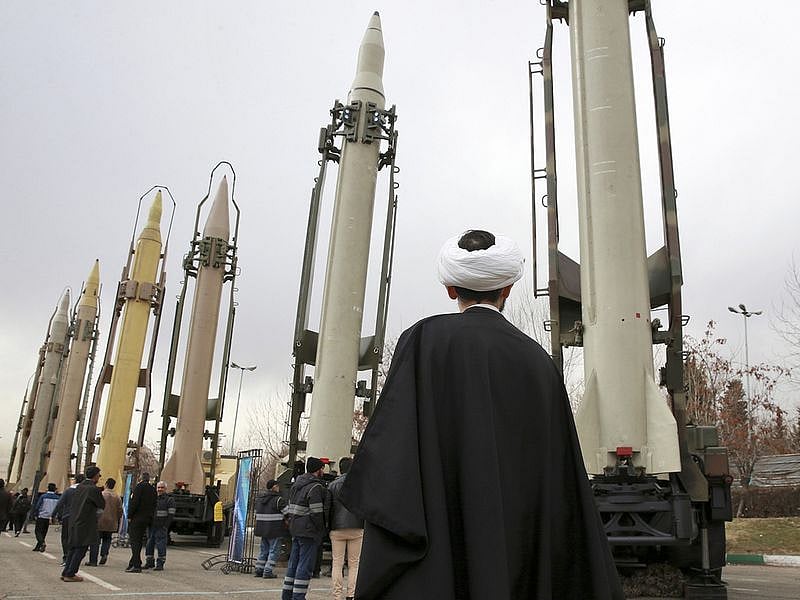
Iran’s Supreme National Security Council member, Mohsen Rezaei, boasted of new missile capability and claimed it had been “tested” against a US warship.
AP
Iran’s missile arsenal remains one of the central pillars of its military strategy.
So, how many missiles does Iran still have in its underground bunkers?
For years, the benchmark figure was more than 3,000 ballistic missiles, based on a 2022 assessment by the US Central Command.
That figure is now outdated.
The latest publicly-reported assessment puts Iran’s ballistic-missile stockpile at fewer than 2,000 missiles, following sustained US and Israeli attacks.
Earlier this year, the Israeli military estimated that Iran had about 2,500 ballistic missiles, while reporting that Tehran was producing dozens of new missiles a month.
A Reuters report, meanwhile, estimated Iran's missile inventory at roughly 1,000 to 1,500 functional missiles out of a pre-conflict baseline of about 2,500.
More significantly, up to 90% of Iran’s heavily fortified "missile cities" and tunnel storage sites remain partially or fully operational despite targeted airstrikes.
In terms of launcher availability, roughly 60% of Iran's missile and drone launchers remain intact or have been recovered from damaged site, CNN reported.
The exact numbers remain uncertain.
And given the Islamic regime's asymmetric war strategy, or "decentralised mosaic defence", the command lines are unclear.
Official data highlights that Iran's 2025 oil revenue surpassed $45 billion, while prior stronger production cycles approached nearly $58 billion. (Sources: US Energy Information Administration | Iran International)
Replenishing missile, drone stockpile
Iran has fired thousands of missiles and drones in successive rounds of regional conflict since 2024, while continuing efforts to replenish its stockpile.
On March 1, 2026, one day after the US and Israel launched joint strikes against Iran, Iranian Foreign Minister Abbas Araghchi said Tehran had spent two decades studying US military campaigns in Iraq and Afghanistan and had incorporated lessons from them into its defence strategy.
“Bombings in our capital have no impact on our ability to conduct war,” Araghchi said in a post on X. He added that “Decentralised Mosaic Defence” would enable Iran to determine when and how the war would end.
Araghchi was referring to Iran’s “mosaic defence” doctrine, a decentralised military concept associated with the IRGC.
The strategy is designed to distribute command and control across regional structures so that military units can continue operating even if senior leaders, communications networks or central command facilities are attacked.
A May 2026 assessment by the Foundation for Defense of Democracies estimated that Iran had launched roughly 2,200–2,400 missiles in four waves of military operations between 2024 and 2026, making simple comparisons with the old 3,000-plus estimate unreliable.
Location of around 30 "missile cities" in Iran. Tehran has also spent the past decade improving the accuracy of its missiles, addressing a major weakness of its earlier weapons.
2,200–2,400 missiles
Estimated number of ballistic missiles launched by Iran in 4 waves of military operations between 2024 and 2026, accordinv to a May 2026 assessment by the Foundation for Defence of Democracies.
Tehran does not currently possess nuclear weapons or an intercontinental ballistic missile capable of reaching the United States.
The US and Israel have focused heavily on degrading Iran's ability to use its conventional weapons and missile force, targeting mobile launchers mounted on trucks as well as fixed launch facilities.
Despite those losses, Iran's remaining missile capability remains a crucial element of its conventional deterrence.
According to recent reporting by El Pais and Iran International, Tehran regime's strategic ballistic missile network is anchored around 30 critical underground and surface installations, as mapped by international intelligence.
These fortified "missile cities" house, manufacture, and deploy thousands of precision-guided short, medium, and long-range ballistic missiles capable of regional power projection:
An Iranian Kheibarshekan missile at an undisclosed underground location in Iran. The IRGC has reportedly regained access to most missile sites overlooking the Strait of Hormuz, according to intelligence assessments cited by The New York Times.
Top Iranian missile sites
Tabriz Missile Base
Location: East Azerbaijan Province, Northwestern Iran
Description: This massive facility serves as Iran's second-largest underground missile silo network. It is heavily carved into mountainous terrain to maximise structural survivability. The site primarily deploys Shahab-2 and Shahab-3 medium-range ballistic missiles. It is strategically positioned to project military force deep into parts of Eastern and Central Europe.
Al Zahra Garrison, near Amand
Around Tabriz, the largest city in northwestern Iran and a strategic hub near the borders with Azerbaijan, Armenia and Turkey, three important missile bases are co-located.
The most important is the Al-Zahra garrison near the town of Amand, northwest of Tabriz, and the base is often referred to by that name. South of Tabriz, near the town of Sardroud and the Tabriz radar station, an old air-defence site was later repurposed as the southern Tabriz missile base.
A third site is located in Urmia, the capital of West Azarbaijan province, inside a military zone that houses the IRGC Ground Force’s 3rd Special Forces Division and the northwest regional support command.
Khorramabad Silo Complex
Location: Lorestan Province, Western Iran
Description: Operating as Iran's largest active underground missile silo complex, this heavily fortified facility acts as a central hub. It specializes in the industrial-scale assembly, ballistic production, and subterranean storage of liquid-fueled missiles. The vast network features multiple hardened mountain entry tunnels built to withstand heavy external aerial bombardments.
Kenesht Canyon Underground Base
Location: Kermanshah Province, Western Iran
Description: This highly strategic subterranean fortress features at least 60 distinct tunnel bunkers visible on satellite imagery. It functions as a primary launch repository for rapid-response mobile transporter erector launchers (TELs). Its proximity to the western border allows targeted coverage over Israel and the immediate Gulf region.
Bakhtaran Missile Base
Location: Kermanshah Province, Western Iran
Description: Positioned alongside regional launch corridors, this major base integrates a dense underground facility with multiple deployment sites. It contains two primary subterranean missile storage sectors and hardened launch pads. The garrison permanently houses medium-range solid-fuel platforms configured for rapid strategic escalation across the Middle East.
Construction activity seen in this 2021 at Kermanshah Underground Facility near Bakhtaran Ballistic Missile Base in Iran. After a 7-month stall, tunnels excavation has been renewed at the beginning of August 2021, the site footprint has been increased, excavations for structure foundations are in progress.
Isfahan Assembly Complex
Location: Isfahan Province, Central Iran
Description: This sprawling infrastructure serves as Iran's largest domestic missile manufacturing and industrial assembly headquarters. It produces solid and liquid propellants while assembling advanced long-range variants. The highly guarded site includes deeply buried research centers and adjacent subterranean launch garrisons designed for strategic weapon preservation.
Semnan Launch Site
Location: Semnan Province, Northern Iran
Description: Acting as the primary testing ground for Iran's long-range ballistic missile inventory, this expansive desert facility features large launch pads. It integrates above-ground servicing towers with complex subterranean storage bunkers. The site supports dual-use liquid-propellant testing and provides critical infrastructure for the Islamic Revolutionary Guard Corps (IRGC) space program.
Shahrud Space Center
Location: Semnan Province, Northeast of Tehran
Description: This primary aerospace facility is operated directly by the IRGC Aerospace Force for solid-propellant motor fabrication. It features massive horizontal test stands and underground assembly vaults. The installation plays a foundational role in testing multi-stage ballistic military systems disguised under civilian satellite launch initiatives.
The Shahrud Space Center, the chief aerospace hub run by the IRGC Aerospace Force, is used for manufacturing solid-propellant rocket motors. The facility is equipped with large-scale horizontal test stands and subterranean assembly vaults. It acts as a critical base for developing multi-stage military ballistic systems under the guise of civilian satellite launch programs.
Parchin Military Complex
Location: Tehran Province, East of Tehran
Description: This vast, heavily restricted military reservation serves as a premier research, development, and fuel-production site. It specializes in synthesizing chemical propellants, testing warhead explosives, and manufacturing ballistic rocket components. The complex incorporates deeply tunneled mountain vaults used to shield illicit high-explosive weapon research from international observation.
Dezful Underground Base
Location: Khuzestan Province, Southwestern Iran
Description: Built deep inside regional mountain chains, this major subterranean facility acts as a forward-deployed missile storage hub. It features at least five major fortified concrete tunnel entrances linked to interior railway systems. The base is specifically designed to roll out and launch precision tactical ballistic systems targeting regional naval assets.
Qeshm Island Fortress
Location: Qeshm Island, Strait of Hormuz
Description: Operating as an "unsinkable aircraft carrier," this island outpost contains a extensive underground maritime "missile city". It houses highly classified anti-ship cruise and ballistic platforms hidden within subterranean coastal labyrinth networks. The site's primary mission is enforcing strategic chokehold operations across the vital Strait of Hormuz.
A Google map showing Qeshm island.
Khorgo Underground Facility
Location: Bandar Abbas, Hormozgan Province
Description: Located near Iran's southern coast, this heavily bunkered installation contains reinforced underground silos dug into dense mountain slopes. It provides immediate launch capabilities for anti-ship ballistic variants and maritime denial assets. The facility features hardened entry networks built to withstand conventional bunker-busting airstrikes.
Khourgou Base: The Khourgou (Khorgo) missile base is located about 32 kilometers northeast of Bandar Abbas, Iran’s main port city on the Strait of Hormuz, and roughly 100 kilometers from the strait itself.
Khormuj Silo Base
Location: Bushehr Province, Southern Iran
Description: This modern subterranean launch facility features nine primitive but highly functional underground firing silos. The vertical silos are bored directly into the mountain faces flanking the primary complex. This design enables direct, automated missile launches aimed toward the Gulf without exposing ground crews or vehicles.
The Khormoj missile base lies about 6 km from the city of Khormoj in Bushehr province, southern Iran, and about 260 kilometers across the Gulf from Saudi Arabia’s coast.
Its location places key Gulf cities at roughly 550 to 650 km away. The site contains nine vertical launch shafts, giving it one of the more extensive hardened missile launch layouts in the southern cluster.
The first signs of construction appeared in satellite imagery in 2018. Development has moved quickly since then, turning Khormoj into one of the newer but more significant missile sites along Iran’s southern belt.
The Jam missile base sits on the edge of the city of Jam in Bushehr province, about 13 kilometers from the Gulf coast. Much of the site was already in place before 2005. Two tunnel entrances were added later, with the first visible signs of construction appearing in 2010 and 2017. In total, the complex contains five tunnel entrances, along with two vertical launch shafts in its older tunnel section. Elsewhere at the base, at least 19 depot entrances are visible. In one aerial image, a missile transport vehicle can be seen near one of them. Jam’s location gives it direct reach across the Gulf: the base is about 300 kilometers from the Saudi coast, 220 kilometers from Bahrain. An analysis of a video aired by Iranian state television identified a Qiam-1 missile at the Jam base. The liquid-fuel missile has a reported range of about 800 km.
Haji Abad Missile Base
Location: Hormozgan Province, Southern Iran
Description: This fortified base serves as a specialized underground launch facility for hardened mobile transporter trucks. It incorporates heavily reinforced concrete structures engineered to conceal advanced solid-fuel missile batteries from modern satellite reconnaissance. The installation acts as a vital link in Iran's secondary coastal strike architecture.
Open-source satellite imagery of the suspected IRGC's missile base near Haji Abad reveals this development. Although Tehran has in recent years showcased several underground complexes (dubbed ‘missile cities’) – complete with cavernous launch silos – they have not included the Haji Abad structures. While Iran’s ballistic-missile designs are road mobile, Tehran also deploys some in hardened static launch sites.
In 2021, the International Institute of Strategic Studies (IISS) cited “open-source" satellite imagery as revealing the suspected development of a new missile base near Haji Abad in Iran, "possibly the first hardened launch site intended specifically for solid-fuel ballistic missiles".
The new structures have drawn attention from the intelligence community. The IISS stated then that "Iran may have developed a new design of hardened launch site, possibly the first intended specifically for solid-fuel ballistic missiles."
Panj Pelleh Base
Location: Kermanshah Province, Western Iran
Description: Panj-Peleh, one of IRGC's oldest missile bases, is located about four kilometers east of Kermanshah. This military facility is configured specifically for regional missile storage and automated launch staging.
The installation contains multiple hardened mountain entryways connected to hidden subterranean caverns. It maintains a high state of operational readiness to field mobile tactical weapons along the western border zone. It is also known as Imam Hassan Garrison.
The base was heavily struck during the 12-day war. At least two videos of attacks on the site were published on June 14 and June 18, 2025. Spread across roughly six square kilometers, the complex contains at least 80 earth-covered ammunition depots visible in satellite imagery, as well as two tunnel entrances on its northern side.
The Panj Peleh base was heavily struck during the 12-day war. At least two videos of attacks on the site were published on June 14 and June 18, 2025.
Northern Kermanshah Base
Location: Tangeh Kenesht area north of Kermanshah.
Description: This base lies 3 to 8 kilometers northwest of Panj-Peleh, or Imam Hassan Garrison, in the Tangeh Kenesht area north of Kermanshah.
Satellite imagery shows that much of the complex’s southern section predates 2001, including dozens of earth-covered ammunition bunkers, known in military terminology as igloos, as well as support facilities. At least 63 such bunkers are visible there.
At the eastern end of the complex, two tunnel entrances are visible. Construction on them began in 2005. Four more tunnel entrances were later built in the northern part of the complex. Construction of two of them began in 2020, while the other two were built from 2022 onward.
Two tunnel entrances are visible at the eastern end of the complex. Construction on began in 2005. Four more tunnel entrances were later built in the northern part of the complex. Construction of two of them began in 2020, while the other two were built from 2022 onward, as per Iran International.
Bidganeh Missile Facility
Location: Alborz Province, West of Tehran
Description: Historically significant as a primary research and solid-fuel development center for the IRGC, this base handles advanced testing. It focuses on extending the operational range of precision-guided ballistic missiles. The installation incorporates isolated, blast-reinforced testing cells and deep storage bunkers built to contain volatile chemical accidents.
Garmdareh Missile Base
Location: Alborz Province, Tehran Cluster
Description: Operating as a vital logistical node within the northern missile defense belt, this base supports rapid deployment. It features underground storage vaults designed to house short-range mobile ballistic platforms. The facility provides critical security and technical upkeep for missile systems defending the capital's airspace.
Deh Torkaman Base
Location: Tehran Province, East of Capital
Description: Part of the core north-central strategic defense chain, this hidden facility emphasizes underground weapon storage. It provides quick-reaction deployment options for mobile launcher trucks stationed near political command sectors. The base is protected by layered anti-aircraft defense networks to safeguard its subterranean military assets.
Garmsar Missile Site
Location: Semnan Province, North-Central Iran
Description: This testing and training facility supports operational crews transitioning to long-range weapon platforms. It contains multiple open-air launch pads paired with underground assembly hangars. The site allows the IRGC to simulate active battlefield deployments while keeping its primary missile stock safely under deep mountain cover.
The Garmsar missile-related facility is a strategic military and industrial site located about 14 km northwest of Garmsar in Semnan Province, Iran. Built and expanded since the 2010s, it forms a key part of Iran's north-central missile production chain — focusing on solid and liquid-fuel components — and has been targeted in regional military strikes.
Al-Zahra Garrison | Northern Tabriz missile city
Location: Tabriz Region, East Azerbaijan Province
Description: Functioning as a high-security military garrison, this site anchors the Tabriz defense cluster. It features specialized underground infrastructure used to store mobile short-range ballistic systems. The facility is positioned to rapidly reinforce frontline operations along Iran's northwestern borders.
Al-Zahra Base is a missile base about 2.5 kilometers northwest of Amand, and 20 kilometers northwest of Tabriz. It is known as the northern Tabriz “missile city,” the Amand base or Al-Zahra garrison.
The Amand base or Al-Zahra garrison/base, is also known as the northern Tabriz “missile city,” The site stretches roughly 4 kilometers from east to west. It includes clusters of tunnels dug into the mountainside and multiple halls and support buildings spread across the compound. It resembles the Khorramabad base in western Iran in terms of In layout and function. Like Khorramabad, the Al-Zahra complex appears to be one of the IRGC’s older missile-storage sites.
Mobarakeh Complex
Location: Isfahan Province, Central Iran
Description: This industrial site functions as a major support facility within the central manufacturing network. It specializes in fabrication, mechanical engineering, and hardware testing for advanced weapon casings. The heavily guarded plant supplies essential structural components to nearby missile assembly lines.
The Mobarakeh complex is located about 30 kilometers south of Isfahan, in the Mobarakeh area. More precisely, it lies about 12 km east of Mobarakeh and six 6 km south of Asadabad.
Ahmad Kazemi Base
Location: Isfahan Cluster, Central Iran
Description: This major IRGC garrison is dedicated to managing and housing mobile ballistic missile launchers. It maintains a network of reinforced underground garages that shield launcher trucks from preemptive air tracking. The base acts as a mobile reserve force capable of deploying across central Iranian territory.
Ahmad Kazemi Base
Ya Haydar Karar Base
Location: Alborz Mountains, Northern Iran
Description: This modern fortress is engineered to be one of Iran's largest and deepest underground military centers. Excavated at depths between 500 and 700 meters, it features a sprawling multi-kilometer tunnel web. The facility is built to survive nuclear strikes while hosting mass production, storage, and automated launch systems.
Treereze Missile Site
Location: Northwestern Border Region
Description: Tucked deep inside rugged mountain geography, this tactical base utilises hardened subterranean caverns for missile concealment. It features pop-up launch mechanisms and automated exit tunnels designed for rapid strike execution. The site focuses on providing high-survivability strike coverage facing northwestern regional borders.
Qom Subterranean Base
Location: Qom Province, Central Iran
Description: Situated adjacent to heavily fortified nuclear infrastructure, this deeply buried base provides retaliatory missile defence capabilities. It features reinforced mountain bunkers housing advanced medium-range precision weapons. The facility is designed to safeguard strategic launch assets directly alongside Iran's core nuclear facilities.
A satellite image shows an overview of the Fordow underground complex near Qom, Iran, before and after the US struck the nuclear facility on June 22, 2025.
Shiraz Missile Facility
Location: Fars Province, Southern Iran
Description: Shiraz Cluster: Two main missile bases are located around Shiraz, the largest city in southwestern Iran and the capital of Fars province. One lies northeast of the city, inside a military zone near Bajgah and the agricultural college of Shiraz University. The other is southwest of Shiraz, near the village of Kafari.
The large southern hub focuses on storing and maintaining liquid-fueled medium-range ballistic inventory. It incorporates a sprawling series of subterranean galleries carved out of the local hillsides. The base serves as a crucial launch point for targeting operations tracking across the Gulf and southern shipping lanes.
One assessment shows the northern Shiraz base suffered more than 50 percent damage during the 12-day war, while damage to the southern Shiraz base was estimated at less than 10 percent.
Bandar Abbas Naval Missile Base
Location: Hormozgan Province, Southern Coast
Description: Operated primarily by the IRGC Navy, this subterranean coastal installation houses high-speed anti-ship ballistic platforms. The facility features automated rail networks designed to move weapon systems from deep interior bunkers out to coastal firing points. It acts as a primary naval denial installation. The Khourgou (also "Khorgo") missile base, about 32 kilometers northeast of Bandar Abbas, Iran’s main port city on the Strait of Hormuz, is roughly 100 kilometers from the Hormuz Strait itself.
In this Khourgou (also "Khorgo") missile base, located about 32 kilometers northeast of Bandar Abbas, Iran’s main port city on the Strait of Hormuz, is roughly 100 kilometers from the Hormuz Strait itself.
The site had basic military infrastructure before 2001. Around 30 ammunition depots had already been built in the area. Fox News first reported in 2021 that construction of a new facility south of the older site had begun around 2017. A newer section shows at least three launch shafts completeed. A large tunnel entrance has been cut into the hillside at the end of the western access route, and additional entrances have appeared near the older ammunition depots.
Dorud Missile Facility
Location: Lorestan Province, Western Iran
Description: This component facility supports the nearby Khorramabad complex by managing heavy manufacturing and missile logistics. It handles precision metallurgy, structural engineering, and casing assembly for solid-propellant rockets. The site relies on deeply recessed structural bunkers to protect its volatile industrial machinery.
Arak Research Complex
Location: Markazi Province, Western Iran
Description: While known for nuclear research, this heavily secured complex includes dedicated aerospace research and engineering labs. It designs advanced guidance packages, flight control systems, and reentry vehicle technologies. These design initiatives aim to improve the accuracy of Iran's long-range weapon platforms.
This handout satellite image released by Maxar Technologies on June 19, 2025 and taken on June 19, 2025, shows damage at the Iranian nuclear facility at Arak in central Iran, after an Israeli strike.
Karaj R&D Facility
Location: Alborz Province, Near Tehran
Description: This highly classified electronics and industrial center specialises in engineering research for the defense sector. It focuses on developing counter-radar shielding, electronic warfare packages, and automated components for ballistic systems. The facility utilizes heavily bunkered laboratory complexes to prevent foreign intelligence monitoring.
A car exits a tunnel on Chalus Road, one of the most scenic routes in Iran's northern Alborz mountain range, on June 1, 2025, which connects Tehran and Karaj to the country's Caspian Sea coast.
Manzariyah Fuel Site
Location: Qom/Tehran Border Region
Description: Operating as a critical chemical depot, this site specialises in the research, processing, and storage of liquid rocket fuels. It features heavily insulated underground storage tanks and mixing facilities engineered to safely handle toxic propellants. The depot directly supplies active launch bases throughout north-central Iran.
Network Links
GN StoreAbout Gulf NewsTerms & ConditionsReach by GNSitemapContact usPrivacy PolicyGN FocusHave your sayWork with usAdvertise with usGulf News epaperPrinting Services
Download our app
© Al Nisr Publishing LLC 2026. All rights reserved.