Iran's war doctrine revealed: 'Decentralised Mosaic Defence' — what it means for US, Israel
Araghchi, Larijani highlight 'endurance' as key part of strategy as war widens
Iranian Foreign Minister Abbas Araghchi claimed that Tehran can withstand sustained US-Israeli military pressure, able to defend the regime despite a successful “decapitation” hit, and wage a prolonged war.
How? He calls it the "decentralised mosaic defence" (DMD) strategy, which he claims Iran had developed over the years.
More to it, Tehran's top diplomat claims that by following this asymmetric war doctrine, Iran can choose how — and when — the conflict ends.


Araghchi isn’t just describing military doctrine — he’s broadcasting a message.
His invocation of the Islamic Revolutionary Guard Corps’s “decentralised mosaic defence” is strategic theatre as much as strategy itself: a carefully calibrated signal aimed inward at a rattled domestic audience and outward at adversaries weighing their next move.
At home, it projects resilience.
The image he projects is one of a state too dispersed, too layered, too entrenched to be shattered by airstrikes or leadership losses.
Abroad, it serves as a warning: Iran’s warfighting capacity is not a single pillar that can be toppled, but a web designed to endure, adapt, and retaliate.
In other words, Araghchi’s message is not merely about defence. It's about deterrence — psychological as much as military — wrapped in the language of doctrine.
In an interview with ABC News’ George Stephanopoulos, Araghchi also lashed out at the joint strikes against Iran conducted by the US and Israel, saying: “We have every legitimate right to defend ourselves”.
Araghchi blamed Trump for the war’s outbreak.
“A deal was within reach. We left Geneva with (the) understanding that we'd seal a deal next time we meet. Those who wanted to spoil diplomacy succeeded in their mission. But it was Mr. Trump, yet again, who ultimately ordered bombing of the negotiating table.”
The initial salvo killed Iran’s Supreme Leader Ayatollah Ali Khamenei on February 28, 2026, as confirmed by Tehran’s official media.
Two themes
In a post explaining the so-called Decentralised Mosaic Defence, Araghchi’s message carried two themes.
Iran will not be defeated by bombardment
It intends to shape how — and when — the conflict ends.
He said the bombings have "no impact" on Iran's ability to conduct war.
Araghchi argued: the recent strikes do not erode Iran’s military resilience even in the face of leadership losses or so-called “decapitation” strikes.
Citing the main theme of DMD doctrine, Araghchi suggested that Iran’s capacity to fight does not hinge on a single command centre, city, or leader.
The message serves both as domestic reassurance and as a warning to adversaries: military escalation will not quickly collapse the system.
What is 'decentralised mosaic defence'?
It refers to a doctrine developed by Iran over the last two decades, particularly within the IRGC.
The idea is rather simple: It disperses command structures, weapons systems, and operational units across vast geographic and organisational nodes.
Iran is about 4.1 times larger than California. With a total land area of about 1.65 million km2, Iran's size is comparable to the US state of Alaska.
Rather than concentrating power in a single headquarters vulnerable to precision strikes, the Iran's DMD strategy is one that empowers regional commanders to operate autonomously if communications with Tehran are disrupted.
Defence-in-depth
Western strategic studies describe this as a form of “defence-in-depth” designed to complicate an adversary’s objectives.
While US President Trump envisages a four-week military operation against Iran, Iran’s security chief on Monday said the Islamic republic was prepared for a long, drawn-out timeline.
“Iran, unlike the United States, has prepared itself for a long war,” said Ali Larijani, the powerful head of Tehran’s Supreme National Security Council, in a post on X.
A Center for Strategic and Budgetary Assessments (CSBA) study on Middle East military balance notes that Iran’s decentralised command structure allows local units to adapt quickly, after surviving initial attacks.
An analysis published by Air University, the US Air and Space Force's centre for professional military education, also highlights how Iran tailored its doctrine to offset a technologically superior opponent by relying on distributed forces and “asymmetric” tactics.
Similarly, research from the Canadian Forces College emphasises Iran’s integration of territorial defence with forward networks — including “proxy” groups (such as Hezbollah, Hamas, Houthis) and irregular forces — creating interconnected, but highly dispersed layers, instead of a single "point of failure".
Shift from conventional warfare
In practical terms, this doctrine shifts away from traditional conventional warfare, which prioritises centralised command and massed formations.
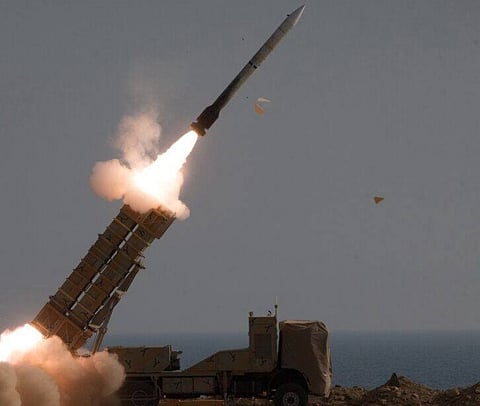
In practice, it favours dispersed missile units, mobile launchers, hardened facilities, naval swarm tactics in the Gulf, and allied non-state actors across the region.
The goal: Endurance
In a nutshell, it means: Survive the initial shock, retaliate through multiple channels, and raise the cost of prolonged engagement.
When Araghchi speaks of “two decades to study defeats of the US military to our immediate east and west,” he is referencing US wars in Afghanistan and Iraq:
In Afghanistan (2001–2021), the United States achieved rapid battlefield victories but struggled to establish lasting political stability, ultimately withdrawing as the Taliban regained control.
In Iraq (after the 2003 invasion), initial regime change gave way to insurgency, sectarian violence, and the rise of Daesh (Islamic State or Iran and Syria, ISIS), demonstrating how conventional superiority does not guarantee strategic success.
From Tehran’s perspective, these conflicts showed that centralised systems and reliance on fixed positions can become liabilities in protracted wars.
Iran’s doctrine attempts to absorb those lessons:
Decentralise authority,
Blur the battlefield,
Extend conflict across multiple domains, and
Make military victory politically and economically costly for an adversary.
Strategic signalling
Araghchi’s rhetoric is not merely commentary.
It is strategic signalling. He is presenting Iran as patient, adaptive, and prepared for endurance.
The implication is clear: even if struck hard and fast, Tehran believes its “mosaic” can continue fighting, fragment by fragment, long after the opening blows land.


