Operation Epic Fury: From B-2s to HIMARS, here’s how US is unleashing full war arsenal on Iran
Pentagon details sweeping air, sea and missile campaign under Operation Epic Fury
Dubai: Before the US–Israeli strikes on Iran began, Washington had already assembled its largest concentration of firepower in the Middle East in decades — a force President Donald Trump had warned was “locked and loaded.”
When Saturday’s strikes killed Iran’s supreme leader, that force moved from deterrence to destruction.
US Central Command (CENTCOM) has released details of the weapons and platforms used so far in what the Pentagon calls “Operation Epic Fury.”
CNN reported that the buildup represents one of the most significant US military deployments in the region since the Iraq War.
Here’s a look at the firepower now in action.
Strategic strike: B-2 bombers lead the assault
At the centre of the campaign are the US Air Force’s B-2 Spirit stealth bombers — the bat-winged aircraft that cost more than $1 billion each and represent America’s most potent long-range strike platform.
Powered by four jet engines and flown by a two-person crew, the B-2 can carry conventional or nuclear weapons and fly intercontinental missions with aerial refueling.
Last year, seven of the 19 B-2s in the fleet flew a 34-hour round-trip mission from Whiteman Air Force Base in Missouri to strike Iranian nuclear complexes using 30,000-pound Massive Ordnance Penetrators — the largest conventional bombs in the US arsenal.
This time, CENTCOM says the bombers used 2,000-pound precision-guided bombs to hit Iranian ballistic missile installations — signaling a shift toward degrading Tehran’s retaliatory capabilities.
Carrier strike groups and Tomahawk barrages
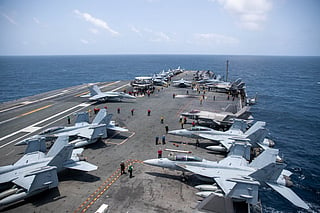
Two US aircraft carriers — USS Abraham Lincoln and USS Gerald R. Ford — were already positioned in the region when the war began.
The Lincoln operated in the Arabian Sea, while the Ford was stationed in the eastern Mediterranean off Israel.
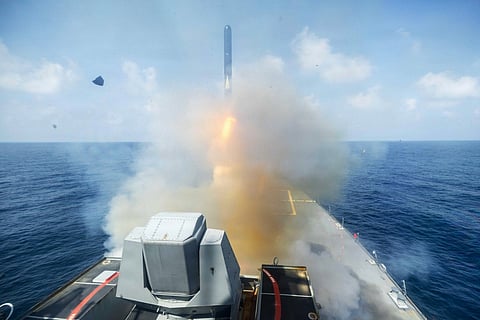
Video released by CENTCOM shows F/A-18 and F-35 fighter jets launching from the Lincoln’s deck. Guided-missile destroyers have also fired Tomahawk cruise missiles — long-range precision weapons capable of striking targets hundreds of miles inland.
US Arleigh Burke-class destroyers, several of which are deployed in the region, can carry up to 96 Tomahawk missiles each. Equipped with the Aegis ballistic missile defense system, they also protect carriers and regional bases from incoming threats.
Iran has claimed it struck the Lincoln with ballistic missiles — an assertion CENTCOM dismissed on social media as a “LIE.”
Air superiority and electronic warfare
A range of US fighter aircraft are operating across the battlespace, including:
F-16s (Air Force)
F/A-18s (Navy and Marine Corps)
Stealth F-22 Raptors
F-35 Lightning II jets
Twin-engine A-10 attack aircraft — designed for close air support — have also been deployed.
Meanwhile, EA-18G Growlers are providing electronic warfare support. Based on the F/A-18 platform, these aircraft carry jamming pods and anti-radiation missiles that suppress enemy radar and communications systems — blinding adversaries before strikes land.
Drones enter the fight
Operation Epic Fury marks the first combat use of the Low-cost Unmanned Combat Attack System (LUCAS) drone, according to CENTCOM.
The drones are operated by Task Force Scorpion Strike, activated in the Middle East late last year.
LUCAS drones are modeled after Iran’s Shahed-136 drones — the same type Russia has used extensively in Ukraine. “These low-cost drones, modeled after Iran’s Shahed drones, are now delivering American-made retribution,” CENTCOM said.
The Air Force’s MQ-9 Reaper drones are also flying missions, carrying Hellfire missiles and guided bombs to target high-value and time-sensitive threats.
Missile defence under pressure
Patriot and THAAD (Terminal High Altitude Area Defense) batteries are intercepting Iranian drones and ballistic missiles across the region.
Iran has launched thousands of projectiles in retaliation, raising concerns among analysts that interceptor stocks — already strained by last year’s 12-day Israel-Iran war and US supplies to Ukraine — could be tested if the conflict drags on.
Intelligence and battlefield control
The US has deployed a powerful intelligence network:
E-3 Sentry and E-2 Hawkeye AWACS aircraft for airborne surveillance
RC-135 reconnaissance jets for near real-time intelligence gathering
P-8A Poseidon maritime patrol aircraft
EA-11 BACN “Wi-Fi in the Sky” aircraft to relay communications across the battlefield
These systems allow US forces to track aircraft, ships and missile launches across hundreds of miles, feeding live data to commanders at sea and on land.
Ground firepower and logistics backbone
Army M-142 HIMARS rocket systems have been filmed firing precision munitions. Mounted on mobile trucks, HIMARS units can “shoot and scoot,” firing and relocating quickly to avoid counterstrikes. Some configurations allow ranges of over 300 miles.
Supporting the campaign is an enormous logistics network:
KC-135 and KC-46 aerial refueling tankers
Supply ships refueling warships at sea
C-17 Globemaster and C-130 Hercules cargo aircraft transporting troops and munitions
In-flight refueling is particularly critical for long-range B-2 missions originating from the US mainland.
A regional power projection unmatched in decades
CNN reported that the sheer scale of the assets involved — stealth bombers, dual carrier strike groups, electronic warfare aircraft, missile defense batteries and long-range rocket systems — underscores Washington’s readiness for a prolonged and potentially expanding war.
Operation Epic Fury is no limited strike campaign. It is a multi-domain assault combining air, sea, cyber-electronic and ground-based systems — a demonstration of overwhelming force designed not just to punish, but to dominate.