Biggest US military build-up since 2003 near Iran signals potential multi-week air campaign
Carrier groups, bombers and fighters suggest preparation for extended operations
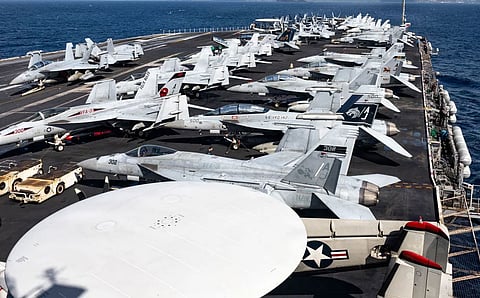
Dubai: Fresh satellite imagery and flight-tracking data point to a significant expansion of US military assets across Europe and the Middle East, underscoring rising tensions with Iran and fuelling renewed debate over whether Washington is preparing for a sustained military campaign.
Signals of possible escalation have also emerged from Israel. An Israeli official was quoted by Yedioth Ahronoth as saying a potential US attack on Iran “has become imminent.” The newspaper also cited sources familiar with discussions with President Donald Trump as indicating that he is inclined toward authorising military action.
Separately, Israel’s Channel 12 reported that Tel Aviv has completed preparations for the possibility of additional fronts being opened, underscoring growing regional concerns.
According to a Washington Post report, the US military has shifted more than 150 aircraft to bases in Europe and the Middle East in recent weeks, marking what analysts describe as one of the largest regional force concentrations in decades. The deployments accelerated after a second round of nuclear talks between the United States and Iran ended without a breakthrough on February 17.
The publication, citing satellite images and flight data, said the current US military footprint near Iran is “among the largest” seen since the period preceding the 2003 Iraq war — a comparison that immediately drew attention from defence observers.
Revolutionary Guards conduct military drills in Iran’s south
Iran’s Revolutionary Guards, the ideological arm of the military, are carrying out drills on the country’s southern shores of the Gulf, state media said Tuesday.
“Combined 1404 (2026) exercise of the IRGC Ground Forces has begun,” state TV reported, referring to this year in both the Iranian and Gregorian calendars.
The war games are focused on the south coasts but similar drills are happening in other parts of Iran, the report added.
They include drones, vessels, amphibious vehicles, ground-to-sea missiles and rockets as well as artillery, state TV said.
“Very good measures have been designed in various sectors, including missiles, artillery, drones, special forces, armoured vehicles and armoured personnel carriers,” Mohammad Karami, commander of IRGC ground forces, told state television.
He said the drills were being conducted “based on the threats that exist”, without elaborating.
President Donald Trump has repeatedly warned that military action remains an option if diplomacy fails to produce a nuclear agreement.
Iranian officials, while signalling openness to negotiations, have insisted that any deal would require time.
But the scale and composition of US deployments are prompting analysts to question whether Washington is preparing for something far beyond limited retaliatory strikes.
Helicopter crash kills 4
A helicopter belonging to the Iranian army’s Air Force crashed on Tuesday into a fruit market in the central province of Isfahan, killing four people, state media reported.
The pilot, co-pilot and two fruit vendors on the ground were killed, the official IRNA news agency said, attributing the crash to “a technical malfunction”.
The tragedy took place in the city of Khomeynishahr in Isfahan province.
Experts reviewing the movements told the Washington Post that the assets being assembled appear consistent with planning for a multi-day or even multi-week air campaign, rather than a short-duration show of force.
“They said the assets being assembled are indicative of a multiday campaign without a ground invasion,” the report noted.
Dana Stroul, a former deputy assistant secretary of defence for the Middle East, said the concentration of forces provides Washington with extraordinary operational flexibility.
“The massive level of force amassed means the US military can execute on whatever Trump decides — anything from a sustained, highly kinetic campaign to more targeted, limited strikes,” she said.
However, defence analysts cautioned that the current build-up may represent only an initial phase if policymakers intend a prolonged conflict. Mark Cancian of the Center for Strategic and International Studies said a weeks-long air campaign would require even greater resources.
“If the administration is planning for an extended, weeks-long air campaign, even more military assets will be needed,” Cancian said.
Carrier groups and warships signal escalation
At sea, US naval movements have drawn particular scrutiny. The United States already maintains more than a dozen warships in the Middle East, including the aircraft carrier USS Abraham Lincoln, multiple guided-missile destroyers, and littoral combat ships.
The arrival of the USS Gerald R. Ford — the world’s largest aircraft carrier — at Souda Bay in Crete this week adds another layer of strategic significance. It is rare for Washington to position two carrier strike groups within operational proximity of the region.
Analysts note that dual-carrier deployments typically signal preparation for either high-intensity combat operations or powerful deterrence messaging.
The last comparable concentration occurred during last year’s hostilities involving Iran and Israel, when US forces joined strikes on Iranian nuclear facilities.
‘Biggest build-up since 2003’
Col. Richard Kemp, a former British Army commander, described the present posture as historically significant.
“As I understand it, this is the biggest military buildup in the Middle East since 2003,” Kemp said, adding that the visible concentration of assets exceeds levels observed during last year’s fighting.
“I think it’s likely there will be a military strike, but I don’t think you’d say it’s inevitable,” he said. “I think it’s very likely.”
Kemp emphasised that the deployments reflect both offensive planning and defensive preparation. American bases and personnel across the Gulf would face immediate risk in the event of hostilities, particularly from Iranian missile forces and allied militias.
Duration, not just impact, now central
Unlike shorter confrontations, military planners may be preparing for a campaign measured in weeks rather than days, Kemp suggested.
“It could run into weeks. It could well be a fairly long, sustained bombing campaign against Iran,” he said.
Any escalation would also require simultaneous management of regional flashpoints. Iran-aligned groups, including the Houthis in Yemen and Hezbollah in Lebanon, retain varying degrees of strike capability despite recent setbacks.
“They would have to be dealt with either before a US strike in Iran, or at the same time,” Kemp said. “We’re talking about a much more intensive attack.”
For now, officials continue to frame the deployments as precautionary and deterrent. But the sheer scale of assets moving into theatre has intensified speculation across diplomatic and defence circles.
Taken together, analysts say, the military posture surrounding Iran is becoming increasingly difficult to interpret as routine.


