Iran-US tensions: Submarine hunter aircraft circles Strait of Hormuz
US Navy P-8 Poseidon hunts for subs, mines, boat swarms near Iran: Escalation signal?
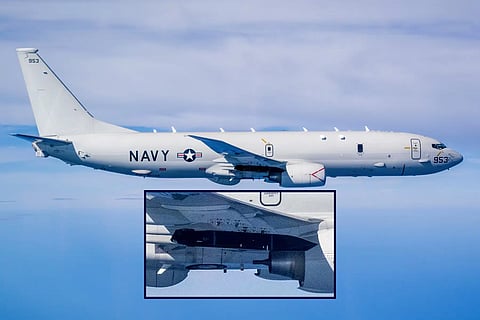
In what military analysts cite as “controlled escalation”, an armed US maritime patrol jet known as P-8A "Poseidon", has been reportedly seen orbiting near Iran's Bandar Abbas port and Qeshm Island in the Strait of Hormuz — the 39-km-wide (21 mile) chokepoint funneling 20% of global seaborne oil.
Flightradar24 tracked two P-8As, based on the Boeing 737, having taken off at around 3:30 am UTC on Sunday from the Sheikh Isa Air Base, then scanning the Strait and Gulf of Oman.
While certain sources described the mission as "routine" or "not unusual", this flying hunter is equipped to detect subs, mines, and boat swarms via sonobuoys and radar.


Iran is estimated to operate a submarine fleet of up to 30 vessels, primarily designed for shallow-water operations and potential mining operations in the Gulf and Hormuz.
Online buzz spiked amid US President Trump's 10-15 day nuclear deal deadline or “bad things” warning, with nearby carriers and aircraft shifts fuelling a posture of military “buildup”.
BBC noted a massive reposition of US forces from Europe to the Middle East, including fighter jets, refuellers, Patriot missile batteries, and heavy-lift aircraft as Trump pressures Tehran.
Pentagon calls it defensive deterrence, not provocation.
Analysts like OperativMM and StoryChase frame these as "routine" intel amid nuclear talks, monitoring Islamic Revolutionary Guard Corps (IRGC) assets — not a prelude to strikes.
In Budapest, Hungary, US Secretary of State Marco Rubio said US hopes to achieve a deal with Iran, despite the difficulties.
"I'm not going to prejudge these talks," Rubio said. "The president always prefers peaceful outcomes and negotiated outcomes to things."
US hunter
The P-8A Poseidon isn’t just a jet — it’s a flying sensor truck and hunter, built to pierce the fog of a sensitive maritime domain like the Hormuz Strait.
Orbiting near Bandar Abbas and Qeshm, it spots small boat swarms before they mass, detects minelaying patterns on the surface, tracks missile launch signatures to cue defenses, and flags “quiet” maritime moves signaling intent.
This real-time readability keeps the Hormuz Strait — passageway for 20% of global oil — transparent.
For Iran, Hormuz is prime leverage but also its biggest escalation trap; the P-8 establishes clarity of intent.
Dual-track strategy
Persistent ISR (intelligence, surveillance, reconnaissance) like this isn't random — it's deliberate preconditioning.
If Iran credibly threatens Hormuz closure, the global economy falls under the gun.
While diplomatic contacts over Tehran’s nuclear programme continue amid a massive US military buildup around it, Washington is keen to make the Strait less usable as a threat.
US media reported that Trump could be open to a "deal".
A possible common ground may be one that allows limited Iranian nuclear enrichment — if Tehran provides assurances that its programme leaves “no possible path” to a nuclear weapon.
However, the threshold for any agreement remains "exceptionally high", officials warned.
“President Trump will be ready to accept a deal that would be substantive and that he can sell politically at home,” a senior US official told Axios.
At the same time, the US military is preparing for worst-case scenarios, underscoring the administration’s "dual-track strategy" involving diplomatic negotiations, backed by overwhelming military deterrence.
Signal of controlled escalation
This posture reveals US beliefs: Iran might lash out in the maritime domain if pressured, yet America wants the first move contained — not all-out war.
The move could deter Tehran while keeping options surgical.
As carrier strike groups reposition, the P-8 could keep a close eye and help contain any Iranian gamble.
On February 10, the same US Navy P-8A Poseidon anti-sub patrol aircraft, alongside a MQ-4C Triton long-range unmanned aerial vehicle (UAV) reportedly conducted multiple reconnaissance flights along the southeastern coast of Iran, as per the Operative Information Center-OMM, citing foreign media reports.
Subsequently, the MQ-4C Triton drone performed an extended reconnaissance flight over international waters in the Gulf of Oman, near Iran's southeastern maritime borders.


