Russian, Chinese, Iran warships conduct 'surprise' Hormuz Strait exercises, amid massive US military Mideast buildup
Iran issues notice to airmen (NOTAM) warning pilots of hazards amid missile testing
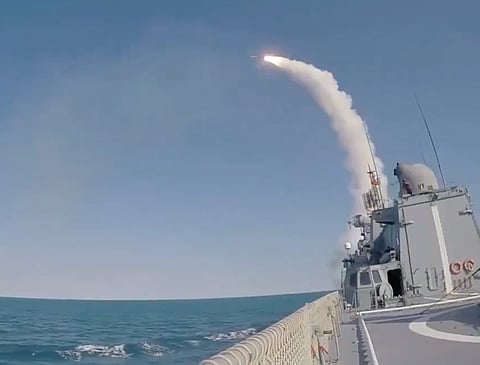
Russia, China and Iran have deployed naval vessels for joint exercises in the strategic Strait of Hormuz region under the “Maritime Security Belt 2026” framework, Russian and Iranian state media reported.
Global Surveillance, a geopolitics think-tank, described the move as a “surprise”.
The Moscow Times reported that the Russian Steregushchiy-class corvette Stoikiy has docked in Bandar Abbas ahead of joint drills with Iran’s navy set to begin later this week.
The exercises — expected to take place in the Gulf of Oman and northern Indian Ocean — are described by Tehran as efforts to strengthen maritime security and deepen “military cooperation”, amid a growing US warship presence in the region.
“Iran and Russia will hold joint naval drills this week,” The Moscow Times reported Wednesday (February 18), citing the Russian Defense Ministry and Iranian state media, even as US and Iranian negotiators meet in Switzerland for talks on Tehran’s nuclear programme.
Russia’s military released a video showing one of its warships, the corvette Stoiky, arriving at an Iranian port.
Global Surveillance, a geopolitics and tech analysis outfit, reported that Stoikiy docked at Iran's strategic naval base in Bandar Abbas, where Iran’s navy is based, on Wednesday morning (February 18).
Iran has also reportedly issued an active NOTAMs (Notices to Airmen), warning pilots of airspace hazards.
Global Update, in an X post, showed red pins for 22 gunfire zones mainly in the northwest, a purple pin for UAV/drone activity near Tehran, and a yellow pin with a southward trajectory line indicating rocket/missile tests toward the Gulf of Oman.
The notice signals Iran's preparations for testing advanced anti-ship ballistic missiles, in exercises that demonstrate military capabilities, potentially disrupting shipping lanes and escalating risks of miscalculation in the Persian Gulf.
US ‘prepared’ to strike
US media, meanwhile, reported that the American military is “prepared to strike Iran” as early as this weekend, though President Donald Trump has yet to make a final decision on whether to authorize such action.
The assessment, attributed to “sources familiar with the matter,” was first reported by CNN, which said operational planning has advanced to the point where assets in the region are positioned and ready, pending presidential approval.
The Wall Street Journal reported that senior Pentagon officials have presented the White House with a range of strike options — from limited, targeted attacks on Iranian nuclear and missile facilities to broader operations aimed at degrading Tehran’s regional military capabilities.
The Journal reported that discussions inside the administration have intensified in recent days as intelligence assessments warn that Iran could be approaching key nuclear thresholds.
Weighing arguments
The New York Times reported that Trump has been weighing competing arguments from advisers: some urging a decisive show of force to reestablish deterrence, others warning that even a limited strike could spiral into a wider regional conflict involving proxy militias and potentially Israel.
The Times added that US officials remain concerned about retaliation against American bases in the Gulf and naval assets operating in or near the Strait of Hormuz.
Volatile moment
Despite the heightened military posture — including the possible arrival of the USS Gerald R. Ford carrier strike group and repositioning of US Air Force aircraft — the president has publicly maintained that diplomacy remains his preferred course.
The convergence of advancing US strike preparations and ongoing indirect talks with Tehran underscores the volatile moment: Washington is signaling readiness to act — but leaving the final call squarely in the Oval Office.
More clarity from Iran sought
Leavitt said Wednesday that Iran was expected to provide more clarity on its negotiating position “in the next couple of weeks.”
She declined to say whether US President Donald Trump would refrain from military action during that period.
“I’m not going to set deadlines on behalf of the president of the United States,” Leavitt said, underscoring what administration officials have described as a strategy of maintaining “maximum leverage” while talks continue.
US Secretary of State Marco Rubio is expected to travel to Israel on February 28 to meet with Israeli Prime Minister Benjamin Netanyahu and brief him on the status of negotiations with Tehran, according to a State Department official.
Leavitt stressed that “diplomacy is always his first option,” but added that military action remains under consideration.
“There’s many reasons and arguments that one could make for a strike against Iran,” she said, noting that Trump was relying on advice from his national security team “first and foremost.”
Khamenei’s warning
Amid the tensions, Iran’s Supreme Leader Ali Khamenei issued a sharp rebuke of Washington, both in public remarks and in posts on X.
“The US President keeps saying that they have the strongest military force in the world,” Khamenei said. “The strongest military force in the world may at times be struck so hard that it cannot get up again.”
He also pointedly referenced US naval deployments near Iran, suggesting American warships operating in the region could be vulnerable — rhetoric that analysts say is aimed at deterring potential strikes while projecting resilience at home.
Military movement intensifies
Even as diplomacy continues, US military positioning intensifies.
The USS USS Gerald R. Ford — the most advanced aircraft carrier in the American fleet — could arrive in the region as soon as this weekend, following other force deployments.
US Air Force assets based in the United Kingdom, including refueling tankers and fighter aircraft, are also being repositioned closer to the Middle East, according to sources familiar with the movements.
The magazine U.S. News & World Report noted that such deployments are often designed as both deterrent signalling and contingency preparation, particularly during sensitive diplomatic windows.
Miscalculation risks
The White House’s refusal to commit publicly to a pause in military buildup or possible action — even while acknowledging ongoing talks — has fueled fears of miscalculation.
Analysts cited by Western media have warned that a single strike or regional incident could rapidly unravel the diplomatic track.
For now, the administration’s message remains deliberately ambiguous: diplomacy is the preferred path — but force has not been ruled out.


