Iran draws red line on uranium enrichment: ‘US military deployment does not scare us’
Top diplomat hardens stance after Oman talks, questioning Washington’s seriousness
Dubai: The latest round of US–Iran nuclear talks risks sliding from diplomacy back toward confrontation, as Tehran draws a firm red line on uranium enrichment and shrugs off Washington’s growing military presence in the region.
Iranian Foreign Minister Abbas Araghchi said Tehran would never give up enrichment, insisting that US military deployments — including an aircraft carrier strike group — would not intimidate the Islamic republic. His remarks came days after Iran and the United States resumed talks in Oman for the first time in years, even as sanctions, tariff threats and military pressure continue to shadow the negotiations.
“Why do we insist on enrichment and refuse to give it up, even if war is imposed on us?” Araghchi said at a forum in Tehran attended by Agence France-Presse. “Because no one has the right to dictate our behaviour.”
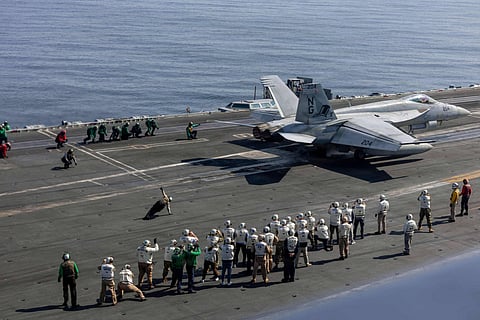
He dismissed US military deployments — including the arrival of the USS Abraham Lincoln strike group in the Arabian Sea — saying: “Their military deployment in the region does not scare us.”
Talks resume, trust remains thin
The comments came just days after Iran and the United States reopened talks in Oman — their first in years — aimed at reviving negotiations over Tehran’s nuclear programme. Iran is seeking the lifting of US sanctions, while Washington wants strict limits on enrichment.
Araghchi questioned Washington’s seriousness, pointing to the continuation of sanctions, tariff threats and military pressure even as talks resumed.
Also Read: Iran–US talks in Oman: What we know so far
“The continuation of sanctions and military actions raises doubts about the readiness of the other side for genuine negotiations,” he said, adding that Iran would assess US actions before deciding whether to continue talks.
US President Donald Trump described the Oman talks as “very good” and said more were planned, while Iranian President Masoud Pezeshkian called them “a step forward” — underscoring a sharp contrast in tone between Iran’s political leadership and its top diplomat.
‘Our atomic bomb is the power to say no’
Araghchi rejected Western and Israeli accusations that Iran is seeking nuclear weapons, calling them a pretext for pressure.
“They fear our atomic bomb, while we are not looking for one,” he said. “Our atomic bomb is the power to say ‘no’ to the great powers.”
While Iran insists its programme is peaceful, the International Atomic Energy Agency has said Tehran has enriched uranium up to 60% purity — a short technical step from weapons-grade levels. Iran says a religious decree by Supreme Leader Ayatollah Ali Khamenei forbids building a bomb.
Israel steps in, Netanyahu to meet Trump
As talks remain fragile, Israel has moved to assert its position. Israeli Prime Minister Benjamin Netanyahu will meet President Trump in Washington on Wednesday, his office said, with Iran expected to dominate the agenda.
Netanyahu’s office said any agreement must curb Iran’s ballistic missile programme and end support for militant groups such as Hezbollah and Hamas — demands Tehran has repeatedly rejected.
Israel believes Iran is pursuing a nuclear weapon and wants its programme dismantled. Iran denies the charge.
Threats and warnings
In comments that heightened regional anxiety, Araghchi warned that if the US attacked Iran, Tehran would retaliate against American bases in the region, acknowledging it could not strike the US mainland directly.
He cited “very deep distrust” following last year’s Israel–Iran war, when US forces bombed Iranian nuclear sites during negotiations — a point he said showed how talks could suddenly collapse into conflict.
Gulf Arab states have privately expressed fears that any military escalation could trigger a wider regional war, with memories still fresh from the 12-day Israel–Iran conflict.
What comes next
It remains unclear when — or whether — a second round of US–Iran talks will take place. While Trump says Iran “wants a deal very badly,” Araghchi warned that pressure and threats could derail diplomacy entirely.
“If you take a step back in negotiations,” he said, “it is not clear where it will end.”
For now, enrichment remains Tehran’s red line — and the region waits to see whether talks lead to compromise, confrontation, or something far more dangerous.


