Trump renews hard-line Iran stance, says war must end as 'armada' heads to region
Trump warns Iran with fresh military deployments while signalling openness to talks
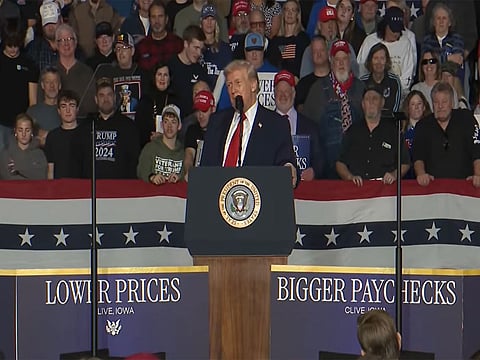
Iowa: US President Donald Trump reiterated his hard-line stance on Iran during a campaign-style event in Clive, Iowa, emphasising both military pressure and the possibility of negotiations with Tehran as tensions persist over the crackdown on protesters and regional security.
Pointing to a significant US military buildup in the Middle East, Trump said: "By the way, there's another beautiful armada floating beautifully toward Iran right now. So we'll see. I hope they make a deal.


'I hope they make a deal'
"I hope they make a deal. They should have made a deal the first time. They'd have a country."
His comments highlighted Washington's show of force while also leaving the door open for diplomacy.
That dual message was echoed in a separate interview with Axios, where Trump said the situation with Iran is "in flux," noting that he has moved major American military assets into the Middle East and suggesting that Tehran may be open to a diplomatic solution, according to The Times of Israel.
Amplifying the contrast between force and negotiation, Trump told Axios: "We have a big armada next to Iran. Bigger than Venezuela," and added that officials in Tehran have repeatedly signalled a willingness to engage.
"They want to make a deal. I know so. They called on numerous occasions. They want to talk," he said.
Conditions
Following the interview, a senior US official briefed reporters that the United States remains prepared to enter talks if Iran reaches out under clear conditions.
"With regard to Iran, we are open for business. If they want to contact us, and they know what the terms are, then we're going to have the conversation," the official said.
Earlier this month, US special envoy Steve Witkoff outlined conditions the administration says would be necessary for any deal, including a ban on uranium enrichment, the removal of already-enriched uranium, capping Iran's long-range missile stockpile, and reversing support for regional proxy forces.
While Tehran has expressed willingness to negotiate, it has rejected those terms outright.
Trump also referenced previous military action against Iran's nuclear infrastructure.
He asserted that US strikes in June had "obliterated" the country's nuclear capacity by hitting three facilities, though the extent of disruption to Iran's enrichment programme remains unclear.
"People have been waiting for 22 years to do that," he said while referring to the June bombing campaign.
Maximum pressure
The president's tough stance follows his first-term decision to withdraw the United States from the 2015 nuclear agreement and pursue a "maximum pressure" campaign aimed at weakening Tehran through sanctions.
Despite his warnings, Trump has not yet decided whether to authorise further military action against Iran, even after previously pledging to act if the regime killed protesters -- a crackdown that resulted in thousands of deaths.
He is scheduled to hold further consultations with his national security team this week, with military options likely to expand following the arrival of the USS Abraham Lincoln aircraft carrier in Middle Eastern waters, according to The Times of Israel.
Trump also staed that during a 12-day war last June, he prevented an Iranian missile attack on Israel by authorising Jerusalem to strike first, underscoring his administration's emphasis on combining military pressure with diplomatic overtones.


