Aircraft carrier USS Abraham Lincoln in the Middle East: What you need to know
'Floating city' with 5,680 soldiers, accompanied by destroyers, arrives in the Middle East
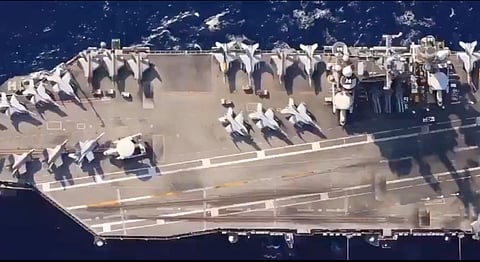
From South China Sea live-fire drills to Middle East flashpoint, the nuclear-powered behemoth USS Abraham Lincoln (CVN-72) — flanked by destroyers Spruance, Michael Murphy, and Frank E. Petersen Jr. — steamed into the Middle East waters on January 26, 2026 amid the ongoing standoff in the region.
This $6.8-billion naval juggernaut packs a massive firepower. It's not just a ship: it is a floating city of war, a tech marvel, and a symbol of American naval dominance.
The size, power, and reach of these massive vessels enable the US Navy to maintain unparalleled control over the seas, ensuring that no other nation can challenge its supremacy on the water.
This flat-top, the fifth vessel in the Nimitz-class line of nuclear-powered aircraft carriers, is a cornerstone of US naval dominance.


Flagship of US carrier strike group
Named in honour of the 16th President of the United States, Abraham Lincoln, who embodied leadership during the Civil War, the ship symbolises American resolve and technological prowess.
At more than 1,000 ft long and weighing over 100,000 tonnes, the USS Abraham Lincoln aircraft carrier is a true giant.
But its real power comes from what it carries: fighter jets, advanced weapon systems, early warning aircraft, and a crew of over 5,630 sailors.
This floating fortress can carry up to 90 aircraft, providing the US military with a formidable air power platform that can operate anywhere in the world.
Symbol of military might
But how does the US Navy use this incredible power to control the oceans?
The answer lies in the Carrier Strike Group. In a nutshell, it’s a fleet of ships surrounding the aircraft carrier, including destroyers, cruisers, and submarines.
Together, these vessels create a formidable force able to dominate any region of the world — projecting power, influence, and military might.
Air superiority
Perhaps the most important role of the aircraft carrier is its ability to maintain air superiority.
In modern warfare, control of the skies is often the deciding factor between victory and defeat. The fighter jets launched from US aircraft carriers, such as the F/A-18 Hornet or F-35 Lightning II, are among the most advanced in the world.
They can engage enemy aircraft, defend against missile threats, provide close air support for ground forces, and strike targets deep behind enemy lines — all from the deck of the aircraft carrier.
But air superiority isn’t just about fighter jets.
US aircraft carriers also deploy early warning and surveillance planes such as the E-2C Hawkeye.
These aircraft provide 360° coverage, scanning for potential threats over vast areas and ensuring that the carrier group can detect and neutralise dangers long before they get close.
The stealth capabilities of aircraft like the F-35 are also crucial to maintaining control of the air.
These fighters can infiltrate enemy airspace without being detected, allowing them to strike high-value targets with precision.
This combination of stealth, speed, and firepower makes the US carrier strike group an undefeated force in modern combat.
Flagship of Carrier Strike Group 3
The US currently has 11 Carrier Strike Groups, the most of any military.
As the flagship of Carrier Strike Group 3, USS Abraham Lincoln operates under the US Pacific Fleet, with its homeport at Naval Air Station North Island in San Diego, California.
Deployed November 2025 from San Diego, she has swapped Indo-Pacific patrols for regional tensions — bolstering options as fires rage.
Since entering service, the carrier has projected power across global hotspots, supporting combat operations, humanitarian aid, and deterrence missions.
Construction
Construction of the USS Abraham Lincoln commenced with a contract awarded to Newport News Shipbuilding on December 27, 1982.
The keel was laid on November 3, 1984, in Newport News, Virginia. The hull was launched on February 13, 1988, and christened the same day by sponsor JoAnn K. Webb, wife of former Secretary of the Navy James H. Webb.
Acquired by the Navy on October 30, 1989, it was formally commissioned on November 11, 1989, at a cost of $2.24 billion (about $6.82 billion in 2024 dollars).
This marked the beginning of its service life, designed for a 50-year operational span with mid-life refuelling.
2 reactors, 4 turbines
In terms of specifications, the carrier displaces approximately 104,300 long tons fully loaded, stretches 1,092 feet in overall length (1,040 feet at the waterline), and boasts a beam of 252 feet.
Its draft (vertical distance from the waterline down to the lowest point of the hull) reaches up to 41 feet.
Propulsion comes from two Westinghouse A4W nuclear reactors, driving four steam turbines and shafts to produce 260,000 shaft horsepower, enabling speeds over 30 knots (35 mph) and virtually unlimited range — limited only by crew endurance and supplies, typically 20-25 years between refuellings.
Crew
The ship accommodates a crew of 3,200 sailors plus an air wing of 2,480 personnel, totaling around 5,680.
Capabilities are vast, centred on power projection.
The flight deck supports up to 90 fixed-wing aircraft and helicopters, facilitating rapid launches and recoveries for strike, reconnaissance, and support roles.
Armament includes two Mk 57 Mod 3 Sea Sparrow missile launchers, two RIM-116 Rolling Airframe Missile systems, and two Phalanx Close-In Weapon Systems (CIWS) for defense against missiles and aircraft.
Advanced sensors like AN/SPS-48E 3-D air search radar, AN/SPQ-9B target acquisition, and electronic warfare suites such as SLQ-32A(V)4 enhance situational awareness and countermeasures.
Upgrades, including a 2013-2017 Refueling and Complex Overhaul (RCOH) costing billions, modernised combat systems, navigation, and integrated F-35C operations, ensuring compatibility with fifth-generation stealth fighters.
Air Wing
The air wing, Carrier Air Wing Nine (CVW-9), features squadrons like:
VFA-14 and VFA-151 with F/A-18E Super Hornets for air superiority;
VMFA-314 with F-35C Lightning II for stealth strikes;
VAQ-133 with EA-18G Growlers for electronic warfare;
VAW-117 with E-2D Hawkeyes for airborne early warning; and
helicopter units HSC-14 and HSM-71 with MH-60 variants for search, rescue, and anti-submarine duties.
This mix allows versatile missions from precision bombing to maritime interdiction.
Operation Desert Storm
Notable deployments highlight its legacy. In 1991, it supported Operation Desert Storm with combat air patrols.
The 2002-2003 cruise aided Operations Enduring Freedom and Iraqi Freedom, logging a record 290-day deployment.
Humanitarian efforts included evacuating 45,000 after the 1991 Mount Pinatubo eruption and delivering millions of pounds of aid post-2004 Indian Ocean tsunami.
In 2019-2020, it endured a 295-day stint amid Iran tensions.
More recently, in 2024, it struck Houthi targets in Yemen and deterred Iranian aggression in the Middle East.
Deployments
As of January 2026, the USS Abraham Lincoln is on a high-stakes deployment in the US Central Command area, operating in the 5th Fleet amid escalating tensions and regional instability.
The Carrier Strike Group, which departed San Diego on November 21, 2025, includes the carrier, CVW-9, and destroyers USS Frank E. Petersen Jr. (DDG-121), USS Spruance (DDG-111), and USS Michael Murphy (DDG-112).
Redirected from Pacific
Redirected from Indo-Pacific operations — including time in the Philippine and South China Seas — it entered the Indian Ocean by January 20 and the Middle East by January 26, bolstering deterrence and readiness for potential conflicts.
This mission underscores its enduring role in safeguarding global security.
The power of US aircraft carriers is not just in their ability to wage war. They are also essential tools for global diplomacy.
Their presence alone can influence international relations, enforce trade routes, and ensure the stability of key regions around the world.
Summary: Major Milestones
1984–1989: Construction and commissioning.
1991: Desert Storm and humanitarian evacuation (Operation Fiery Vigil).
2002–2003: Support of post-9/11 operations.
2013–2017: Reactor refuelling and modernisation.
2018: Homeport shift to Pacific.
2022: Major exercises and public outreach events.
2024–2025: Global deployments spanning Indo-Pacific & Middle East.
2026: Strategic deployment toward Middle East amid geopolitical tensions.


