Pentagon prepares second carrier strike group for Middle East
USS George H.W. Bush may join USS Abraham Lincoln amid rising tensions with Iran
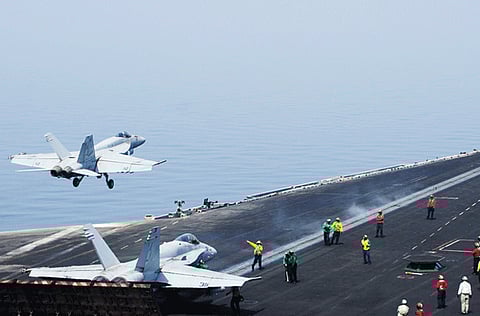
The Pentagon has reportedly instructed a second aircraft carrier strike group to prepare for deployment to the Middle East, as President Donald Trump ramps up military pressure on Tehran amid stalling nuclear negotiations.
Set to sail toward the region is the USS George H.W. Bush Carrier Strike Group (GHWBCSG), also known as Carrier Strike Group 10 (CSG-10), a massive naval force with overwhelming firepower enough to shred enemy territory to smithereens in a few hours.


The Fleet: USS George H.W. Bush
The USS George H.W. Bush (CVN-77), also known as GHWBCSG, is the flagship of the naval flotilla currently conducting training exercises off the coast of Virginia, is the vessel tapped for the potential mission.
Officials indicate that the carrier’s training schedule could be expedited to allow for a departure within the next two weeks.
Current status (2026)
Recent reports indicate the CVN-77, the last and most advanced ship of the Nimitz class, is currently in a high state of readiness.
It concluded a major 8-month deployment in early 2023.
As of February 2026, has been prepared for rapid redeployment to the Middle East/Mediterranean to counter regional threats.
Here is the breakdown of its composition, personnel, and capabilities:
Ships and composition
A typical strike group consists of the carrier, its air wing, and a "ring of steel" provided by escort ships.
The flagship: USS George H.W. Bush (CVN-77), a nuclear-powered supercarrier.
Guided-missile cruiser: Usually one Ticonderoga-class cruiser (e.g., USS Leyte Gulf) for command and control of air defense.
Destroyer squadron (DESRON 26): Typically 3–4 Arleigh Burke-class guided-missile destroyers (e.g., USS Nitze, USS Truxtun, USS Delbert D. Black).
Submarines: While rarely publicised for stealth reasons, 1–2 nuclear-powered attack submarines (Los Angeles or Virginia class) usually provide underwater screening.
Support ships: A fast combat support ship (T-AOE) often joins to provide fuel, ammunition, and supplies.
Personnel and Aircraft
The strike group is effectively a floating city with thousands of personnel and a specialised air wing.
People: Approximately 6,000 to 7,500 personnel total.
Ship’s Crew: ~3,500 sailors to operate the carrier.
Air Wing: ~2,500 personnel (pilots and maintainers).
Escorts: ~300+ sailors per destroyer/cruiser.
Aircraft (Carrier Air Wing 7): Roughly 60–90 aircraft, including:
F/A-18E/F Super Hornets (Strike Fighters)
EA-18G Growlers (Electronic Warfare)
E-2D Advanced Hawkeyes (Airborne Early Warning)
MH-60R/S Seahawks (Helicopters for search & rescue and anti-submarine warfare)
C-2A Greyhound or CMV-22B Osprey (Logistics/Transport)
When deployed, it will join the USS Abraham Lincoln (CVN-72), which reached the Arabian Sea in late January.
This would mark the first time in nearly a year that two US supercarriers have operated simultaneously in the region.


