Strait of Hormuz will be closed for several hours for live fire drills, Iran says
It's a vital oil export route which connects oil producers with Gulf of Oman, Arabian Sea
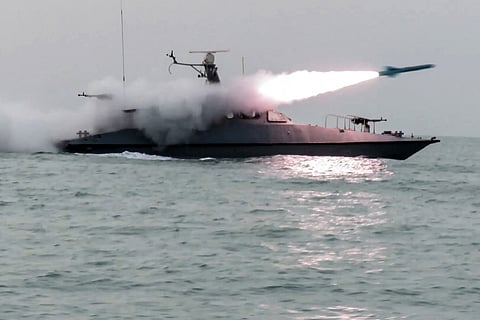
Dubai: Parts of the Strait of Hormuz will close for a few hours on Tuesday due to ‘security precautions’ for shipping safety, semi-official Fars news agency reported, as the Revolutionary Guards conduct military drills in the waterway.
The strait is the world’s most vital oil export route, which connects the biggest oil producers, such as Saudi Arabia, Iran, Iraq and the United Arab Emirates, with the Gulf of Oman and the Arabian Sea.
This is the first time that Iran has closed parts of the strait since the US began threatening Iran with military action.
Earlier, Iranian media also announced that Iran had fired live missiles towards the Strait of Hormuz.
The Revolutionary Guards announced a maritime military exercise on Monday in waterways that are crucial international trade routes through which 20% of the world’s oil passes.
The semi-official Tasnim news agency, which is close to the paramilitary Guard, said missiles launched inside Iran and along its coast had struck their targets in the Strait of Hormuz.
Talks with US
The announcements come as Iranian state TV reported on Tuesday that the negotiations with the US will be indirect and will focus only on Iran’s nuclear programme, not domestic policies including its bloody crackdown on protesters last month.
US President Donald Trump has repeatedly threatened to use force to compel Iran to agree to constrain its nuclear programme. Iran has said it would respond with an attack of its own. Trump has also threatened Iran over its deadly crackdown on recent nationwide protests.
The first round of talks on February 6 were held in Oman and were indirect, with SUVs flying the American flag entering the palace venue only after it appeared the Iranian officials had left.
Similarly to the last round of talks, the Iranians appeared to be meeting with Omani mediators separately from the Americans on Tuesday.
Trump's envoys Steve Witkoff and Jared Kushner were traveling for the new round of talks. US Secretary of State Marco Rubio, visiting Budapest, Hungary, said Monday that the US hopes to achieve a deal with Iran, despite the difficulties. "I'm not going to prejudge these talks," Rubio said. "The president always prefers peaceful outcomes and negotiated outcomes to things."
Iranian Foreign Minister Abbas Araghchi, who is leading the talks for Iran, met with the head of the UN nuclear watchdog agency Monday in Geneva.
"I am in Geneva with real ideas to achieve a fair and equitable deal," Araghchi wrote on X. "What is not on the table: Submission before threats."