Strait of Hormuz explained: Why the Iran war threatens global energy flows
War in the Gulf imperils the route that carries one-fifth of global oil supplies
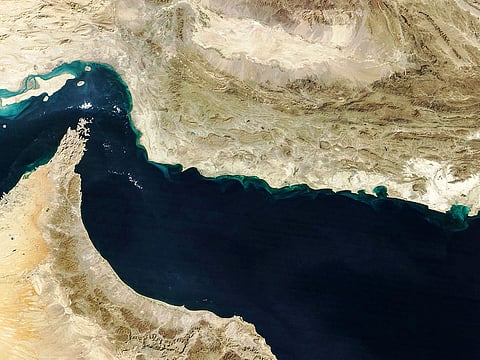
The war triggered by US-Israeli strikes on Iran has pushed one of the world’s most critical maritime chokepoints — the Strait of Hormuz — to the centre of a rapidly escalating global energy crisis. Tanker traffic through the narrow passageway has plunged as shipping companies suspend operations and insurers withdraw coverage, sending oil prices soaring and forcing Gulf producers to cut exports.
Shipping activity through the strait has fallen by as much as 90 per cent, according to shipping analytics firm Kpler, as shipowners grow reluctant to risk vessels in waters increasingly threatened by missiles, drones and naval confrontation. Oil prices surged above $100 per barrel and briefly approached $120, reflecting fears that a prolonged disruption could choke off a major share of the world’s energy supply.
The mounting disruption has triggered an international scramble to keep the shipping route open. The United States has said its navy could escort oil tankers through the strait, while France and other allies are discussing a mission aimed at gradually restoring maritime traffic. At stake is the continued flow of energy from the Gulf to the global economy.
Below is a guide to the Strait of Hormuz — where it is located, why it is so important and what could happen if the disruption continues.
Where is the Strait of Hormuz?
The Strait of Hormuz is the narrow maritime passage linking the Arabian Gulf to the Gulf of Oman and the Arabian Sea, providing the only sea route through which oil and gas produced in the Gulf can reach global markets.
The strait lies between Iran to the north and Oman’s Musandam Peninsula to the south, with the United Arab Emirates located just west of the waterway. At its narrowest point the channel is about 33 kilometres wide, although the shipping lanes used by tankers are far narrower, only a few kilometres across in each direction.
Despite being bordered by the territorial waters of Iran and Oman, the strait is legally regarded as an international transit route, allowing commercial vessels from all countries to pass through it.
Why is the Strait of Hormuz so important?
The strait is widely regarded as the most critical oil transit chokepoint in the world. Every day enormous volumes of energy supplies move through this narrow corridor.
Key figures illustrate its significance:
Around 20 million barrels of oil per day pass through the strait.
This represents roughly one-fifth of global oil consumption.
About 20 per cent of global liquefied natural gas (LNG) shipments also transit the route.
The waterway serves as the main export route for energy produced by Saudi Arabia, Iraq, Kuwait, the UAE, Qatar, Bahrain and Iran. Much of that oil is shipped to Asia, particularly China, India, Japan and South Korea.
Because global supply chains depend on these exports, even limited disruptions to shipping through the strait can send shockwaves through energy markets.
Stay updated: Get the latest faster by downloading the Gulf News app - it's completely free. Click here for Apple or here for Android. You can also find it on the Huawei AppGallery.
What has happened to shipping during the current crisis?
The war has sharply reduced the number of tankers passing through the strait. Many of the world’s largest shipping companies have suspended operations in the area, citing security risks and the soaring cost of war-risk insurance.
Hundreds of vessels are now stranded inside the Gulf or waiting outside its entrance, while others have diverted to safer routes. Although a few tankers have still attempted the crossing — sometimes switching off tracking signals — the overall flow of energy shipments remains far below normal levels.
The slowdown has quickly begun affecting oil production across the Gulf as exporters struggle to move crude out of the region.
Strait of Hormuz: Key numbers
About 20 million barrels of oil per day pass through the strait
That equals roughly 20% of global oil consumption
Around 20% of global LNG exports also move through the route
The strait is about 33 km wide at its narrowest point
Shipping traffic has dropped by around 90% during the current crisis
Oil prices briefly approached $120 per barrel amid the disruption
What happens to oil production if the strait is blocked?
When tankers cannot leave the Gulf, oil producers face a rapid logistical bottleneck. Export terminals fill with crude and storage facilities reach capacity, forcing companies to cut production.
The current disruption has already triggered such cuts. Iraq has sharply reduced output, while other Gulf countries have also scaled back production as storage tanks filled. Qatar has halted some liquefied natural gas exports after attacks on energy infrastructure.
Because alternative export routes are limited, most of the oil produced in the region cannot reach global markets without passing through the Strait of Hormuz.
How has the crisis affected oil prices and the global economy?
Energy markets reacted almost immediately to the disruption. Oil prices surged above $100 per barrel and briefly approached $120 as traders priced in the risk of a major supply shock.
Higher oil prices quickly feed through the global economy. Fuel costs rise for airlines, shipping companies and manufacturers, pushing up prices for goods and transportation. Economists warn that sustained prices above $100 could increase inflation and slow economic growth.
The shock has revived comparisons with past energy crises that triggered recessions and global inflation, including the oil shocks of the 1970s and the price spike following Russia’s attack of Ukraine in 2022.
Who controls the Strait of Hormuz?
Geographically, the strait lies between Iran and Oman, but legally it is considered an international waterway governed by the principle of freedom of navigation.
In practice, however, the waterway sits at the centre of a heavily militarised region. Iran maintains naval bases and missile batteries along its northern coast, while the United States and allied naval forces patrol nearby waters to protect commercial shipping.
This overlapping military presence means that control of the strait has long been a source of tension.
Can Iran really close the Strait of Hormuz?
Iran has the capability to disrupt shipping through the strait, but permanently sealing it off would be extremely difficult.
Iranian forces could interfere with maritime traffic in several ways:
Deploying naval mines in shipping lanes
Launching missiles or drones at vessels
Harassing tankers using fast attack boats
Such tactics could temporarily slow or halt shipping. However, a sustained blockade would likely trigger a major international naval response aimed at reopening the route.
There is also a strategic constraint: Iran itself depends on the strait to export its own oil. A long-term closure would therefore harm its own economy.
If there were a battle for the Strait of Hormuz, how would it be fought?
A confrontation over the strait would likely centre on control of shipping lanes rather than large naval battles.
Iran’s strategy would probably rely on asymmetric tactics such as mines, drones, missile strikes and harassment by small naval craft designed to disrupt traffic and raise risks for commercial vessels.
The response from the United States and its allies would likely involve clearing mines, escorting tankers with warships and using air power to neutralise missile sites or naval bases threatening the shipping corridor.
Similar operations occurred during the “Tanker War” of the 1980s, when the United States escorted oil tankers through the Gulf after attacks on shipping during the Iran-Iraq conflict.
Could the crisis trigger a global energy shock?
Many analysts warn that a prolonged disruption in the Strait of Hormuz could become the largest oil supply shock in decades.
If exports from the Gulf remain blocked for an extended period, global markets could lose millions of barrels of daily supply. Strategic petroleum reserves could help offset the disruption temporarily, but they would not fully replace the enormous volume of oil normally moving through the strait.
For this reason, governments and energy companies around the world are watching developments in Hormuz closely. The reopening of the waterway may ultimately determine whether the current spike in oil prices proves temporary — or evolves into a deeper global energy crisis.
What happens if the Strait of Hormuz stays closed for weeks?
A prolonged disruption in the Strait of Hormuz could trigger one of the most severe energy shocks in modern history. With around 20 million barrels of oil per day normally flowing through the waterway, even a partial shutdown quickly tightens global supply.
Strategic petroleum reserves held by major economies could help cushion the immediate impact, but they would not fully replace the enormous volume of energy exports from the Gulf. As the disruption continues, oil producers outside the region — including the United States, Brazil and Norway — would struggle to increase output quickly enough to compensate.
Sustained oil prices above $100 per barrel would push up transportation and manufacturing costs worldwide, fuelling inflation and slowing economic growth. Analysts say prices could climb toward $150 per barrel or higher if Gulf exports remain blocked for an extended period.
The longer the strait remains disrupted, the greater the risk that the crisis shifts from an energy shock to a broader economic one, potentially triggering inflation spikes, financial market volatility and slower growth across major economies.

