Surge in construction at Iran’s deeply buried Pickaxe Mountain nuclear site seen
New satellite images show Iran expanding fortified underground site near Natanz
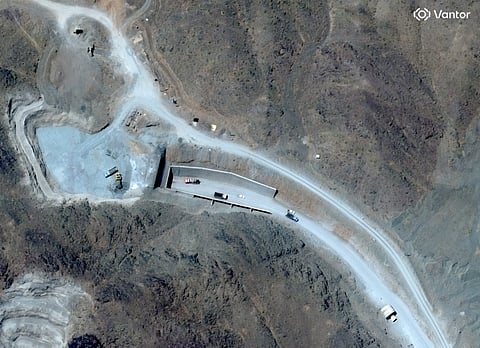
Satellite imagery has revealed a significant increase in construction activity at Pickaxe Mountain, a deeply buried Iranian facility near Natanz that has attracted growing attention from US and Israeli intelligence officials.
A new analysis by the Center for Strategic and International Studies (CSIS) examined six years of satellite imagery and found that construction activity in 2026 is higher than at any previous point observed at the site, CNN reported.
The work includes:
reinforcement of underground access points;
paving and expansion of internal roads;
hardening around entrances;
removal of excavated material;
continued work on the underground complex.
CSIS said the imagery cannot confirm an Israeli intelligence claim that Iran moved uranium centrifuges and centrifuge components into the facility.


The analysts also said the site does not currently appear to be operating as an enrichment facility, based on the absence of certain observable activity.
But the location is strategically important.
Pickaxe Mountain facility
Pickaxe Mountain is a heavily buried granite facility close to Iran's Natanz nuclear complex. Its depth and geology could make it extremely difficult to destroy with conventional weapons.
CSIS said even America's largest conventional bunker-buster, the GBU-57 Massive Ordnance Penetrator, could have difficulty destroying the facility completely.
The development comes at an especially sensitive moment.
On Wednesday, the International Atomic Energy Agency's (IAEA) board voted to report Iran to the UN Security Council over its failure to provide sufficient cooperation and access relating to its nuclear programme.
The resolution passed 23-3, with Russia and China opposing it.
Enriched uranium
Reuters reported that Iran had not allowed IAEA inspectors to return to the bombed locations or verify what remained of its enriched-uranium stocks.
The IAEA estimates Iran holds about 440.9 kilograms of uranium enriched to 60%, a stockpile that could theoretically provide enough material for multiple nuclear weapons if further enriched and weaponised.
That quantity is viewed by the agency as a serious proliferation concern because further enrichment, if a political decision were made, could shorten the time needed to produce weapons-grade material.
The IAEA’s inspectors have not been able to return to Iranian facilities hit in the conflict, and the agency cannot verify the location, quantity or condition of Iran’s declared enriched-uranium stocks, including uranium enriched to 60% U-235.
That level is below the roughly 90% commonly associated with weapons-grade uranium but is much closer to it than the enrichment levels generally used for civilian power-reactor fuel.
The agency’s inability to verify non-diversion does not establish that material has been diverted to weapons work.
It means the safeguards system lacks the access, continuity of knowledge and physical inspection needed to make that determination.
Bigger danger
The combination of restricted UN inspections, an unverified stockpile of uranium enriched up to 60% and evidence of an apparently intact, partially underground structure at Natanz has deepened uncertainty over Iran’s nuclear programme.
The IAEA says it cannot verify the location or status of Iranian enriched-uranium stocks at bombed facilities, while the Washington-based Institute for Science and International Security (ISIS) has identified a hardened structure that it assesses was likely intended to support large-scale enrichment.
Neither finding, by itself, proves Iran is rebuilding a nuclear-weapons capability.
But the uncertainty could make diplomacy more difficult and military planning more dangerous.
If the US concludes that Iran is shifting nuclear-related activity into hardened or underground sites, the task would move beyond attacking known facilities to locating, identifying and disabling assets designed to survive airstrikes — a challenge that could increase the risk of a wider confrontation.


