Trump warns of possible new Iran strikes; Araghchi vows ‘doomsday war’ — but remains open to diplomacy
Washington rejects Iran’s Hormuz proposal as Tehran claims 19 civilian ships targeted
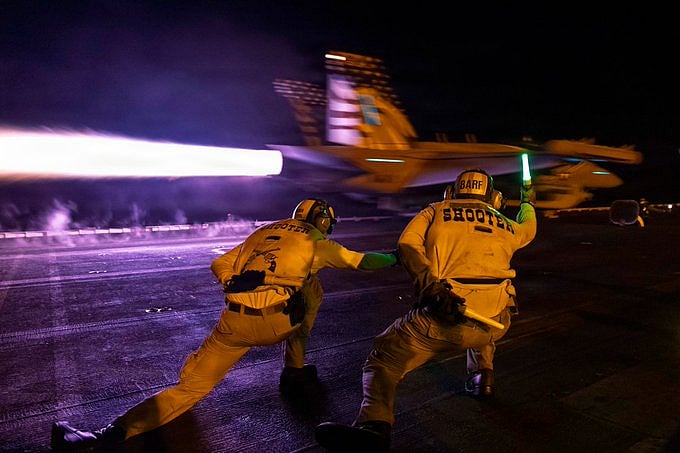
Washington: US President Donald Trump has warned that "further strikes" against Iran remain possible before November’s midterm elections, as Tehran vowed to resist renewed attacks and the confrontation over the Strait of Hormuz intensified.
Trump said that additional military action was possible, although he also predicted the war would end “very soon”.
He said preventing Iran from acquiring a nuclear weapon remained a central US objective.
He declined to rule out strikes before the November elections.
"I think what's going to happen is we're going to win the war very soon," the president told Fox News at the Presidents Cup at Medinah Country Club. Trump predicted oil prices will fall once the war ends, and said he believes the U.S. is winning the war through both economic pressure and military action.
Get it: Fast, verified news for FREE ... download the Gulf News app — simply click here
Aragchi: Iran ready for ‘doomsday war’, but open to diplomacy
Iranian Foreign Minister Abbas Araghchi, meanwhile, said Tehran was prepared for the conflict to resume, even if it escalated into what he called a “doomsday war”.
“We stand firm in the face of any new aggression, even if it comes to a doomsday war,” Araghchi told NBC’s Meet the Press on Sunday.
US Naval Blockade of Iran: Enforcing compliance and preventing commercial transit to or from Iranian coastal areas and ports.
He said Iran had changed its military tactics after previous rounds of fighting but remained open to diplomacy, leaving the decision to pursue negotiations with Trump.
Araghchi also said Tehran was awaiting an official US response through mediators to its proposal for ending the conflict. Under the plan he described, the Strait of Hormuz would reopen on the sixth day after agreed US steps, followed by negotiations on a final agreement on the seventh day.
Washington rejects Iran’s proposal
US Ambassador to the United Nations Mike Waltz described Tehran’s proposal as a “pretty cynical attempt” to obtain sanctions relief, end the US blockade of Iranian ports and gain access to billions of dollars in frozen assets.
Waltz said Washington lacked confidence in Iran following what the US considers violations of an earlier understanding, including attacks on international shipping.
He added that Trump would keep military options available and said any agreement must address Iran’s highly enriched uranium and its ability to resume enrichment.
Iran claims 19 ships were targeted
The Strait of Hormuz remained a major flashpoint after Iran’s Fars news agency, which is affiliated with the Islamic Revolutionary Guard Corps, reported that Iranian forces targeted 19 vessels over Friday and Saturday.
According to Fars, 12 vessels were targeted on Friday night and seven more on Saturday after attempting to cross outside routes authorised by Tehran.
The agency did not identify the vessels or provide details of their flags, cargoes or destinations. The claims have not been independently verified, and the reports do not establish whether the ships were damaged, detained or forced to turn back.
Iranian authorities have warned shipping companies against using routes they consider unauthorised, threatening restrictions on vessels associated with non-compliant operators.
However, claims that the waterway is completely empty should be treated cautiously.
US Energy Secretary Chris Wright said on Sunday that oil flows through Hormuz were averaging nearly 13 million barrels a day, with more than 20 million barrels passing through on one day last week. The figures indicate that substantial oil volumes continue to move despite the security risks.
IRGC claims second US underwater vehicle seized
The IRGC also said its navy had seized a second US underwater vehicle in the Strait of Hormuz.
IRGC spokesman Hossein Mohebbi identified the device as an Mk 18 Mod 2 Kingfish autonomous underwater vehicle and described it as a technological and intelligence prize.
The claim was reported by Iran International. The announcement, by itself, does not establish the circumstances of the alleged seizure or independently verify Iran’s account.
Canada condemns Iran’s threats to shipping
Canada’s Foreign Minister Anita Anand said Iran’s threats to navigation rights in Hormuz were a direct affront to international law.
In remarks to the United Nations General Assembly on September 26, Anand said Canada regarded Iran as a major threat to regional peace and security and insisted it must never acquire a nuclear weapon.
She said Canada would use available measures, including targeted sanctions, and expressed support for Gulf and European partners condemning Iranian attacks in the region.
Canada announced additional sanctions on five Iranian individuals and five entities on September 23, citing their alleged roles in repression and human rights violations.
What happens next?
Despite Trump’s public rejection of Iran’s proposal, diplomatic contacts have not entirely stopped. Iran International reported that Trump expected further discussions during the week, with Qatar continuing to mediate, while Iran’s delegation said it was awaiting Washington’s response.
The central disagreement remains the sequence of concessions: Tehran wants relief from the US blockade and economic pressure in exchange for reopening Hormuz, while Washington is resisting those conditions and demanding assurances on Iran’s nuclear programme.
With both sides keeping military options open, the security of commercial shipping and the prospect of renewed strikes remain major risks for regional stability and global energy markets.
Network Links
GN StoreDownload our app
© Al Nisr Publishing LLC 2026. All rights reserved.