The Strait of Hormuz
Strait of Hormuz on edge: Why this narrow waterway matters as Iran readies live-fire naval drills from Feb 1
Live-fire drills near key oil chokepoint heighten fears of escalation, market disruption
Last updated:
5 MIN READ
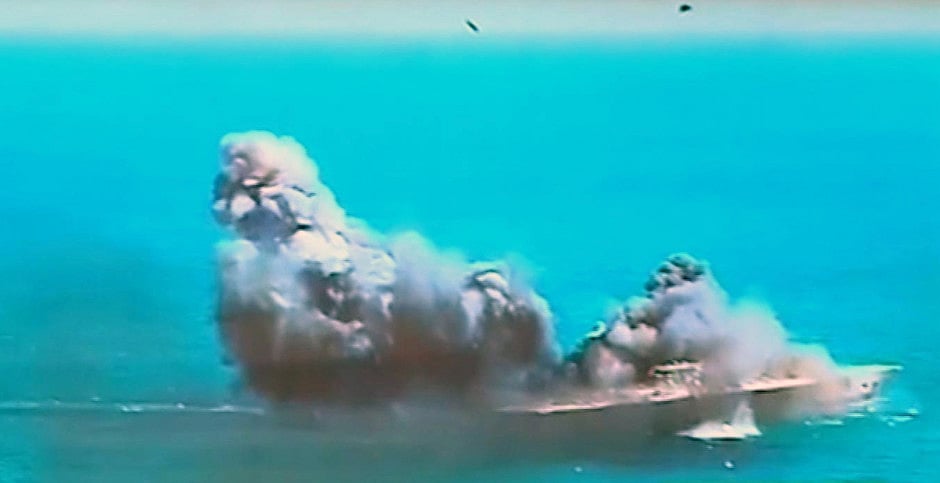
This image taken from Iranian state TV, shows damage to a mock US aircraft carrier during large-scale naval and air defence drills by Iran's Revolutionary Guard, near the Strait of Hormuz, Iran, in a file photo.
AP
Dubai: The Strait of Hormuz, a slender maritime passage separating Iran from Oman, has once again become the centre of global geopolitical tension.
At its narrowest, this strategically vital strait spans just about 33km (21 miles), yet it serves as the gateway between the Arabian Gulf and the Gulf of Oman, linking major oil-producing states with international markets.
Roughly a fifth of the world’s traded crude oil flows through these waters — a proportion so large that even fleeting disruptions can send shockwaves through global energy markets and inflation indices.
Iran’s Islamic Revolutionary Guard Corps announced plans to conduct a two-day, live-fire naval exercise in the Strait beginning February 1 — a move confirmed by multiple media outlets.
The drills, which have drawn maritime warnings and notices to shipping, risk intruding into internationally used traffic lanes that bind global commerce.
10 key facts about the Strait of Hormuz
It lies between Iran and Oman, linking the Arabian Gulf to the Gulf of Oman
Narrowest width: about 33 km (21 miles)
One of the world’s most critical energy chokepoints
Roughly 20% of global oil trade passes through it daily
Also vital for liquefied natural gas (LNG) exports, especially from Qatar
Shipping lanes are just a few kilometres wide in each direction
Deep enough to handle the world’s largest oil supertankers (VLCCs)
Most Gulf oil exports have no alternative route
Any disruption can trigger global oil price spikes
It is considered an international waterway, despite bordering nations’ territorial waters
In response, the United States Central Command has publicly cautioned Tehran to conduct the exercise in a safe, professional manner and avoid behaviour that could jeopardise commercial vessels or American and allied naval forces.
The backdrop to this stand-off is a wider bruising of US-Iran relations. From Iran’s domestic protests and diplomatic isolation to US deployments — including the USS Abraham Lincoln carrier strike group in the nearby Arabian Sea — both capitals are on heightened alert.
What happens if the Strait of Hormuz is closed or disrupted?
If shipping through the Strait of Hormuz is blocked — even briefly — the consequences could be global:
Oil prices would surge sharply within hours, as nearly 20% of global supply is affected
Fuel costs worldwide would rise, hitting transport, food prices, and inflation
Energy-importing nations in Asia and Europe would face immediate supply stress
Shipping routes would be forced to reroute, causing delays and higher freight costs
Insurance premiums for vessels would spike, raising trade costs
Stock markets could tumble, especially energy-sensitive sectors
Strategic oil reserves may be released by major economies to stabilise prices
Risk of wider military conflict in the Gulf would increase
Global economic growth could slow if disruption lasts
Developing countries would feel the biggest impact from rising fuel and food prices
Regional partners, including Gulf Arab states, are urging restraint, warning that any misstep could destabilise broader Middle East security and global energy markets.
Against this backdrop of mounting warnings and military posturing, here’s a closer look at what’s unfolding in the Strait of Hormuz — and why it matters.
Timeline: When the Strait of Hormuz faced blockades, threats & major disruptions
1980–1988 | Iran-Iraq War (“Tanker War”)
Both Iran and Iraq attacked oil tankers in the Gulf.
Dozens of ships were damaged or sunk.
While not fully closed, traffic through Hormuz was severely disrupted.
2011–2012 | Iranian closure threats
Iran repeatedly threatened to block the strait in response to Western sanctions over its nuclear programme.
No physical closure occurred, but oil prices surged on fears alone.
2019 | Tanker attacks & seizures
Multiple oil tankers were attacked or seized near the strait.
The US and allies blamed Iran.
Shipping insurance costs spiked; some vessels rerouted.
2020 | US-Iran standoff
After the killing of Iranian General Qassem Soleimani, Iran again threatened Hormuz.
Heightened naval patrols; no full closure.
2023 | Increased harassment incidents
Iranian forces intercepted commercial ships amid regional tensions involving Israel and Gaza.
Short-term shipping delays reported.
2024 | Drone and missile fears
Regional conflicts raised repeated warnings of Hormuz disruption, though shipping continued.
2026 | Live-fire naval drills near shipping lanes
Iran announces exercises that could enter commercial traffic routes.
The US issues safety warnings.
Markets remain on edge over possible escalation.
Is Iran actually going ahead with the naval drills?
Yes. Iran has publicly confirmed that the IRGC naval forces will conduct a two-day, live-fire exercise in the Strait of Hormuz beginning February 1. This has been widely reported in both Iranian and international media.
Why are these drills significant?
The Strait is one of the world’s most important chokepoints for oil transport. Roughly 20 per cent of global seaborne oil — amounting to tens of millions of barrels per day — passes through this narrow corridor. Disruption, even temporary, can spike energy prices and shock global markets.
What has the United States said about Iran’s plans?
The United States Central Command (CENTCOM) has issued a stern statement urging Iran to conduct the exercises safely and professionally. While acknowledging Iran’s right to operate in international waters, CENTCOM warned against any “unsafe or unprofessional behaviour” near US forces, regional partners, or commercial vessels.
What behaviours does Washington say it will not tolerate?
CENTCOM specifically cautioned against:
Low-altitude or armed overflights of US military assets
High-speed boat approaches on collision courses with US ships
Weapons pointed at US forces
Any actions endangering commercial or allied vessels
It added that it will ensure the safety of US personnel, ships, and aircraft in the region.
What is the broader context of US-Iran tensions?
Tensions have multiple roots, including:
Iran’s recent domestic protests and its government’s crackdown
Ongoing international concern about Iran’s nuclear programme
A heavy US military presence — including the USS Abraham Lincoln carrier group — deployed nearby
Iran’s warnings that it could retaliate if struck by US or Israeli forces
Arab Gulf states and other regional partners have urged restraint, warning that even misunderstandings in the Strait could escalate into wider conflict.
Could these drills threaten shipping traffic?
Official notices to mariners have flagged that the live-fire drills could overlap with crucial shipping lanes. If not carefully managed, live weapons exercises near standard traffic separation schemes could disrupt commercial traffic and increase insurance costs, shipping delays, and investor nervousness.
What are the possible consequences of an escalation?
Analysts warn that any escalation — including accidental clashes — could disrupt oil supplies, send prices sharply upward, and provoke wider regional insecurity. Previous periods of tension in the Strait have already shown how sensitive global markets are to threats in this waterway.

A Senior Associate Editor with more than 30 years in the media, Stephen N.R. curates, edits and publishes impactful stories for Gulf News — both in print and online — focusing on Middle East politics, student issues and explainers on global topics. Stephen has spent most of his career in journalism, working behind the scenes — shaping headlines, editing copy and putting together newspaper pages with precision. For the past many years, he has brought that same dedication to the Gulf News digital team, where he curates stories, crafts explainers and helps keep both the web and print editions sharp and engaging.
Sign up for the Daily Briefing
Get the latest news and updates straight to your inbox
Network Links
GN StoreAbout Gulf NewsTerms & ConditionsReach by GNSitemapContact usPrivacy PolicyGN FocusHave your sayWork with usAdvertise with usGulf News epaperPrinting Services
Download our app
© Al Nisr Publishing LLC 2026. All rights reserved.