Mohammad Bagher Ghalibaf (right) shaking with Pakistan's Defence Forces Chief Asim Munir before their meeting in Tehran.
New power circle: Meet the hardest-line IRGC ‘brotherhood’ running post-Khamenei Iran
Ex-intelligence chiefs, veteran Revolutionary Guard commanders now dominate war decisions
Last updated:
4 MIN READ
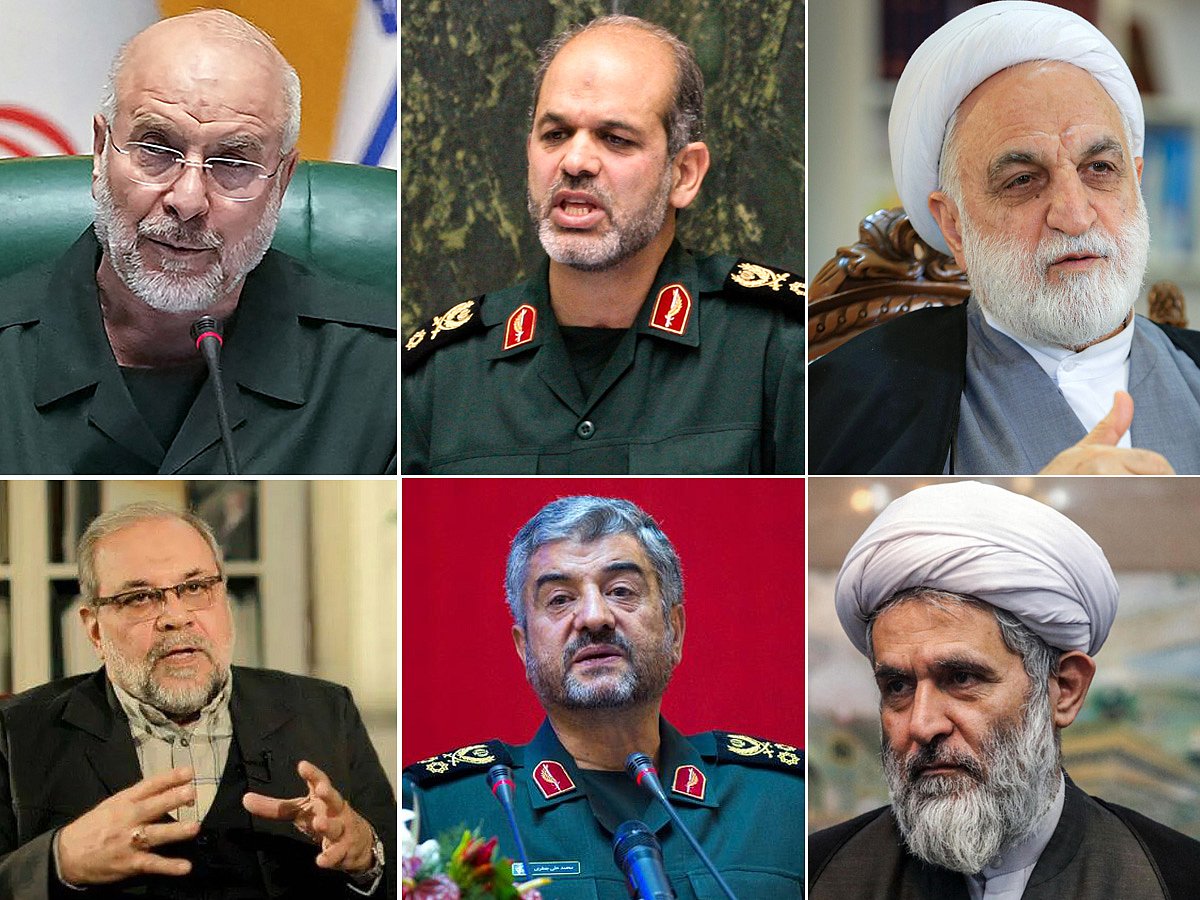
From top left: Mohammad-Bagher Ghalibaf, 64, Ahmad Vahidi, 67, Gholam-Hossein Mohseni-Ejei, 69, Hossein Taeb, 63, Mohammad Ali Jafari, 68 , and Mohammad Bagher Zolghadr, 72.
AFP file
Dubai: When Ali Khamenei was killed in an Israeli airstrike at the start of the Iran war on February 28, many observers expected the Islamic Republic to descend into chaos or a bitter succession struggle.
According to a detailed report by The New York Times, power in Tehran has increasingly consolidated around a hardened inner circle of former and current commanders of the Islamic Revolutionary Guard Corps (IRGC) — a secretive network shaped by the trauma of the Iran-Iraq war and decades of ideological warfare, repression and intelligence operations.
While Khamenei’s 56-year-old son, Mojtaba Khamenei, formally succeeded his father, experts cited by the newspaper say real decision-making is now driven by what one analyst described as a “brotherhood running the country.”
The group is not merely a military command structure, but an elite alliance of intelligence chiefs, security strongmen and veteran Guards commanders who rose together during the brutal 1980-88 Iran-Iraq war — a conflict that forged both their worldview and distrust of the West.
The NYT report said many of these figures later went on to dominate Iran’s intelligence agencies, judiciary, police, security forces and regional proxy operations, giving them sweeping influence across nearly every lever of state power.
Experts say their shared wartime experience and ideological rigidity explain why the Iranian system has not collapsed despite the deaths of dozens of senior commanders and political figures during months of conflict with Israel and the United States.
“These men survey, control and spy on each other,” Saeid Golkar, a political science professor and expert on the Guards, told The New York Times. “Because of that dominance over intelligence, they gradually became dominant in almost every aspect of politics in Iran.”
Mohammad Bagher Ghalibaf
Among the most influential figures identified by the newspaper is Mohammad Bagher Ghalibaf, the speaker of parliament and a former IRGC air force commander who has emerged as a key bridge between Iran’s military and political establishment.
Viewed by some as a pragmatic operator, Ghalibaf reportedly took part in direct talks with US officials in Pakistan last month. But critics inside Iran suspect he may ultimately seek to position himself as a post-war strongman.
Ahmad Vahidi is believed to be influencing both war strategy and peace talks.
Ahmad Vahidi
Another powerful figure is Ahmad Vahidi, the former defence minister who took over the IRGC after senior commanders were killed in US-Israeli strikes earlier this year.
The NYT noted that Vahidi previously led the IRGC’s Quds Force and has long been associated with Iran’s regional proxy network, including Hezbollah. Argentina has accused him of involvement in the 1994 bombing of a Jewish community centre in Buenos Aires that killed 85 people — allegations Tehran denies.
Iranian leadership of speaker Ghalibaf, President Pezeshkian and Judiciary head Mohseni-Ejei
Hossein Taeb and Gholam-Hossein Mohseni-Ejei
The report also highlighted the continuing influence of hardline intelligence and security figures such as Hossein Taeb and Gholam-Hossein Mohseni-Ejei, both deeply associated with crackdowns on anti-government protests and state repression over the past two decades.
Before becoming the Guards Intelligence Chief in 2009, Taeb worked at the office of Iran’s top authority Supreme Leader Ali Khamenei.
Mohseni-Ejei, Iran’s judiciary chief, has overseen waves of executions and detentions linked to protest movements, while Taeb, a former intelligence chief, was long feared for his role in crushing dissent and overseeing the detention of dual nationals.
Commander of Iran's Revolutionary Guard Gen. Mohammad Ali Jafari in a file photo..
Mohammad Ali Jafari
Another central figure is former IRGC commander Mohammad Ali Jafari, credited with developing the Guards’ so-called “mosaic strategy” — a decentralised military doctrine designed to keep operations functioning even if senior commanders are assassinated.
Analysts say that doctrine has proven crucial during the current war, allowing Iran’s military and proxy networks to continue operating despite repeated Israeli and US strikes on leadership targets.
The report paints a picture of an Iranian leadership structure increasingly shaped not by clerics alone, but by an entrenched security elite forged through war, intelligence operations and ideological militancy.
Even as diplomacy continues through mediators in Pakistan, Oman and the Gulf, analysts say the men now surrounding Mojtaba Khamenei are among the hardest-line figures in the Islamic Republic — and may ultimately determine whether Iran chooses compromise or prolonged confrontation.

A Senior Associate Editor with more than 30 years in the media, Stephen N.R. curates, edits and publishes impactful stories for Gulf News — both in print and online — focusing on Middle East politics, student issues and explainers on global topics. Stephen has spent most of his career in journalism, working behind the scenes — shaping headlines, editing copy and putting together newspaper pages with precision. For the past many years, he has brought that same dedication to the Gulf News digital team, where he curates stories, crafts explainers and helps keep both the web and print editions sharp and engaging.
Sign up for the Daily Briefing
Get the latest news and updates straight to your inbox
Network Links
GN StoreAbout Gulf NewsTerms & ConditionsReach by GNSitemapContact usPrivacy PolicyGN FocusHave your sayWork with usAdvertise with usGulf News epaperPrinting Services
Download our app
© Al Nisr Publishing LLC 2026. All rights reserved.