US-Iran deal talks show 'some good signs,' Rubio says as Pakistan visits Tehran
Rubio denounces NATO refusal to help on Iran ahead of alliance talks
Highlights
We are closing this coverage now. For latest updates, click here.
Venezuelan leader to travel to India for oil talks: Rubio
Venezuela's president will travel to India next week to discuss selling oil, US Secretary of State Marco Rubio said, an unusual announcement of a foreign leader's travel that shows the new US influence over Caracas.
Rubio mentioned the trip by interim President Delcy Rodriguez, in power since US forces deposed Nicolas Maduro in January, as the top US diplomat left on his own trip that will take him to India starting Saturday.
Brent crule oil price rises $2.38 to $105/barrel
Oil prices rose in Asian trading Friday after stronger US fuel demand data, thinning US strategic petroleum reserves and ongoing concerns over supply disruptions in key producing regions supported the market, while natural gas edged lower. As of 10:18 am Tokyo time, West Texas Intermediate (WTI) crude gained $1.75, or 1.82%, to $98.10/barrel. Brent crude rose $2.38, or 2.32%, to $105/barrel. Market sentiment was buoyed by expectations of tighter crude supplies heading into the Northern Hemisphere summer driving season, with traders also monitoring geopolitical tensions in the Middle East and production risks affecting global exports. Murban crude, the benchmark grade traded in Abu Dhabi, fell $1.07, or 1.04%, to $102.2 a barrel, diverging from gains in U.S. and Brent contracts.
US, Iran in 'intense indirect talks' for final draft agreement: Report
The United States and Iran are engaged in "instense" indirect talks aimed at developing a framework for a possible agreement, Iran's ISNA News Agency reported.
According to the report, the two sides are currently exchanging messages and draft texts.
Germany charges two accused of IRGC-backed murder plot
German prosecutors charged two men Thursday with planning to kill a prominent pro-Israel public figure and spying on Jews on behalf of Iranian secret services. Danish national Ali S. is charged with espionage, attempted murder, attempted arson and sabotage, prosecutors in Karlsruhe said. His alleged Afghan complice, Tawab M., is accused of attempted murder.
US oil inventories hit record low amid Iran war
US crude oil inventories fell sharply while emergency petroleum reserves dropped to their lowest level in nearly two years, according to new government data, as the war involving Iran continues to disrupt one of the world’s most critical energy chokepoints.
The latest figures from the US Energy Information Administration (EIA) showed commercial crude inventories declined by 7.9 million barrels for the week ending May 15, far exceeding analyst expectations for a smaller drawdown.
At the same time, the Strategic Petroleum Reserve, or SPR — America’s emergency crude stockpile — fell by another 9.9 million barrels, marking the eighth consecutive week of declines. The drop pushed the reserve to its lowest level since July 2024.
The inventory declines come amid escalating energy market disruptions tied to the Iran conflict.
Iran restarts rebuilding drone arsenal 'faster than expected': report
Iran has restarted parts of its drone production and is rebuilding its military-industrial base faster than US intelligence agencies expected, according to intelligence assessments cited in recent reports.
This has raised concerns that Tehran could again threaten US allies in the Middle East if fighting resumes.
The assessment, first reported by CNN and cited by Reuters, said Iran resumed some drone manufacturing during a six-week ceasefire that began in early April after intense US-Israeli strikes targeted Iranian missile sites, defence facilities and military infrastructure.
US officials familiar with intelligence findings reportedly concluded that Tehran’s recovery effort is moving “much faster” than early Pentagon estimates, though an independent verification of the assessment is not immediately possible, Reuters reported.
Get updated faster and for FREE: Download the Gulf News app now - simply click here.
Qatar, Egypt discuss US–Iran ceasefire and ongoing de-escalation efforts
Qatar Prime Minister and Minister of Foreign Affairs Sheikh Mohammed bin Abdulrahman bin Jassim Al Thani received a phone call from Egypt’s Foreign Minister Dr. Badr Abdelatty, according to a statement.
During the call, the two sides discussed bilateral relations and ways to strengthen cooperation between Qatar and Egypt, as well as recent regional developments.
The talks also focused on the ceasefire between the United States and Iran, alongside ongoing efforts aimed at de-escalation and enhancing security and stability in the region.
The Qatari Prime Minister stressed the importance of all parties responding positively to mediation efforts, noting that such initiatives could help address the root causes of the crisis through dialogue and peaceful means, leading to a sustainable agreement that prevents renewed escalation.
US sanctions nine over Hezbollah ties, including Lebanese MPs
The United States on Thursday sanctioned nine Hezbollah-linked individuals it accused of "obstructing the peace process in Lebanon," as Israeli strikes on the southern part of the country continued despite a ceasefire.
"Hezbollah is a terrorist organization and must be fully disarmed," said Treasury Secretary Scott Bessent.
"Treasury will continue to take action against officials who have infiltrated the Lebanese government and are enabling Hezbollah to wage its senseless campaign of violence against the Lebanese people and obstruct lasting peace."
Among those sanctioned on Thursday were Hezbollah MPs Hassan Fadlallah, Ibrahim al-Moussawi and Hussein al-Hajj Hassan, and executive council leader Mohamed Abdel-Mottaleb Fanich.
Washington has also sanctioned Mohammad Reza Sheibani, the Iranian ambassador-designate to Lebanon who was declared persona non grata and ordered to leave the country in March.
Others sanctioned on Thursday included Ahmad Asaad Baalbaki and Ali Ahmad Safawi of Hezbollah political ally Amal, and serving Lebanese military officers Brigadier-General Khattar Nasser Eldin and Colonel Samir Hamadi.
In a separate statement, the US State Department said it was offering a reward of up to $10 million "for information leading to the disruption of the financial mechanisms of Hezbollah."
Trump on US-Iran talks: 'Right now, we’re negotiating'
US President Donald Trump said the United States is currently engaged in negotiations with Iran, but insisted the outcome would prevent Tehran from obtaining a nuclear weapon.
“Right now, we’re negotiating, and we’ll see, but we’re going to get it one way or the other. They’re not going to have a nuclear weapon,” Trump said.
When asked by a reporter whether Iran could keep its highly enriched uranium, Trump replied: “No. We will get it. We don’t need it. We don’t want it. We’ll probably destroy it after we get it — but we’re not going to let them have it.”
Trump reiterates US claim on Strait of Hormuz control
Trump said the US is reviewing Iran’s proposal to impose tolls on shipping in the Strait of Hormuz.
Asked about the idea, Trump told reporters: “We’re looking at it.”
He claimed the United States maintains “total control” of the strategic waterway through a naval blockade.
“We have total control of the Strait of Hormuz, as you know, with our blockade. The blockade has been 100 percent effective. Nobody has been able to get through it; it’s like a steel wall,” Trump said.
“We want it free, we don’t want tolls. It’s international, it’s an international waterway,” he added.
Venezuelan leader to travel to India for oil talks, Rubio says
Venezuela's president will travel to India next week to discuss selling oil, US Secretary of State Marco Rubio said Thursday, an unusual announcement of a foreign leader's travel that shows the new US influence over Caracas.
Rubio mentioned the trip by interim President Delcy Rodriguez, in power since US forces deposed Nicolas Maduro in January, as the top US diplomat left on his own trip that will take him to India starting Saturday.
With India's growing economy hit by the chaos set off by the US and Israeli attack on Iran, Rubio said, "We want to sell them as much energy as they'll buy."
"We also think there's opportunities with Venezuelan oil. In fact, it's my understanding that the interim president of Venezuela will be traveling to India next week as well," he said.
"There's a lot to work on with India. They're a great ally, a great partner."
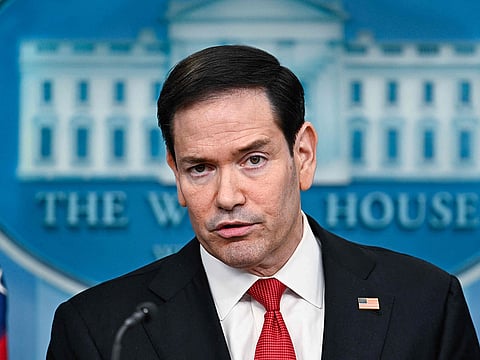
Marco Rubio sees 'some good signs' on possible US-Iran deal
US Secretary of State Marco Rubio said there are “some good signs” that a deal between Washington and Tehran could be reached, while cautioning against being overly optimistic.
Speaking to reporters, Rubio said Pakistani officials would be travelling to Tehran on Thursday, adding: “So hopefully that will advance this further.”
He said US President Donald Trump’s “preference is to do a good deal,” adding that this has “always been his preference.”
“If we can get a good deal done, that would be great,” Rubio said.
“But if we can’t get a good deal, the president has been clear – he has other options. I’m not going to elaborate on what those are, but everybody knows what those are.”
Rubio added: “There are some good signs, but we understand … I don’t want to be overly optimistic, as well, so let’s see what happens over the next few days.”
Rubio denounces NATO refusal to help on Iran ahead of alliance talks
US Secretary of State Marco Rubio on Thursday renewed criticism of NATO for not supporting the US war on Iran, as he headed to alliance talks in Sweden.
President Donald Trump is "not asking them to send their fighter jets in. But they refuse to do anything," Rubio told reporters. "We were very upset about that."
Iran hangs two men for armed rebellion
Iran on Thursday hanged two men convicted of armed rebellion and membership of "separatist terrorist groups", the latest in a string of executions during the Middle East war.
Since the start of the conflict with Israel and the United States in February, Iran has ramped up executions, with many of the convicts hanged over anti-government protests that took place across Iran early this year.
Iran's judiciary said the two men executed Thursday were involved in armed attacks against security forces and assassination plots in western Iran.
"Ramin Zaleh and Karim Maroufpour were hanged for membership in separatist terrorist groups, forming a group with the aim of disrupting the country's security, armed rebellion through the formation of criminal groups, shooting and carrying out assassination attempts," the judiciary's Mizan Online website reported.
It was not immediately clear when they were arrested but the judiciary said they had been trained to become "leaders in the unrest".
IRGC says 31 ships transited Strait of Hormuz
Iran’s Islamic Revolutionary Guard Corps (IRGC) said 31 vessels passed through the Strait of Hormuz over the past 24 hours.
In a statement carried by Iran’s Tasnim news agency, the IRGC said the ships, including oil tankers, container ships and other commercial vessels, transited the waterway' with the coordination and security of the IRGC Navy.'
Lebanon says Israeli strike damaged hospital in south
Lebanon said an Israeli strike on Thursday damaged a hospital in the country's south, where Israel and Hezbollah have been trading fire despite a ceasefire.
The state-run National News Agency (NNA) reported that Israeli aircraft "launched two strikes on the town of Tibnin near the public hospital, where significant damage was recorded".
The health ministry circulated a video showing part of the hospital with shattered glass on the floor, blown-out ceiling panels and window panes, and other damage to what appeared to be offices.
Oil market risks 'red zone' by summer, IEA chief warns
The world oil market risks entering a "red zone" by the upcoming summer season should there be no progress on ending the Middle East war, the head of the International Energy Agency warned Thursday.
"We may be entering the red zone (on supplies) in July or August if we don't see that there are some improvements in the (war) situation," Fatih Birol said at the Chatham House think tank in London.
Iran internet blackout enters 83rd day
Internet monitoring group NetBlocks reports that the internet blackout in Iran has now entered its 83rd consecutive day, with international connectivity largely restricted for more than 1,968 hours.
NetBlocks said the prolonged disruption continues to raise concerns over digital rights, transparency, and public access to information, stressing that a free and open internet remains essential for safeguarding life, liberty, and accountability.
13 ways Dubai’s new Dh1.5b stimulus package affects you
Dubai has unveiled a second Dh1.5 billion package of economic incentives aimed at cutting business costs, supporting key industries and easing financial pressure across sectors ranging from tourism and education to construction and logistics.
Approved by Sheikh Hamdan bin Mohammed bin Rashid Al Maktoum, Crown Prince of Dubai, Deputy Prime Minister, Minister of Defence, and Chairman of The Executive Council of Dubai, the package includes 33 initiatives that will roll out over the next three to 12 months.
Combined with the Dh1 billion package announced in late March, Dubai has now introduced Dh2.5 billion in economic support measures within less than two months.
Read more here.
EU slashes eurozone 2026 growth forecast on Mideast war
The eurozone economy will expand less than expected this year and inflation will be significantly higher than forecast, the EU executive said Thursday, as the Middle East war and subsequent energy shock take their toll.
The European Commission said the single currency area's economy was expected to grow 0.9 percent in 2026, down from a previous prediction of 1.2 percent, "as the conflict in the Middle East triggers a new energy shock that reignites inflation and shakes economic sentiment".
The commission also hiked its forecast for inflation in the 21-country eurozone to 3.0 percent this year, up from the 1.9 percent forecast last November.
Iran's bullying has shattered Gulf trust: Gargash
Dr Anwar Mohammed Gargash, Diplomatic Adviser to the UAE President, said the Iranian bullying has eroded trust, warning that attempts to impose a new regional reality following its recent military setbacks would not succeed.
In a post on X platform, Gargash said the Gulf region had grown accustomed over decades to what he called Iranian “bullying”, adding that its credibility had been lost between aggressive political discourse and what he described as hollow statements of friendship.
Iran restarted drone production during ceasefire, US intel says
Iran has resumed parts of its drone manufacturing operations during the six-week ceasefire that began in early April, signalling a rapid effort to restore military capabilities damaged by US-Israeli strikes, according to two sources familiar with US intelligence assessments. Four sources told CNN that American intelligence believes Iran’s military recovery is progressing significantly faster than initially expected.
Pakistan PM Sharif to visit China May 23-26: Beijing
Pakistan Prime Minister Shehbaz Sharif will visit Beijing from Saturday to Tuesday for talks, the Chinese foreign ministry said, without specifying whether the war in Iran would be discussed.
"The leaders of China and Pakistan will have an in-depth exchange of views on bilateral relations and issues of common concern," ministry spokesman Guo Jiakun told a press conference on Thursday, adding that "China supports Pakistan in playing a fair and balanced mediating role in promoting peace and ending the war."
The two countries have both sought to mediate in the Middle East conflict, sparked by US and Israeli strikes.
Iran media say mediator Pakistan's army chief due in Tehran Thursday
Iranian media reported that Pakistan's army chief Field Marshal Asim Munir was due in Tehran on Thursday, with Islamabad mediating as Iran examines the latest US proposal to end the Middle East war.
Iran's ISNA news agency said Munir's visit was aimed at continuing "talks and consultations" with Iranian authorities, without providing details. Other Iranian media carried the same report.
EasyJet says first-half losses deepen on Mideast war
British no-frills airline EasyJet said Thursday that its losses deepened in the first half of its financial year to end-March after the Middle East war sent jet fuel prices soaring and disrupted travel plans.
Its headline loss after tax came in at GBP377 million ($506 million) for the period, a rise of 27 percent a year earlier.
Vahidi: Hard-line Iranian general, key player in talks
As negotiations with the United States hang in the balance, a hard-line Iranian general linked to notorious attacks at home and abroad over the past decades is believed to have seized a place near the center of power.
Brig. Gen. Ahmad Vahidi, who heads Iran's paramilitary Revolutionary Guard, has become a major player in formulating Iran's tough stance in negotiating a possible end to the war with the United States, experts say. He is believed to be part of a small clique in direct contact with Iran's Supreme Leader Ayatollah Mojtaba Khameini, who remains in hiding after being reportedly wounded in the Feb. 28 Israeli strikes that killed his father, Ayatollah Ali Khamenei.
Like everything in Iran since the war began, who ultimately controls decision-making remains uncertain. As people within the upper ranks of Iran's theocracy vie for power, they can gain or lose favor quickly. Vahidi himself hasn't been seen publicly since Feb. 8, weeks before the war began.
Strait of Hormuz supervision boundaries defined by Iran
Iran's newly launched PGSA authority has defined the boundaries of the Strait of Hormuz management supervision area in a post on X.
This comes as the deadlock over US-Iran peace talks continues with no side budging from their demands.
Washington has demanded complete prohibition of Iran's nuclear programme, while Tehran continue to hold onto its energy security while demanding control of the Strait of Hormuz.
Iran on Monday announced the launch of a new regulatory body aimed at managing and monitoring operations related to the strategically important waterway, the Strait of Hormuz.
Get updated faster and for FREE: Download the Gulf News app now - simply click here.
Intense phone call between Trump and Israeli PM over new peace proposal
US President Donald Trump and Israeli Prime Minister Benjamin Netanyahu held a "difficult" phone call, during which they discussed renewed diplomatic efforts to reach an agreement with Iran, Axios reported, citing multiple sources.
As per Axios, the call comes amid intensified mediation efforts involving Qatar, Pakistan, Saudi Arabia, Turkey and Egypt to bridge differences between Washington and Tehran over Iran's nuclear programme and broader regional issues. One source was quoted as saying Netanyahu was extremely upset after the conversation, stating that his "hair was on fire" following the call.
The developments come as a revised draft proposal, reportedly prepared with inputs from regional mediators, is being considered to narrow gaps between the United States and Iran. The proposal is said to aim at securing clearer commitments from Tehran on its nuclear programme while also outlining conditions for the possible release of frozen Iranian assets.
FAO warns of agri-food 'shock' from Strait of Hormuz closure
The Food and Agriculture Organisation (FAO) of the United Nations warned that a prolonged closure of the Strait of Hormuz risks triggering a structural agrifood shock, which could culminate in a severe global food price crisis within six to 12 months. The situation could be further exacerbated by the onset of the El Niño weather phenomenon, which is expected to cause droughts and disrupt rainfall and temperature patterns across multiple regions.
Global energy economy needs infrastructure, AI, freedom of navigation: Al Jaber
Renewed infrastructure investment, a razor-sharp focus on AI and an absolute commitment to freedom of navigation through the Strait of Hormuz are needed to enhance global energy resilience, a senior UAE official said.
Dr. Sultan bin Ahmed Al Jaber, UAE Minister of Industry and Advanced Technology, said: “Once you accept that a single country can hold the world’s most important waterway hostage, freedom of navigation as we know it is just finished.”
Al Jaber, who is also Managing Director and Group CEO of the Abu Dhabi National Oil Co (ADNOC), Chairman of Masdar and Executive Chairman of XRG, was speaking at the Atlantic Council, where is called for investment across the value chain to strengthen the global energy economy.
Germany renews solidarity with the UAE, condemns terrorist drone attacks on Barakah nuclear power plant
Germany has renewed its solidarity with the UAE, and condemned terrorist drone attacks launched from Iraq targeting the Barakah nuclear power plant facility in Abu Dhabi. This was conveyed by Friedrich Merz, Chancellor of the Federal Republic of Germany on Wednesday, during a meeting with Sheikh Abdullah bin Zayed Al Nahyan, Deputy Prime Minister and Minister of Foreign Affairs. The meeting reviewed the strategic relations between the two countries and ways to strengthen joint cooperation across various sectors, including economic, trade and investment fields. During the meeting, Sheikh Abdullah conveyed to the Chancellor the greetings of President His Highness Sheikh Mohamed bin Zayed Al Nahyan and his wishes for further progress and prosperity for the Federal Republic of Germany and its friendly people.
Brent crude oil prices tumble more than 5%
Brent crude oil prices tumbled more than 5% on Thursday as diplomatic progress toward ending the Iran conflict eased market fears over blocked energy supplies.
The drop followed reports that a number of Asian-bound supertankers managed to safely exit the Strait of Hormuz, unlocking millions of barrels of crude.
Trump says Iran talks 'right on the borderline'
US President Donald Trump said Wednesday that talks with Tehran were "on the borderline" between a deal to end the Middle East war and a resumption of strikes on Iran.
Trump has given conflicting signals since announcing on Monday that he had called off renewed attacks to give time for negotiations, veering between optimism about an agreement and threats of more action.
"It's right on the borderline, believe me," Trump told reporters at Joint Base Andrews near Washington when asked where the talks with Iran stood.
"If we don't get the right answers, it goes very quickly. We're all ready to go. We have to get the right answers - it would have to be a complete 100 percent good answers."
Trump said it would save "a lot of time, energy and lives" if Iran made a deal, saying it could happen "very quickly, or (in) a few days."
The US leader said this week he had been an hour away from ordering the resumption of strikes on Iran but postponed the attack planned for Tuesday at the request of Gulf states.
Get updated faster and for FREE: Download the Gulf News app now - simply click here.
'All paths remain open from our side': Iran President
Iran’s President Masoud Pezeshkian has said Tehran remains open to all diplomatic avenues to prevent escalation, stressing that coercion will not force the Islamic Republic into surrender.
In a post on X, Pezeshkian said Iran “has consistently honored its commitments and explored every avenue to avert war,” adding that “all paths remain open” from Tehran’s side.
He warned against attempts to pressure Iran into submission, saying: “Forcing Iran to surrender through coercion is nothing but an illusion.”
The Iranian president added that mutual respect remains the only viable path forward, stating that diplomacy based on respect is “far wiser, safer, and more sustainable than war.”
Iran says examining new US proposal as Pakistani mediator visits
Iranian foreign ministry spokesman Esmaeil Baqaei said on Wednesday that the Islamic republic had received a new US proposal and was currently examining it, as a minister from mediator Pakistan visited Tehran.
"We received the points of view of the American side and we are currently examining them. The presence of Pakistan's interior minister is aimed at facilitating the exchange of messages," Baqaei told state television.
He reiterated Iran's demands in talks to end the war including the release of Iranian assets frozen abroad and an end to the US blockade on Iranian ports.
'Do we finish it up or do they sign document?' Trump says of Iran
US President Donald Trump said on Wednesday that Iran’s naval and air capabilities had been effectively wiped out, while suggesting Washington could still launch further action unless Tehran agrees to a deal.
Speaking during a commencement address at the US Coast Guard Academy, Trump said: “Everything’s gone. Their navy’s gone. Their air force is gone. Just about everything.”
“The only question is, do we go and finish it up? Are they going to be signing a document? Let’s see what happens,” he added.
Israel army chief says military 'on highest alert' as threats over Iran war escalate
Israel's army chief Lieutenant Colonel Eyal Zamir on Wednesday said the military was at its highest alert level, as Tehran and Washington traded threats of war.
"At this moment, the IDF (military) is on the highest level of alert and prepared for any development," Zamir said at a meeting of all division commanders, according to a statement issued by the military.
Iran's Revolutionary Guards had earlier warned that the war would expand beyond the region if the US and Israel resumed attacks, after President Donald Trump said he would strike again unless Tehran agreed a peace deal.
US‑Israel war on Iran: Recent developments
Day 82: Trump says US-Iran talks are ‘right on the borderline’
Day 81: Iran’s position 'unclear', deal 'uncertain': VP Vance
Day 80: Trump says 'holding off on attack on Iran tomorrow'
Day 79: Trump says 'clock is ticking' for Iran
Day 78: Iran plans new Strait of Hormuz toll system
Day 77: Israel and Lebanon extend ceasefire by 45 days: US
Day 76: World leaders call for security in Strait of Hormuz
Day 75: Trump arrives in Beijing for summit with Xi
Day 74: Iran signals potential 90% Uranium enrichment
Day 73: Trump calls Iranian response 'totally unacceptable'
Day 72: 'As of today, Tehran’s restraint is over': Iran official
Day 71: Iran keeps US waiting on response to peace plan
Day 70: US fires on Iran tankers as talks hang in balance
Day 69: Iran creates agency to control shipping at the Strait of Hormuz
Day 68: Trump threatens 'higher level' bombing of Iran if deal not agreed
Day 67: 'Project Freedom' paused 'for a short period': Trump
Day 66: UAE intercepts 12 ballistic missiles, 3 cruise missiles, 4 drones


