Primark eyes Abu Dhabi after blockbuster Dubai launch as Alshaya speeds up UAE expansion
After 1 million shoppers and 4 million items sold in Dubai, Primark eyes Abu Dhabi launch
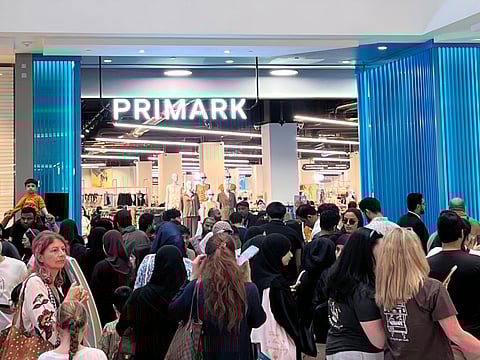
Dubai: After a blockbuster Dubai debut that saw Primark open three large-format stores in less than eight weeks — in the middle of regional disruption, supply chain pressure and even a thunderstorm-hit launch day at Dubai Mall — the Irish fashion giant is now preparing to make its way to Abu Dhabi.
Primark parent Alshaya Group confirmed it is in talks with major landlords in the emirate and expects to announce plans soon.
John Hadden, chief executive of Alshaya Group, said the company is moving faster than originally planned after Primark’s launch in Dubai exceeded expectations. “We want to be more aggressive and grow quicker than what we originally planned,” he said, adding that Abu Dhabi is expected to be “certainly within the next 12 months.”
Hadden said the company is currently negotiating with major landlords in Abu Dhabi and reviewing additional locations in Dubai as it pushes ahead with its UAE expansion. “We’re looking at locations at the moment, because it needs a big space and big space is difficult to find,” he said.
The Abu Dhabi move comes after a standout debut for Primark in Dubai. In fact, the Mall of the Emirates store, which opened on May 21, was originally due to launch later in the month, but the company fast-tracked the opening in response to surging consumer demand.
Beyond UAE, two Primark stores will open in Bahrain (October) and Qatar (opens approximately October- November) later this year, said Hadden, adding, "and then we'll continue the expansion in Dubai through the start of next year. Again, we're talking to landlords, but nothing confirmed at the moment, apart from Bahrain and Qatar."
Dubai loves Primark
Hadden said Dubai’s reception has been far stronger than anticipated, with the retailer serving 1 million customers and selling 4 million items across its stores since launch.
“We’ve sold 4 million units,” he said. “10 per cent of that is pajamas. So, we sold 400,000 sets of pajamas.”
The pyjama category has emerged as one of Primark’s surprise bestsellers in Dubai, highlighting the strong consumer response to the retailer’s low-cost, trend-led fashion model.
Hadden said many shoppers were already familiar with Primark as a global brand, but Dubai customers responded strongly once they experienced its pricing and product quality in person.
“Prices are the same as in Europe,” he said. “I don’t think they appreciated necessarily the price proposition… and also the quality of the product and the fashionability of the product.”
He added that both Dubai stores had performed above expectations, with City Centre Mirdif proving to be a particularly strong performer despite being more community-focused than tourist-heavy Dubai Mall.
“The real nice part has been Mirdif,” he said. “That store has done particularly well for us.”
Dubai’s launch also got a high-profile boost when His Highness Sheikh Mohammed bin Rashid Al Maktoum, Vice President and Prime Minister of the UAE, visited the Dubai Mall store, something Hadden said helped raise the brand’s visibility in the market.
“We had Sheik Mohammed walk through the store,” he said.
Khalifa Bin Braik, CEO of Majid Al Futtaim Asset Management, said the company saw a strong response from shoppers after Primark’s first Dubai launch and is continuing its retail partnership with Alshaya as the brand expands regionally.
“We saw an incredible response following Primark’s opening at City Centre Mirdif, so it’s exciting to now bring the brand to Mall of the Emirates… as part of our growing partnership with Alshaya Group,” he said, adding that City Centre Bahrain will be the next step in the rollout.
Keeping shelves stocked
The pace of Primark’s sales in Dubai has also forced Alshaya to rethink how it moves products into the UAE.
Hadden said stock for the first three stores had already arrived in February, but replenishment demand has been so strong that the company has had to use alternative shipping routes and even charter aircraft.
“We’re finding alternative routes, and we’re also air freighting some product,” he said.
Normally, Primark’s products arrive from Asian manufacturing hubs such as India and Bangladesh in Jebel Ali before being distributed through Alshaya’s warehouse network.
But now, some shipments are being diverted through Jeddah, Salalah and Egypt, before being trucked into the UAE.
“We then have charted a couple of airplanes… because we had to,” Hadden said.
Air freight is significantly more expensive than sea freight, but Hadden said Primark’s high-volume sales model has helped offset those costs.
“It’s a volume business,” he said. “As long as we get in the volume, we can afford to do what we do.”
Big stores, bigger ambitions
One challenge in Abu Dhabi, Hadden said, will be finding enough retail space.
Primark’s stores are known for requiring large-format footprints, something he said is harder to secure in key UAE retail destinations.
“We need big space and big space is difficult to find,” he said.
That large-format approach has become central to Primark’s UAE strategy, with the retailer opting for some of Dubai’s biggest malls and building stores designed to handle very high footfall and broad product categories.
Alshaya’s next UAE investments
Primark’s expansion comes as Alshaya broadens its investment footprint in the UAE beyond retail.
The group has announced a 480,000-square-foot mixed-use joint venture in Dubai Hills with Brookfield Properties, which will include Grade A office space, residential units and retail.
Hadden said construction is expected to begin within the next 12 months, with Alshaya planning to move its UAE office to the site once completed.
“We understand retail, they understand development,” he said of the partnership. The development will also include retail space for some of Alshaya’s brands.
Hadden said the company’s wider brand rollout is also continuing, including newer launches such as Primark and Ulta Beauty.
“We’ve got the rollout of both Primark and Ulta Beauty to continue with,” he said. “Hopefully, more exciting stuff to come soon.” Alshaya entered the UAE in 1985 and now operates more than 700 stores in the country, making it one of its largest markets in the region.


