This handout photo released by Iran's Revolutionary Guards Corps (IRGC)'s official website Sepanews on February 17, 2026, shows boats manoeuvering around a tanker vessel during a military exercise by members of the IRGC and navy in the Strait of Hormuz.
Iran's Strait of Hormuz blockade: Why the US finds it difficult to free this chokepoint — IRGC's strategy explained
Iranian anti-ship missiles, drone boats, mines pose a massive threat to ships here
Last updated:
6 MIN READ
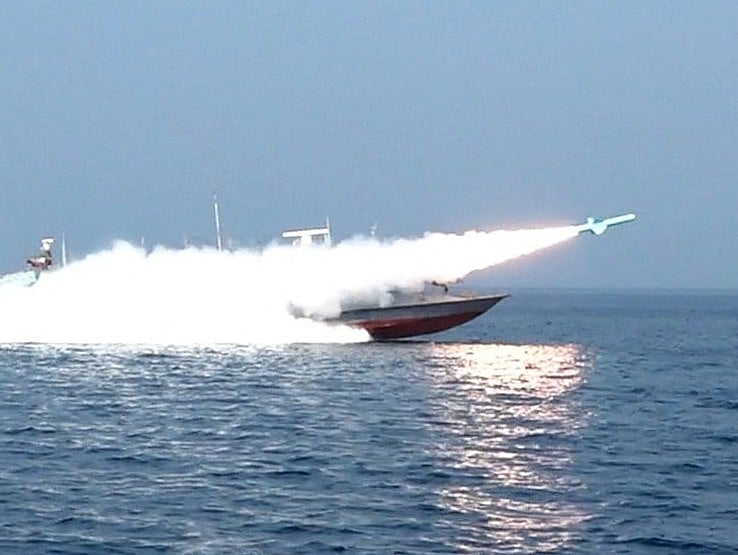
This handout photo released by Iran's Revolutionary Guards Corps (IRGC)'s official website Sepanews on February 17, 2026, shows a rocket being fired from a boat during a military exercise by members of the IRGC and navy in the Strait of Hormuz.
AFP
In the Strait of Hormuz, Iran's strategy is simple: choke off this incredibly narrow passage.
It's a massive bottleneck. Over the last 40+ years, the Islamic Republic Guard Corps (IRGC) has built, developed and refined its area-denial strategy over this chokepoint.
Giant oil tankers are squeezed into just two tight shipping lanes — one for ships going in; one for ships coming out.
The IRGC uses geography to their advatantage: they control three major islands positioned right along these corridors.
Then, hidden deep inside them is a menacing network of underground bunkers, swarm boats and anti-ship missiles that pose a clear and present danger to international shipping here.
So why is it so difficult for the US to secure and clear the strait?
While the IRGC doesn't use ships, small boats launch 360° swarm attacks.
The strategy is to target the bridges of larger ships.
To further complicate things, the US military would have to hunt down each and every one of those underground bunkers on the islands.
This is how Iran manages to block 20% of the world's oil transport.
What's crazy is that major players like the Gulf nations as well as Iraq, and even Iran itself all rely entirely on this one narrow corridor.
Why is it a choke point?
It’s sheer geography. At its narrowest, the strait is only about 39 km or 21 nautical miles wide.
The northern coastline belongs to Iran and is highly mountainous. This provides natural camouflage and deep fortified bunkers for missile launchers.
Plus, Iran controls a string of islands like Larak, Keshm, and Abu Musa.
Think of these not as islands, but as heavily-armed offensive systems parked right on the edge of the shipping routes.
And those routes — they are incredibly tight.
The bulker Mayuree Naree was struck by two projectiles while transiting the Strait and 20 seafarers safely evacuated last week.
Because the waters are shallow and filled with reefs, supertankers are confined to a strict traffic separation scheme.
You have one 2-mile wide inbound lane, one 2-mile wide outbound lane, and a 2-mile buffer zone in between.
If attacked, these massive cargo ships have virtually zero room to manoeuvre.
This handout photo released by Iran's Revolutionary Guards Corps (IRGC)'s official website Sepanews on February 17, 2026, shows a rocket being fired during a military exercise by members of the IRGC and navy in the Strait of Hormuz.
Ways Iran choke Hormuz
But what are the tactics and strategy Iran uses to control this narrow corridor?
To block the Strait of Hormuz, you have to control the islands.
The IRGC relies on a triad of fortified outposts, each with a very specific and very deadly role.
3 choking strategies
#1. Larak Island: The choke point enforcer
It sits right at the throat of the strait, looming directly over international shipping lanes.
The strategy here is all about close-quarters intimidation because it's right on top of the transit corridor.
IRGC fast attack boats staged here can reach a passing cargo ship in mere minutes. For the crew, they have zero time to react.
Larak enforces strict no-move zones. Drones launch to monitor stationary tankers while speedboats physically surround them.
If a captain decides to start their engines, they open fire.
#2. Keshm Island: The heavy arsenal
If Larak is a knife at the throat, Keshm is the sledgehammer. It's the largest island in the Gulf and serves as the IRGC's primary military hub.
Its rugged terrain hides a labyrinth of underground bunkers and mobile anti-ship missile launchers.
Keshm is designed to launch heavy anti-ship missiles like the P-15 Termit. Packed with drone bases and radar installations, it is the strategic anchor of Iran's coastal defense.
#3. The attack point from Abu Musa: the forward outpost
Itu is located further south right on the doorstep of rival Arab states. Abu Musa is a heavily fortified early warning center.
It extends Iran's anti-access or “area denial” bubble deep into the Gulf. Radars here track incoming allied warships and cargo vessels long before they reach the choke point.
It's a launch pad that drastically widens the threat zone.
So how do they attack the cargo ship?
First, they launch the fast-attack swarm.
The IRGC deploys fleets of small, radar-evading speedboats clocking in at 50 to 70 knots. 10 to 20 of these boats will swarm a single cargo ship from 360°.
A boat firing a missile during a military exercise by members of the Iran's Revolutionary Guards Corps on February 16, 2026.
They zip in close, targeting weak points with heavy machine guns and shoulder-fired missiles.
They aim for the bridge to blind the ship and the engine room to leave it dead in the water.
Drone boats
Hidden within this chaos: unmanned suicide vessels — remote-controlled drone boats packed with explosives steered directly into the hull to blow a massive hole at the waterline.
And while the crew is completely overwhelmed, other boats rapidly drop tethered naval mines directly into the ship's path. Stop the ship or risk snapping your keel in half.
Then comes the second tactic: anti-ship missiles.
If a swarm doesn't get you, the missiles will.
Fired from highly mobile trucks that immediately retreat into fortified caves. Coastal defense cruise missiles like the Noor or Ghader employ a deadly trick.
Countering IRGC's area-denial strategy
But the West isn't exactly defenseless. When allied warships enter the strait to escort cargo ships, they form a high-tech defensive bubble.
Here's how they counter the IRGC's triad
#1. Mines: Navies deploy littoral combat ships and specialised mine countermeasure vessels using high-frequency towed sonars, underwater drones, and Sea Hawk helicopters.
They scan the water ahead of the convoy, detonating mines before the cargo ships ever arrive.
The USS Santa Barbara littoral combat ship (LCS), a fast, agile, shallow-draft warship designed for near-shore, or littoral, operations, with capabilities for open-ocean missions. It uses interchangeable mission packages for surface warfare, anti-submarine warfare, and mine countermeasures. Two variants exist: the Freedom-class monohull and Independence-class trimaran.
#2. Anti-ship missiles: Allied destroyers rely on advanced networks like the US Aegis combat system.
The exact moment an Iranian missile is launched, destroyers' radars track it and fire interceptor missiles like the SM-2 or SM-6, blowing the threat out of the sky midair.
Meanwhile, Apache or Seahawk helicopters pick off swarm boats from the air using Hellfire missiles.
Best defence: Offence
But the ultimate countermeasure isn't defense — it's offence.
The US and its allies keep an armada of surveillance drones monitoring the Iranian coastline in real time.
If they detect mobile missile launchers rolling out of mountain bunkers or boats loading mines at port, allied fighter jets and ship-launched Tomahawk missiles are tasked with destroying them, minutes after or even before they can fire a single shot.
To neutralise the risk of Iranian P-15 anti-ship cruise missiles, US forces dropped multiple 5,000 lb deep penetrator bombs on hardened coastal missile sites.
A US Air Force B1 bomber: It uses a 5,000-lb (2,300 kg) class laser-guided "bunker buster" penetrator bomb. A newer 5,000-lb guided bomb unit, the GBU-72 Advanced 5K Penetrator, is designed for deep-target penetration for use on F-15E and B-1B platforms.
The weapon they used is a GBU-72, a 5,000 lb precision-guided bomb fitted with a joint direct attack munition (JDAM) kit. Its massive firepower can smash through 160 feet of earth or 20 feet of solid reinforced concrete.
Once they break through, they trigger a massive explosion that completely wipes out the underground structure.
'Layered' maritime power
A durable answer to any attempt by the IRGC to choke Hormuz would not rest on a single blow.
It would rely on the steady application of 'layered" maritime power.
Mine warfare, for which the Navy has extensive experience in clearing mines to keep open vital lanes, is a key contest.
This would be conducted via dedicated mine countermeasure ships, unmanned systems, and aviation detachments.
Platforms like littoral combat ships — designed for shallow, contested waters — extend this reach. p
Pairing sensors with modular packages to detect and neutralise threats lest they continue to paralyse shipping.
Above and beyond the waterline, precision strike capabilities provide the means to suppress launch sites, storage depots, and command nodes.
Amphibious forces, including the United States Marine Corps, add a further dimension — capable of seizing or securing key coastal positions and denying adversaries the terrain from which to threaten passage.
The biggest factor: Not just firepower, but coordination.
Objective: Continuity, not conquest
With allied naval forces, constant surveillance, convoy protection, and freedom-of-navigation operations (Fonops), this contested chokepointcan be turned into a managed corridor — raising the cost of disruption while reassuring global commerce.
In the end, the objective is not conquest, but continuity: to ensure that even under pressure, the world’s most vital energy artery remains open — proof that control of the seas, once established, is exceedingly difficult to break.
Sign up for the Daily Briefing
Get the latest news and updates straight to your inbox
Network Links
GN StoreAbout Gulf NewsTerms & ConditionsReach by GNSitemapContact usPrivacy PolicyGN FocusHave your sayWork with usAdvertise with usGulf News epaperPrinting Services
Download our app
© Al Nisr Publishing LLC 2026. All rights reserved.