Rare space event: Dwarf planet Haumea to briefly eclipse star over UAE skies
The event could last up to 119 seconds and will be visible across most of the Arab world
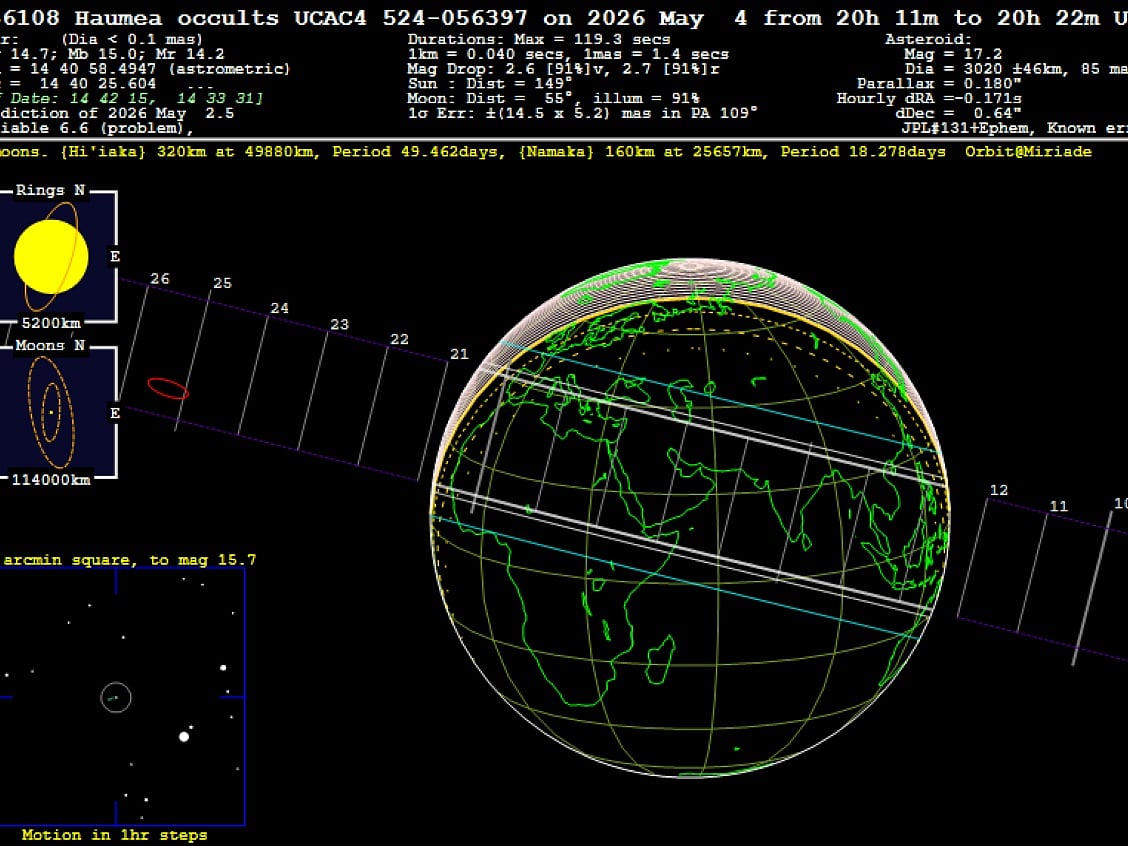
Dubai: A rare astronomical event is set to unfold on Monday evening, as the dwarf planet Haumea passes directly in front of a distant star, briefly blocking its light in a phenomenon known as a stellar occultation.
According to the International Astronomical Center, the event could last up to 119 seconds and will be visible across most of the Arab world, forming part of a coordinated international observation campaign involving observatories and research institutions worldwide.
Get updated faster and for FREE: Download the Gulf News app now - simply click here.
Engineer Mohammed Shawkat Odeh, Director of the Center, said the occultation will begin first in the eastern parts of the region. It is expected to start in Oman and the UAE at 20:16 GMT, followed by Jordan at 20:17, Egypt at 20:18, and Morocco at 20:20. In countries located along the central path, the event is likely to last between 80 and 88 seconds.
Haumea is classified as a dwarf planet, a celestial body larger than an asteroid but smaller than a full planet. The solar system currently includes five recognised dwarf planets: Pluto, Ceres, Eris, Makemake and Haumea.
Haumea, along with Makemake and Pluto, lies within the Kuiper Belt beyond Neptune, while Ceres is located in the asteroid belt between Mars and Jupiter. Eris, meanwhile, orbits even farther out, at the outer edges of the solar system.
What makes Haumea particularly distinctive is that it has two moons and a ring system, adding scientific significance to the upcoming event. As it moves in its orbit around the Sun, it will obscure a faint star with a brightness of magnitude 14.7. During the occultation, only Haumea, shining at magnitude 17.3, will remain visible, resulting in a measurable drop in brightness of about 2.7 magnitudes.
The phenomenon will be observable from most Arab countries, with the exception of Somalia, Djibouti and the Comoros.
Network Links
GN StoreDownload our app
© Al Nisr Publishing LLC 2026. All rights reserved.