Storm Ada (Nokaen) 'weakens' into a tropical depression as it makes a 'loop'
Ada turns into a disorganised cloud cluster with convective activity over Philippine Sea
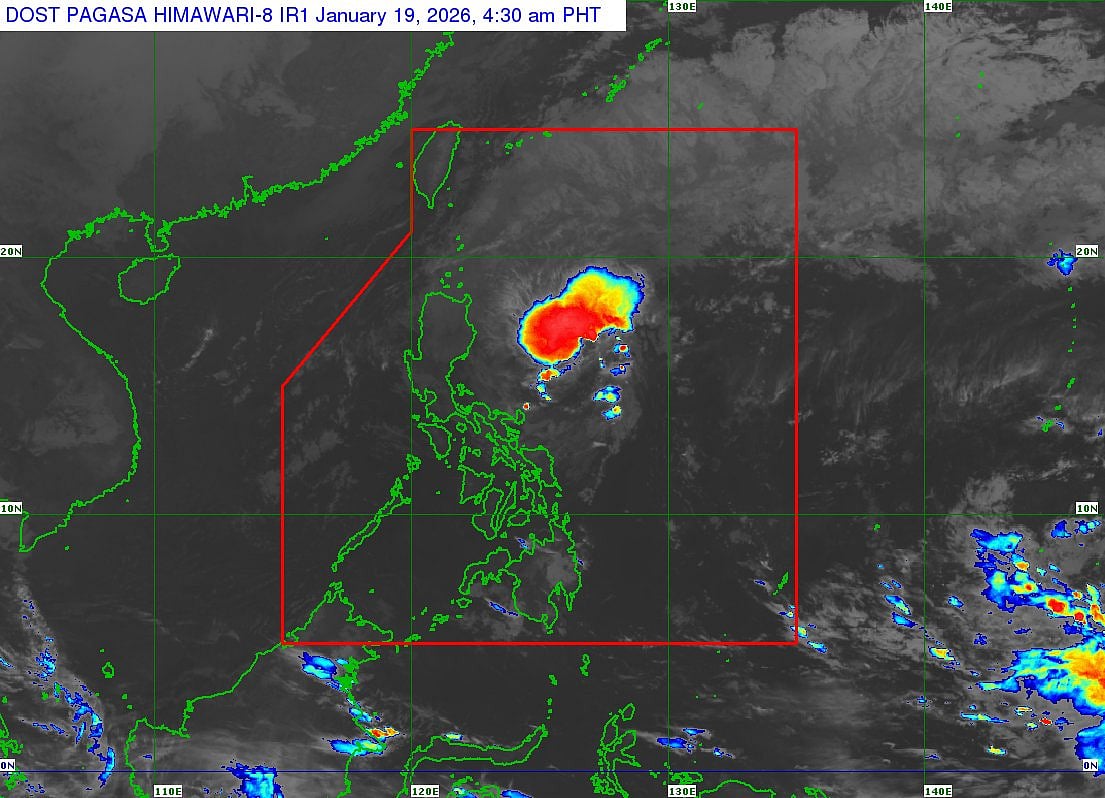
On January 19, 2026, the Philippine Atmospheric, Geophysical, and Astronomical Services Administration (Pagasa) reported that Tropical Storm Ada, internationally known as Nokaen, has weakened into a tropical depression.
The latest satellite imagery from the Himawari-8 IR1, captured at 4:30 am PHT, shows a disorganised cloud cluster with intense convective activity —indicated by red and yellow hues representing cold cloud tops — centred over the Philippine Sea, east of central Luzon.
A red bounding box in the image highlights the storm's core, encompassing parts of the Visayas and Luzon, with scattered thunderstorms extending southward.
According to Pagasa's 5am bulletin, Ada's center was estimated at 385 km east of Casiguran, Aurora (16.2°N, 125.7°E), with maximum sustained winds of 55 km/h and gusts up to 70 km/h.
The weather system is moving north-northeast at 10 km/h, influenced by the northeast monsoon, which is accelerating its weakening.
All tropical cyclone wind signals have been lifted as Ada moved away from the Philippine landmass, reducing direct threats.
Residual effects
Despite the downgrade, residual effects persist.
Cloudy skies with scattered rains and thunderstorms are expected in the Bicol Region, Aurora, Quezon, and Northern Samar due to Ada's trough, potentially causing flash floods or landslides from moderate to heavy rains.
Earlier reports noted flight cancellations and heavy rainfall warnings for January 17-19.
da, the first tropical cyclone of 2026, formed from a low-pressure area east of Mindanao and briefly intensified into a storm before weakening.
Looping track
Forecasts indicate Ada will follow a looping track over the sea east of Luzon starting January 20, possibly dissipating into a low-pressure area by January 21.
Pagasa urges residents in affected areas to monitor updates, as changes in track remain possible.
Overall, while risks have diminished, vigilance is key amid the ongoing northeast monsoon enhancing rainfall across northern Luzon.
This event highlights the early start to the 2026 cyclone season in the Western Pacific.
Sign up for the Daily Briefing
Get the latest news and updates straight to your inbox
Network Links
GN StoreDownload our app
© Al Nisr Publishing LLC 2026. All rights reserved.