Members of a Filipino family take in the scenic beauty of Lake Kawaguchiko, with Mt. Fuji standing majestically in the background. Photo taken on March 30, 2026.
Visa-free travel: Philippine passport opens doors to more destinations in latest global ranking
Competing global rankings, differing methods put Philippine passport in varied spots
Last updated:
4 MIN READ
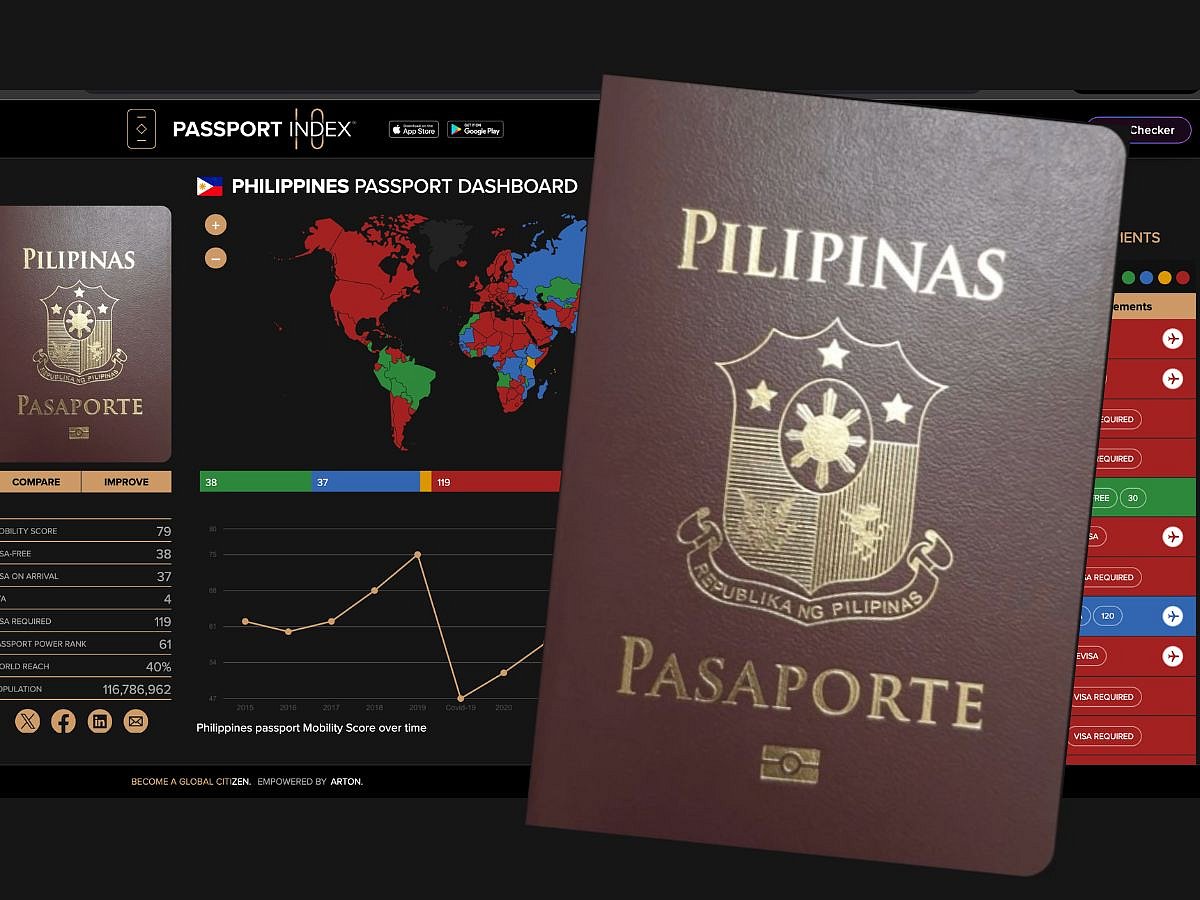
The latest dashboard shows the Philippine passport with a Mobility Score of 79, allowing access to 79 destinations through a combination of 38 visa-free destinations, 37 visa-on-arrival countries and 4 electronic travel authorisation (eTA) destinations.
Passport Index
Manila: The Philippine passport has posted an improvement in global travel mobility, highlighting gradual gains in visa access for Filipinos.
The latest Passport Index dashboard shows the Philippine passport with a Mobility Score of 79, allowing access to 79 destinations through a combination of 38 visa-free destinations, 37 visa-on-arrival countries and 4 electronic travel authorisation (eTA) destinations.
Also In This Package
Major Indian passport update: Visa-free list revealed
Pakistan passport ranking slips: Updated visa-free list
UAE retains title of world’s most powerful passport
Philippine passport gains momentum on new visa waivers
Major travel shift: Top e-visa destinations for Indians
Philippines passport unlocks new visa-free travel perk
Passport Index also lists the Philippine passport at 61st overall in its Passport Power Rank, following a recent update of its real-time database, to reflect bilateral visa policies.
The figures shown in the dashboard indicate a slight improvement from Passport Index's earlier ranking in 2026, which listed a mobility score of 78 and a rank of 62.
When Passport Index places the Philippine passport at 61st globally, it means Filipinos enjoy easier access to more countries than citizens of many other nations, although the passport still trails those of the world's strongest travel documents.
In May the Henley Passport Index placed the country at 66th, with visa-free or visa-on-arrival access to 67–75 destinations back then.
Filipinos continue to face visa requirements across much of Europe — particularly the 29-member Schengen nations — North America and other major destinations.
Visas remain required for 119 destinations for Filipinos, representing a global reach of about 40%.
The Passport Power Rank is a measure of how much travel freedom a passport gives its holder. The Philippine passport offers relatively strong mobility within Southeast Asia and growing access across parts of Latin America, Middle East, Africa, Oceania, and the Caribbean. Filipinos can travel visa-free to Asean + Hong Kong, and Macau, while several other countries offer convenient Visa on Arrival or eVisa programs.
| Category | Territories/Countries | Notes |
|---|---|---|
| Visa-Free | Barbados, Bolivia, Brazil, Brunei, Cambodia, Colombia, Costa Rica Côte d'Ivoire (Ivory Coast), Dominica Fiji, Haiti, Hong Kong, Indonesia, Kazakhstan, Kiribati, Laos, Macao, Malaysia, Micronesia, Mongolia, Morocco, Myanmar, Paraguay, Peru, Rwanda, Singapore, St. Vincent and the Grenadines, Suriname, Taiwan (extended to July 31, 2026), Tajikistan, Thailand, Vanuatu, Vietnam, Cook Islands | Direct entry with a valid passport; no prior application or fee required. Durations vary. Ideal for spontaneous trips! |
| Visa on Arrival (VOA) | Burundi, Comoros, Djibouti, Ethiopia, Guinea-Bissau, Iran, Kyrgyzstan, Madagascar, Maldives, Marshall Islands, Mauritius, Nepal Nicaragua, Palau, Saint Lucia, Samoa, Senegal, Timor-Leste, Trinidad and Tobago, Tuvalu | Issued at airport/port upon arrival (often with fee, onward ticket, and proof of funds/accommodation required); Many offer 30–90 days stay. |
| eVisa/eTA/Entry Clearance | Armenia, India Nepal, Sri Lanka, Uzbekistan, Gabon, Gambia Guinea, Japan (Group e-Visa) Mauritania, South Sudan, Tanzania, Togo, Uganda, Ukraine, Papua New Guinea (eVisitors), Seychelles, | Apply online in advance (quick approval, low/no fee in many cases). Hybrids allow eVisa or VOA choice. Convenient for planning ahead. |
Passport Index regularly revises rankings as governments introduce or remove visa requirements.
Its latest dashboard reflects the Philippines' broader recovery in international mobility following the pandemic and amid the Middle East war.
After mobility scores fell sharply during the global travel shutdown in 2020, the country's travel access steadily rebounded from 2021 onward before reaching one of its strongest performances in recent years.
A family poses for photos during the Lunar New Year celebrations, known in Vietnam as Tet, at Hoan Kiem lake in Hanoi on February 20, 2026.
Challenge for Filipino diplomats
The Philippine passport continues to rank behind several Southeast Asian neighbours.
Countries such as Singapore, Malaysia and Thailand generally provide broader visa-free access for their citizens, reflecting decades of diplomatic agreements and reciprocal travel arrangements.
Travel analysts note that passport rankings are influenced by international diplomacy, reciprocal visa waivers, security cooperation and immigration policy rather than economic strength alone.
And while new visa exemptions or electronic travel authorisation systems can immediately alter mobility scores, geopolitical developments (such as wars or tariffs) may reduce travel access just as quickly.
Economic gains
The Philippine economy, despite reports of massive infrastructure-related kickbacks and geopolitical challenges, has seen dramatic improvements. Within the Southeast Asian region, the Philippines’ GNI per capita currently sits near the middle of the developing market pack.
The Philippines nearly cracked the Upper-Middle-Income Country (UMIC) status, coming up short by just $26, as per World Bank data for fiscal year 2026.
A scene at the Bonifacio Global City (BGC) a district of Manila. The Philippines' 2024 Gross National Income (GNI) per capita reached $4,470, though it remained under the World Bank's required UMIC threshold of $4,496.
Different methodologies
Comparisons between global passport rankings should be made carefully because major indexes use different methodologies.
Passport Index, operated by Arton Capital, calculates mobility by combining visa-free, visa-on-arrival and other entry arrangements into its proprietary scoring system.
By contrast, the Henley Passport Index ranks passports primarily according to the number of destinations accessible without obtaining a visa before departure, using data from the International Air Transport Association (IATA).
Because of those methodological differences, the same passport may occupy different positions across competing rankings.
Recent media reports have likewise presented varying figures for the Philippine passport, reflecting updates made at different points during the year.
Some reports cited a mobility score of 77 with slightly different rankings before later Passport Index revisions increased the country's score.
For Filipino travelers, the latest dashboard nevertheless points to a positive trend: incremental improvements in international mobility.
While obtaining visas remains necessary for many high-demand destinations — including much of the Schengen Area, the US and Canada — the latest Passport Index data suggest Philippine passport holders now enjoy their widest travel access in several years, underscoring gradual progress in the country's global mobility profile.
Sign up for the Daily Briefing
Get the latest news and updates straight to your inbox
Network Links
GN StoreAbout Gulf NewsTerms & ConditionsReach by GNSitemapContact usPrivacy PolicyGN FocusHave your sayWork with usAdvertise with usGulf News epaperPrinting Services
Download our app
© Al Nisr Publishing LLC 2026. All rights reserved.