"BiDaKidney", a low-cost peritoneal dialysis (PD) device developed by engineering students Andrew Jacob Buensalido and Allyson Cabrestante, bagged the top Philippine prize of the 2026 James Dyson Award.
Filipino students develop low-cost machines for dialysis, stroke patients
Low-cost Filipino medical devices bring automated dialysis and rehab beyond hospitals
Last updated:
5 MIN READ
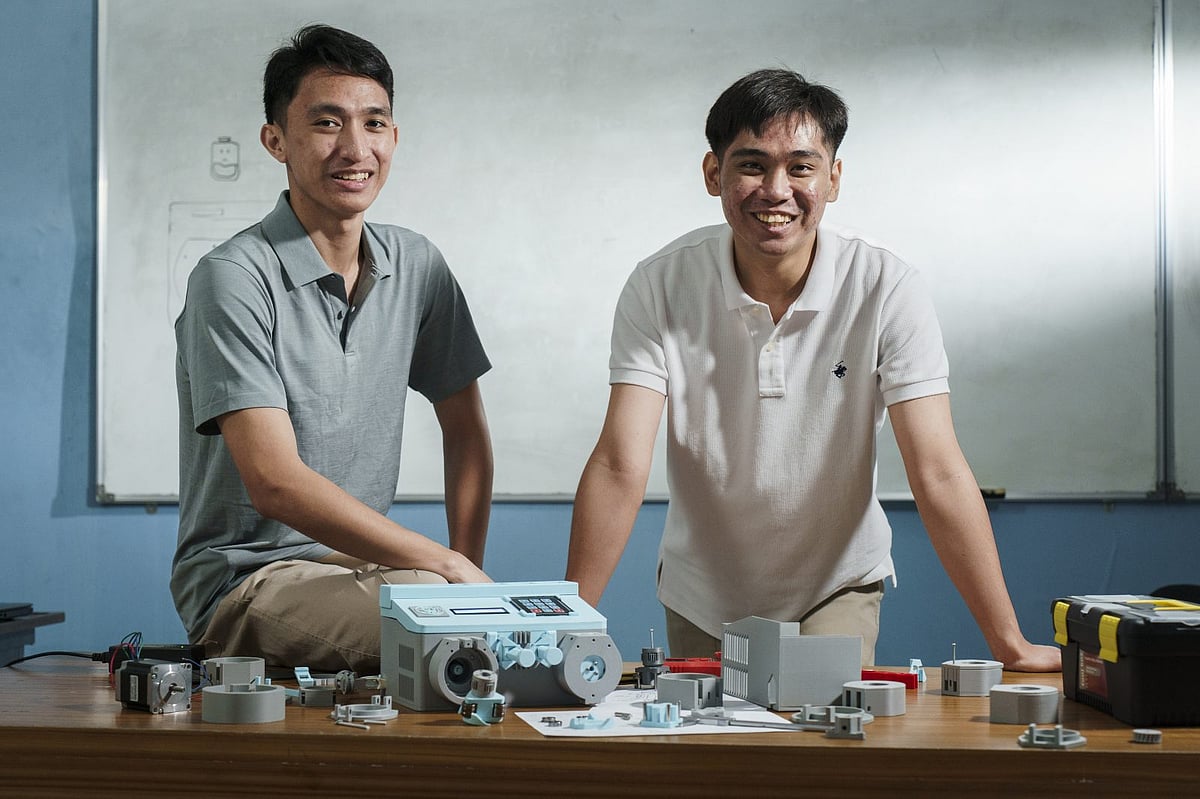
Filipino engineering students Andrew Jacob Buensalido and Allyson Cabrestante snagged the James Dyson prize for developing a low-cost automated peritoneal dialysis machine that costs about $100 vs regular dialysis machines that cost about $10,000.
UP Diliman
Two Filipino student teams have developed low-cost medical devices aimed at helping dialysis and stroke patients manage treatment and rehabilitation — and won the top two Philippine prizes in the 2026 James Dyson Award.
"BiDaKidney", developed by Andrew Jacob Buensalido and Allyson Cabrestante, was named the Philippine national winner, while OrthoFlex, created by Jabez Bote and Ada Koreen Bacay, was the national runner-up.
Both projects were developed at the University of the Philippines (UP) Diliman Campus, Department of Mechanical Engineering.
Get it: Fast, verified news for FREE ... download the Gulf News app — simply click here
The projects tackle different medical problems but share a similar mission: simplify existing technology, make it portable and reduce the cost of accessing care.
Both projects illustrate a local approach to medical engineering: rather than attempting to reproduce expensive gear, the students have started with existing treatment methods and found ways to automate, redesign and strip them down to make essential care more affordable.
There are two types of dialysis: haemodialysis and peritoneal dialysis (PD). With haemodialysis, blood is pumped outside the body through an artificial filter (dialyzer) to clean it, a process usually done 2 to 3 times a week (4 to 5 hours per session) at a specialised dialysis centre or hospital.
With PD, a cleansing fluid is washed inside the abdomen — the body's abdominal lining (peritomneum) acts as the filter.
This process that can be done at home, at work, or while traveling and can be done daily, either manually throughout the day or overnight via an automated machine.
Cleansing fluid, called dialysate, is introduced into the abdomen through a catheter. Waste and excess fluid move into the dialysate, which is subsequently drained and replaced.
A cheaper way to automate dialysis
The BiDaKidney creators explained that their device is a "semi-automated" PD machine designed to work with widely available manual PD sets.
Manual PD is relatively simple but requires patients or caregivers to manage repeated fluid exchanges. The process relies on gravity and careful handling of the tubing and fluid.
Automated peritoneal dialysis, on the other hand, uses a machine known as a "cycler" to control the fill, dwell and drain cycles.
The problem is cost.
The BiDaKidney team says commercial automated cyclers can cost more than $10,000, putting them beyond the reach of many patients, particularly in lower-income settings.
The BiDaKidney gear is designed as an "upgrade" to manual PD — rather than as a replacement for high-end commercial cyclers.
The team's target price is about $100, or roughly ₱6,200, according to the James Dyson Award entry — that's around 1% of the cost of commercial cyclers.
Pumps
The device uses peristaltic pumps to move dialysate without directly exposing the fluid to the pumping mechanism, while load cells monitor the amount of fluid being delivered and drained.
A chip, or microcontroller, automates the treatment sequence, including pump speed, tube-clamp operation and recording the amount of dialysate transferred and the number of cycles completed.
The machine weighs about 2.5 kg and is designed to use the inexpensive PD sets patients already use, avoiding specialised consumables.
That could give patients greater flexibility to undergo treatment at home or while away from a hospital.
Challenge
The prototype still requires further development and formal clinical testing and regulatory approval before it could be considered for routine medical use.
The team says future work includes clinical testing, broader patient evaluation and redesign for scalable manufacturing.
For Buensalido, the goal was not simply to build another machine.
“We were thinking about how we could help patients spend less of their lives managing dialysis and more of their time living it,” he said.
“If treatment at home can become simpler, safer, and cheaper, patients may be able to continue their care with greater confidence and independence.”
The inspiration was also personal to the team: one of the inventors has a sibling working as a healthcare provider at a Philippine government hospital, where they saw the conditions faced by dialysis patients.
The team says about 2.3 million Filipinos live with chronic kidney disease, with nearly 39,000 Filipino deaths annually attributed to the condition, figures cited in its James Dyson Award entry.
OrthoFlex brings repetitive stroke therapy outside hospitals
The second UP Diliman project, OrthoFlex, takes aim at another major challenge: access to rehabilitation after a stroke.
It is a motor-driven elbow exoskeleton designed to provide repetitive flexion-and-extension exercises for patients whose arms have been affected by stroke.
Orthoflex aims to address post-stroke rehabilitation, designed to provide an additional option for patients who cannot afford regular physical-therapy services. The patient's upper arm, forearm and wrist are secured with Velcro cuffs. The device is then connected to power and paired with a smartphone through Bluetooth.
The concept is straightforward.
The patient's upper arm, forearm and wrist are secured with Velcro cuffs. The device is then connected to power and paired with a smartphone through Bluetooth.
Using a companion app, the user can select flexion or extension and control the movement. A stepper motor drives the elbow through a mechanically limited range of 0 to 135 degrees.
The designers built the mechanical limit into the geared mechanism as an additional safety feature, rather than relying solely on electronic controls.
Addressing practical problem
The project addresses a practical problem in Philippine healthcare: rehabilitation services can be expensive and are concentrated in urban and private facilities, while there are not enough therapists to meet demand.
For stroke survivors, repetitive range-of-motion exercises can be an important component of rehabilitation, particularly during the early recovery period.
The OrthoFlex team says its device could provide an additional option for patients who cannot afford regular physical-therapy services.
Target price: ₱10,000 (about $160)
Cost is central to OrthoFlex's design.
The team's prototype cost about ₱3,500, while its calculated retail price is around ₱10,000.
The James Dyson Award entry says comparable products cost at least ₱25,000.
The students also designed OrthoFlex to be field-serviceable. Components such as the motor housing and cuffs are attached with screws rather than permanent adhesives, allowing worn or damaged parts to be replaced individually. The design is not yet a completed commercial medical device.
The team says future development includes adding a battery for full portability and a dedicated physical emergency-stop button independent of the smartphone application.
The current companion app is Android-based, with iOS support also identified as a future development.
International competition
The two projects now move on to the international stage of the James Dyson Award, an annual competition organised by the James Dyson Foundation to recognise student and recent-graduate design engineers.
The competition looks for inventions that address clearly defined problems through practical engineering and considers both technical and commercial viability.
BiDaKidney has already received the Dr Francis Chua Innovation Award and placed first in the UP Diliman College of Engineering's 2026 University Project Competition design category.
It was also recognised as the department's Best Capstone Project at its June 2026 colloquium.
OrthoFlex was a top-10 finisher in UP Diliman Mechanical Engineering's capstone projects and was nominated for the department's undergraduate project competition design category.
The next stage will bring together national winners and runners-up from participating countries.
A global team of Dyson engineers will select the international Top 20, with the shortlist scheduled for announcement on October 14. James Dyson will then select the global winners, to be announced on November 4.
For the Filipino teams, the larger significance may extend beyond the competition itself.
Network Links
GN StoreAbout Gulf NewsTerms & ConditionsReach by GNSitemapContact usPrivacy PolicyGN FocusHave your sayWork with usAdvertise with usGulf News epaperPrinting Services
Download our app
© Al Nisr Publishing LLC 2026. All rights reserved.