Rodrigo Duterte, former Philippines President.
Duterte’s secret killers exposed: How death squads terrorised Philippines for decades – can justice finally win?
Duterte championed vigilante justice amid rising drug pushers, petty thieves
Last updated:
8 MIN READ
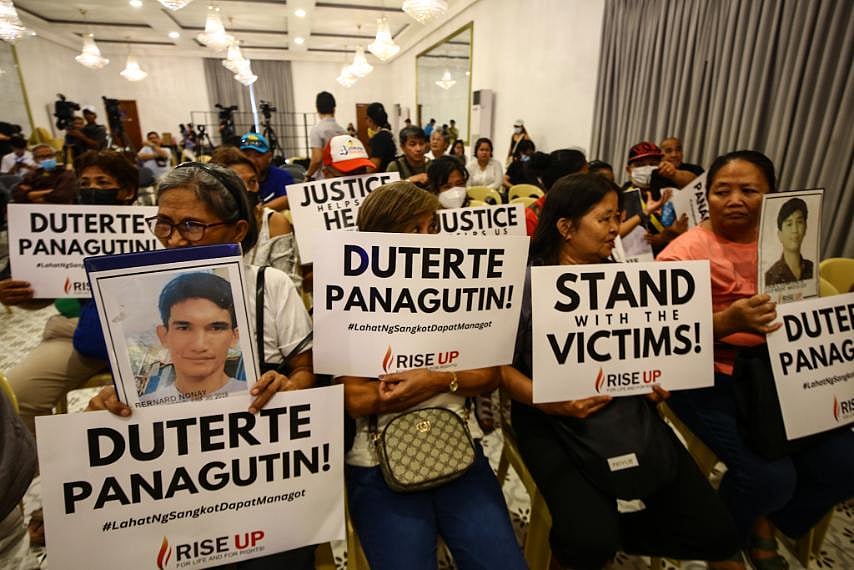
DUTERTE WATCH. Relatives and supporters of alleged extrajudicial killing victims watch the confirmation of charges hearing of former president Rodrigo R. Duterte at the University of the Philippines-Diliman in Quezon City on Monday (Feb. 23, 2026). The International Criminal Court at The Hague, the Netherlands started the first of four sessions to determine if there are enough evidence to try Duterte for crimes against humanity charges related to his anti-drug war as Davao City mayor and as Philippine president. (PNA photo by Joan Bondoc)
PNA
Manila: In 2016, as he campaigned for the presidency, Rodrigo Roa Duterte made inflammatory remarks about his planned war on drugs, saying that the fish in Manila Bay would grow "fat" from the bodies of criminals.
It was music to the ears of many Filipinos frustrated by terror, drugs and crime.
'Undefeated, undefeatable'
Duterte is an "undefeated" and "undefeatable" politician in Davao, where he ran practically unopposed in various posts.
The maverick ex-mayor, known as "The Punisher", has stated on many occasions that he's "happy" to kill.
The statement foreshadowed the violent anti-drug campaign that would define much of his presidency (2016-2022).
Operation 'Tokhang'
Soon after Duterte took office in June 2016, having defeated ex-senator Mar Roxas with a massive lead of 16+ million votes, police launched thousands of anti-drug operations, known as "Tokhang", across the country.
It was a popular move. A number of Filipino Catholic bishops voiced out support for the campaign.
Under Duterte, cops and the military saw their salaries double.
Then, it kicked off a slippery slope of death.
Human rights groups estimate that thousands were killed, many in impoverished urban communities.
In 2017, fishermen in Manila told Al Jazeera that they had been paid by unidentified men, allegedly linked to authorities, to dispose of bodies in Manila Bay.
The fishermen described corpses wrapped in packaging materials and weighed down before being thrown into the water, treated “like trash.”
Communities and densely populated slum areas in Manila, became epicentres of the crackdown.
In April 2020 The New York Times reported that at the height of the campaign, as many as five people a night were being killed in one slum district alone.
Residents described nightly gunshots, masked assailants, and pervasive fear. International media also documented bodies surfacing in waterways.
In 2018, BBC reported that dozens of corpses had been recovered from a river in Bulacan province north of Manila, many bearing signs consistent with drug war executions.
The Philippine government has consistently maintained that police acted in "self-defence" during legitimate anti-drug operations.
However, domestic and international watchdogs have called for independent investigations, arguing that the scale and pattern of killings suggest possible extrajudicial executions.
As scrutiny intensified, the International Criminal Court (ICC) opened an inquiry into alleged crimes against humanity linked to the drug war, examining whether the killings were systematic and state-sanctioned.
Duterte has repeatedly cursed the ICC during and after his presidency, claimed it had no jurisdiction over him.
Origins: Davao Death Squad (DDS) in the 1990s
The term Davao Death Squad (DDS) originally referred to a clandestine group of gunmen active in Davao City during the 1990s and 2000s while Rodrigo Duterte served as mayor. These hit teams were accused of targeting alleged drug pushers, petty criminals, and other marginalised people without due process.
The DDS emerged in the climate of rising violent crime and a citizen demand for “tough” measures. Duterte publicly endorsed harsh methods, including vigilante-style executions and intimidation.
Human rights groups documented numerous suspicious killings and alleged police involvement; some victims included street children and those suspected of minor offenses.
Duterte sent Leila Delima, the Philippines' Justice Secretary who led the probe on DDS, to jail trumped up charges. She spent 7 years behind bars, freed only after witnesses recanted their statements after Duterte left office.
Why the death squads were created
In Davao, the DDS were framed as the preferred solution to crime and disorder. Their methods bypassed the justice system:
They operated outside formal law enforcement oversight, often in plain clothes or with police links.
Members were allegedly paid for “neutralising” targets, creating a perverse incentive structure.
Duterte and associates often portrayed this brutality as necessary to restore peace and order.
This "model" — sometimes called the Davao model — was later expanded into the national “war on drugs” after Duterte became president in 2016.
National expansion: Duterte’s 'war on drugs'
When Duterte won the presidency in 2016 campaigning on an anti-crime platform, he nationalised the approach:
The so-called "war on drugs" led to thousands of killings across the Philippines.
Officials and human-rights groups estimate 6,000 to 30,000 deaths linked to police operations and vigilante actions.
Most victims were alleged drug users or small-scale peddlers.
Investigators noted similarities between the DDS’s operations and later drug war killings — patterns of extra-judicial executions, lack of transparency, and minimal accountability.
Investigations into DDS and drug war killings
Domestic inquiries
Senate hearings, especially in 2016 and years after, investigated extrajudicial killings (EJK) linked to both DDS and the national drug war.
Former participants were called to testify.
International scrutiny
The International Criminal Court (ICC) opened pre-trial hearings into Duterte for crimes against humanity, alleging a coordinated plan involving Duterte and his networks to commit killings.
ICC prosecutors alleged that the violence was systematic, sometimes incentivised, and included thousands of civilian deaths.
Who are Lascañas and Matobato?
Arturo Lascañas
A retired police officer and former DDS operative, Lascañas initially denied involvement but later confessed to participating in extrajudicial killings under Duterte’s orders in Davao.
The self-confessed leader of the Davao Death Squad accused Philippines President Rodrigo Duterte of ordering mosque
His testimony described payment systems, disposal of bodies, and alleged leadership ties.
Retired police officer Arturo Lascanas speaks during a news conference at the Philippine Senate in suburban Pasay, south of Manila, on Monday, February 20, 2017.
In 2017, CNN reported that the self-confessed leader of the Davao Death Squad accused Philippines President Rodrigo Duterte of ordering mosque bombings and the murder of a journalist during his time as Davao mayor.
In a news briefing in 2017, retired Lascañas backed up 2016 allegations made by former hitman Edgar Matobato, including claims of 300-member execution squad run out of the southern city of Davao.
“I was one of those who started it,” he said. “We implemented the personal instructions of (then-Mayor) Duterte to us. All of the killings we did in Davao city, whether we buried or threw them out to sea.”
At a press conference organised by opposition Senator Antonio Trillanes IV, retired police officer Arturo Lascañas said he was coming forward “to follow God’s will … and for love of my country and my own conscience.”
Lascañas alleged that the so-called Davao Death Squad carried out numerous killings and other criminal acts on orders from then-Davao City mayor Rodrigo Duterte or his close associates. Duterte served as mayor of Davao City beginning in 1988, returning to the post in multiple terms over the following decades.
Among the most serious accusations, Lascañas claimed that in 1993 the squad was ordered to bomb mosques in Davao City in retaliation for an attack on San Pedro Cathedral.
He also said he personally received instructions from Duterte to carry out certain operations.
“It’s true, I was one of those who received personal orders from Mayor Duterte,” Lascañas said.
He further alleged involvement in the 2003 killing of radio broadcaster Jun Pala, claiming that he and others were told Duterte was “very angry” with the journalist. According to Lascañas, after Pala survived two earlier attempts on his life, he briefly encountered Duterte at a Davao mall and was told not to rush the operation.
“He told me, ‘Take time,’” Lascañas recounted. “Jun Pala was killed. Two days later, we were given by Mayor Rody Duterte … an amount of 3 million pesos.”
Lascañas said that during his time with the alleged death squad, he was typically paid between 20,000 and 100,000 pesos per killing and received allowances from the mayor’s office. In one of his most shocking claims, he said he had killed two of his own brothers because of what he described as “blind loyalty” to Duterte, alleging they were involved in illegal drugs.
“It was a very painful decision for me,” he said. “No one knew about what I did but me.”
Duterte and his allies have repeatedly denied the existence of an organised death squad or any direct involvement in extrajudicial killings.
Pala’s murder remains unsolved.
Edgar Matobato
A self-confessed member of the Davao Death Squad, Matobato also testified under oath, claiming he personally committed killings and witnessed Duterte’s involvement.
After years in hiding, reports indicate Matobato was able to leave the Philippines under a fake identity amid safety concerns.
A confessed assassin for the Davao Death Squad, he was the first to go public about the killings allegedly ordered by former President Rodrigo Duterte.
Edgar Matobato gestures as he testifies before the Philippine Senate in Pasay, south of Manila, Philippines on Thursday, Sept. 15, 2016.
The Philippine Center for Investigative Journalism (PCIJ) reported that Matobato has been on the run since 2014, when was detained and brutally tortured by his former comrades.
For 10 years, an unlikely network kept him alive: Catholic clergy who believed in his redemption, former military mutineers who shielded him, and, at one point, the security detail of an outgoing president.
Together, they helped him evade the powerful forces intent on silencing him.
Today, Matobato "is out of the country", having fled in the company of two priests, a journalist, and a photographer from The New York Times.
With his wife at his side, he assumed a new identity, slipped through airports under cover, and landed in an unnamed country.
It is an indefinite stop on his way to the ICC in The Hague, where Duterte may one day stand trial for crimes against humanity.
His journey, from a recruit into a brutal profession, to whistleblower, to fugitive, is a remarkable tale that mirrors the country’s complex relationship with violence, power — and redemption.
Both insiders have been cited as key witnesses in both domestic and international investigations due to their first-hand accounts.
Culture of death and impunity
Duterte’s rhetoric — including boasting about death squads and endorsing violence — helped normalise extrajudicial actions for some sectors of society.
Human rights organisations argue that impunity — the lack of meaningful prosecution for perpetrators — became a defining pattern.
Only a handful of cases have led to conviction, even after thousands of killings.
This has contributed to weakened trust in legal institutions, fear among communities, and a perception that violence can be tolerated if framed as “crime control.”
Juan “Jun” Pajadora Pala Jr, a Davao radio commentator (DXGO), was killed while walking home with companions in Davao City on September 6, 2003. Pala was known for his fiery criticisms of communist rebel groups. His radio show has also focused on exposing corruption among local politicians, as per the Manila-based Center for Media Freedom and Responsibility (CMFR). His companions sustained minor injuries.
Cruelty, human rights, and wrongful targets
Investigators and rights groups have criticised the drug war for:
Targetting suspected addicts and petty pushers without due process.
Failing to differentiate between serious crime and minor drug involvement, often leading to disproportionate punishment.
Disrespect for human rights standards guaranteed by the Philippine Constitution and international law.
Many families of the victims remain traumatized, stigmatized, or without closure.
Long-term ramifications
Legal and political
ICC processes and domestic calls for accountability continue to shape politics and legal discourse.
Public opinion is divided, with some Filipinos supporting Duterte’s methods and others demanding justice.
Institutional trust
Confidence in law enforcement and the justice system has been eroded. Many citizens see criminal justice as sidestepped by force.
Human rights culture
The legacy of normalised violence makes future reforms in rights education and accountability more challenging.
The 1987 Philippine Constitution limits presidents to a single term of six years, in a pushback against the 21-year murderous, kleptocratic regime under Ferdinand Marcos Sr. who was ousted in a civilian-backed military coup in 1986.
Can Filipinos reverse the culture of death?
Recovery is possible but not automatic.
It requires:
Accountability for past abuses through transparent legal processes.
Strengthened rule of law and protection of civil liberties.
Public dialogue and education about human rights and community safety.
Many advocates argue that shifting from punitive approaches to public health and rehabilitation for drug issues would help rebuild trust and reduce stigma.
A civic culture rooted in respect for life, due process, and human rights could, over time, counter the culture of death, and a legacy of impunity and fear.
Now, Duterte's daughter, incumbent Vice President Sara Duterte, recently declared her intent to run for president in 2028, potentially replacing President Ferdinand "Bongbong" Marcos Jr, whom the Dutertes accuse as a drug addled.
Network Links
GN StoreAbout Gulf NewsTerms & ConditionsReach by GNSitemapContact usPrivacy PolicyGN FocusHave your sayWork with usAdvertise with usGulf News epaperPrinting Services
Download our app
© Al Nisr Publishing LLC 2026. All rights reserved.