Starlink, with its local partner Data Lake, has been licensed to operate in the Philippines. This allows more than 7,600 islands to get broadband internet at an instant. A Starlink terminal outside a "bahay-kubo" (hut) on Mount Isarog, overlooking the verdant valley in Camarines Sur (a province in eastern Philippine bigger in land area than Dubai). Inset shows a typical speed of a stationary setup.
7,600 islands, one billionaire: Is Elon Musk building his own Philippine paradise?
Billionaire's quiet visits fuel speculation about Philippine island developments
Last updated:
4 MIN READ
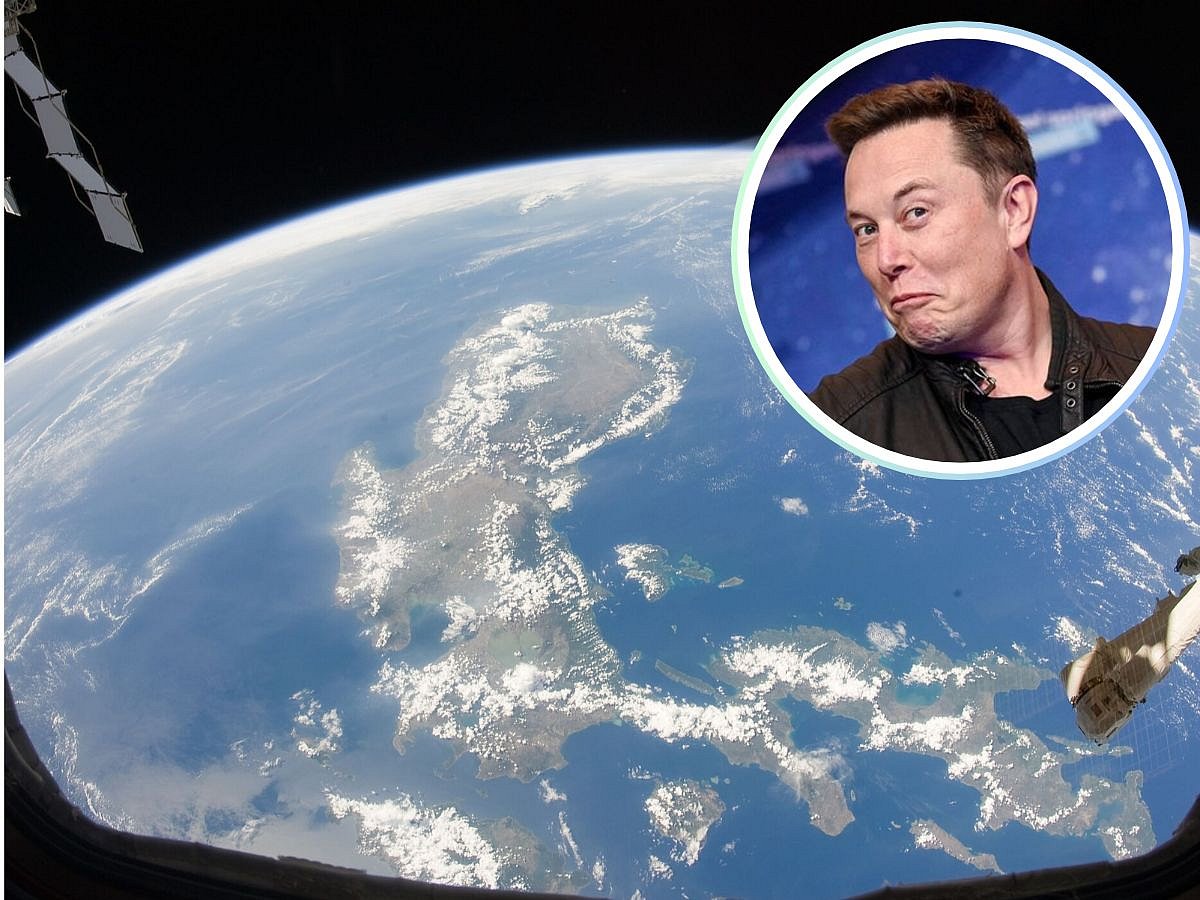
The Philippine islands as seen from the International Space Station (ISS). Elon Musk (inset) has reportedly landed quietly in the capital on Nov. 18, 2026, aboard his private aircraft as part of the business delegation accompanying US President Donald Trump during his Manila visit.
ISS | File photo
Elon Musk reportedly developing '1–2 Philippine islands'
Philippine Ambassador to the US revealed that Musk had arrived in Manila on Nov. 18, 2026 as part of the business delegation joining US President Donald Trump
Is the world’s richest man making a major bet on the Philippines?
Elon Musk may be quietly establishing a presence in the Philippines through the development of "one or two islands", according to Philippine Ambassador to the United States Jose Manuel Romualdez.
The revelation has sparked interest over the billionaire entrepreneur’s potential investments in the country, particularly given his leadership of Tesla, SpaceX, and other tech ventures.
In an interview with ANC on November 19, Romualdez disclosed that Musk had arrived in the Philippines the previous day, Nov. 18, 2026, aboard his private aircraft as part of the business delegation accompanying US President Donald Trump during his Manila visit.
“From what I'm told, Elon Musk comes here quietly very often because he has one or two islands, I'm told, that he's developing,” Romualdez said.
The ambassador described Musk as “very interested” in the Philippines, adding that the billionaire appeared knowledgeable about the country during their personal conversation.
“That's a big sign. The richest man in the world is actually very interested in the Philippines. He loves the Philippines,” Romualdez said.
However, the reported island developments remain unverified.
The ambassador did not disclose the islands' locations, ownership arrangements, investment value, development plans, or project timelines.
Neither Musk nor his companies has publicly confirmed the projects.
What happened during Musk's Philippine visit?
The November 18 visit appears to have been brief.
According to subsequent reporting by ABS-CBN News and the Inquirer:
Musk arrived in Manila at approximately 11:30 am aboard his private aircraft.
He was reportedly part of the American business delegation accompanying Trump.
He did not participate in Trump's official engagements in Manila.
He reportedly waited at the airport before accompanying Trump to China for the APEC summit in Shenzhen.
Romualdez said Musk frequently makes discreet visits to the Philippines.
Manila-based daily Inquirer also sought clarification from the ambassador about the reported island developments.
Why Musk's interest matters
Musk's business empire spans several industries that could have significant implications for the Philippines.
1. Satellite internet and telecommunications
Starlink already operates in the Philippines, the first ASEAN country to offer the service to customers. Its satellite network can provide connectivity to geographically isolated communities, islands, schools, businesses and disaster-hit areas.
2. Electric vehicles and clean energy
Tesla represents opportunities in electric mobility, battery storage, charging infrastructure and renewable-energy integration.
3. Aerospace and space technology
SpaceX could potentially bring opportunities in satellite communications, aerospace supply chains and space-related research.
4. Artificial intelligence and computing
xAI and its computing infrastructure illustrate the scale of investment possible in AI, data processing, energy and advanced digital infrastructure.
These are potential areas of economic relevance, not confirmed components of the reported island projects.
Filipino businessman Glenn Cuarto, a former OFW from the UAE, charges his Tesla Model 3 at a local mall. Location: SM City Cagayan de Oro.
The legal question: Can Elon Musk own Philippine islands?
This is an important distinction.
The Philippine Constitution generally prohibits foreign individuals and corporations from owning private land, subject to limited exceptions. However, foreign investors can enter into long-term land leases.
Under Republic Act No. 12252, signed in September 2025, qualified foreign investors may lease private Philippine land for up to 99 years, subject to requirements including an approved and registered investment and restrictions on the land's permitted use.
Consequently, the ambassador's reference to Musk having islands does not necessarily mean that Musk personally owns the land.
Possible arrangements could include:
Long-term land leases.
Investments through Philippine corporations with legally qualified Filipino ownership.
Partnerships with Filipino landowners or developers.
Tourism, conservation or other approved development ventures.
The actual ownership and investment structure remains unknown.
What remains unknown
Despite the ambassador's statement, several major questions remain unanswered. And as of Nov. 19, 2026, neither Musk nor his companies has publicly confirmed the reported island developments.
The South China Morning Post reported that it had sought comment from Tesla and SpaceX.
The bigger picture: An opportunity for the Philippines?
The Philippines has more than 7,640 islands, an extensive coastline, significant tourism potential and strategic access to major Asian shipping and telecommunications routes.
If the reported projects materialise, they could potentially bring investment in:
Tourism and hospitality infrastructure.
Renewable energy and battery storage.
Telecommunications and satellite connectivity.
Environmental conservation and sustainable island development.
Construction, logistics and local employment.
But the government must ensure that any development respects environmental regulations, coastal communities, indigenous peoples' rights, land-use restrictions and public access to shorelines.
The economic benefits must extend beyond the investor and local property owners.
There is also a wider geopolitical dimension.
Musk's reported interest comes during Trump's visit to Manila and the broader effort to strengthen US economic and technological engagement with the Philippines.
However, there is no evidence that the reported island developments are connected to US government initiatives or any bilateral agreement.
What happens next?
The next important development should be clarification from the Philippine government and the ambassador himself.
Musk's reported interest is potentially significant, but the Philippines should distinguish between attracting a globally influential investor and securing an investment that delivers measurable benefits.
Starlink's benefits for an archipelago like the Philippines, however, is beyond dispute, especially when it comes to disaster or crisis response.
The country needs more than wealthy investors acquiring or developing beautiful islands. It needs productive investments that generate jobs, transfer technology, improve infrastructure, strengthen local industries and protect the country's natural resources.
Network Links
GN StoreAbout Gulf NewsTerms & ConditionsReach by GNSitemapContact usPrivacy PolicyGN FocusHave your sayWork with usAdvertise with usGulf News epaperPrinting Services
Download our app
© Al Nisr Publishing LLC 2026. All rights reserved.