Why building infrastructure in the Philippines takes so long: The politics of permits, power, property rights
How local governance complicates infrastructure development in the Philippines
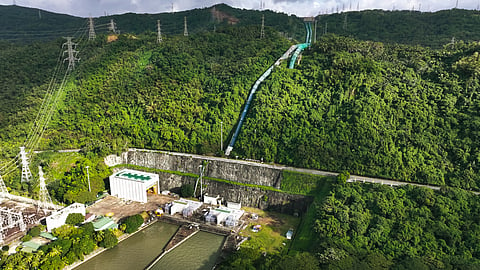
The Philippines does not lack infrastructure ambitions, investors or development plans.
It is rich in human resources and competencies able to compete on the world stage. Every politician, from the Barangay (village) to national, goes around with a sense of mission: improve the lot of their people.
What it often lacks: a predictable, coordinated system for turning projects into reality.
Moreover, there's a sense that local "rights" somehow trump national development plans.
Behind the delays is a permitting culture, and certain ingrained habits.
The culture of "inggit" (envy), "amin dapat ito" (local ringfencing), "dadaan kayo sa butas ng karayom" (I will make life hard for you/You'll pass through a needle's eye), usually directed at project proponents, are hardest to break.
Get it: Fast, verified news for FREE ... download the Gulf News app — simply click here
These are unwritten rules, a part local "superculture". Then there's the usual noise and drama from the hardline environmentalists.
Investors, especially foreign, need to understand these undertones before sinking their money in.
Never mind that such projects do create jobs, ramp up domestic consumption, bring investment dollars to our shores and drive development.
This represents a baggage: it is shaped by local political power, fragmented government authority, weak institutional coordination and a complicated relationship with capitalism.
A road, bridge, railway, industrial park, special economic zone or power project and even a simple building permit in the Philippines can face a lengthy administrative journey before construction even begins.
The difficulty is not simply the number of documents required.
It is the way government authority is distributed, how local politics operates and how communities, officials and businesses interact.
In many cases, developers must first engage the Barangay (or local community), then the municipal or city government, and subsequently the provincial government, alongside national agencies and regulators.
Depending on the project, these layers may involve separate clearances, consultations, endorsements by the "lupon" (council members). That's in addition to labour, fire, zoning approvals and environmental requirements.
This creates a practical problem: several layers of local authority can become three separate points of negotiation, delay and uncertainty.
Anyone thinking of opening even a simple barber shop must grind their way through this gauntlet.
For a new building construction project, that also include mandatory compliance with the Department of Labor and Employment (DOLE) and the Bureau of Fire Protection (BFP).
The arrangement is not universally applicable.
Some permits are issued directly by national agencies, while cities and highly urbanised areas have different administrative arrangements.
Nevertheless, overlapping local responsibilities can make project approval unpredictable at the very least and discouraging at the very most.
The political economy of permitting
The Local Government Code of 1991 institutionalised decentralisation, giving local governments significant responsibilities over land use, local development, permits and public services.
Decentralisation has benefits that are legit: Barangay officials understand their communities; mayors and governors are accountable to local constituents.
Local consultation can identify land disputes, environmental concerns, access problems and potential displacement (especially of natives or historical sites) before construction starts.
But decentralisation becomes a problem when coordination is weak and decision-making is discretionary.
A developer may have secured national government approval, financing and technical clearances, yet still face delays obtaining local endorsements, zoning compatibility, construction permits or other requirements.
Each office may have its own procedures, signatories and interpretation of regulations.
The three-level permitting description is a useful illustration of the local political landscape, not a universal statutory sequence. The ARROW Act principally addresses right-of-way acquisition. It does not eliminate all barangay, municipal, provincial or national permitting requirements. distinction is important when assessing what the reform can actually accomplish.
This is where political relationships can become as important as technical compliance. Some investors solve this by giving local politicians "a piece of the action", in whatever shape or form.
In a political environment where local officials exercise considerable influence over economic activity, businesses may feel compelled to maintain relationships with several political offices. Changes in local leadership can also mean changes in priorities, interpretations and project support.
This does not mean every barangay captain, mayor or governor obstructs investment or is on the take.
Nor does every project require three successive political approvals.
The problem is the absence of a consistently predictable, coordinated permitting system.
The OECD's 2026 Economic Survey of the Philippines identifies precisely this institutional weakness: "burdensome" local permits, fragmented municipal requirements and overlapping agency jurisdictions.
It argues that these regulatory rigidities increase costs and discourage investment.
The complicated Filipino relationship with capitalism
Then there is another dimension that deserves attention: the country's political and social relationship with private enterprise.
It would be inaccurate to say Filipinos generally oppose capitalism.
The Philippines has a vibrant entrepreneurial culture, a large private sector and generations of people who aspire to own businesses, farms and properties.
Capitalism is sometimes viewed through the historical experience of unequal land ownership, political patronage, monopolies, cronyism and displacement.
Capitalism is sometimes viewed through the historical experience of unequal land ownership, political patronage, monopolies, cronyism and displacement.
For communities, a proposed industrial park, expressway, hydro/geothermal power plant or commercial development can represent something very different from what it represents to an investor.
The investor sees employment, infrastructure, productivity and returns.
Residents may see rising land prices, loss of agricultural livelihoods, environmental risks or the possibility that powerful interests will benefit while ordinary people bear the costs.
These concerns cannot simply be dismissed as anti-business sentiment.
Philippine scholarship on crony capitalism and oligarchy, including research by Ateneo and other academics, documents how political connections and concentrated economic power have historically distorted competition and reinforced inequality.
The challenge is that legitimate public suspicion of concentrated corporate power can sometimes become an indiscriminate suspicion of private investment itself.
Here's the rub: the answer to "crony capitalism" is not to discourage capitalism, but to make competition fairer, property rights clearer and public institutions more accountable.
In a country where "accountability" is subject to varying interpretations, people who benefit from loot of taxpayers' money would rather turn a blind eye.
There's no question that this country needs to ramp up private capital to build infrastructure, expand manufacturing, improve services, generate electricity, bolster logistics and create jobs.
Remarables upgrades seen following the handover of running the Ninoy Aquino International Airports (NAIA) to a private concessionaire led by San Miguel is one such example.
Every job created means a family meal, students kept in school and a better hope for the future.
Government cannot finance every development requirement alone.
What reforms are already happening?
There are important legislative and administrative developments:
1. The ARROW Act: fixing right-of-way delays
Enacted September 12, 2025
Republic Act No. 12289, the Accelerated and Reformed Right-of-Way (ARROW) Act amends the 2016 Right-of-Way Act (RA 10752).
It seeks to accelerate land acquisition for national infrastructure and public-service projects, strengthen compensation arrangements and establish more consistent property valuation.
It also provides safeguards against developments or construction within declared project rights-of-way (ROW) that conflict with approved infrastructure plans, subject to statutory conditions.
Importantly, it recognises private-sector participation in delivering public infrastructure while affirming the constitutional requirement of "just compensation".
In effect, infrastructure projects will no longer be dealt with only by lawyers, via never-ending court cases or "temporary restraining orders" issued by courts, that have been gamified in the past.
2. Executive Order 59: cutting infrastructure red tape
Executive Order 59, issued in 2024, introduced streamlined permitting guidelines for "Infrastructure Flagship Projects" (IFP).
Among its measures are "one-stop processing", fewer signatories, electronic signatures and simultaneous processing of applications. These are major changes that encourages big-money projects.
It also provides for prescribed processing periods and automatic approval or renewal in qualifying circumstances under the "Ease of Doing Business" framework.
The objective: reduce the number of agencies involved and prevent projects from becoming trapped in sequential approvals, per Philippine News Agency.
3. Real property valuation reform
Republic Act 12001, the Real Property Valuation and Assessment Reform Act of 2024, seeks to standardise property valuation through more consistent valuation standards and updated schedules of market values.
This is important because disagreements over land valuation can hold up ROW acquisition and increase project costs.
What still needs to change at the local level?
National legislation alone cannot solve a problem that is partly rooted in local administrative culture.
Four reforms deserve priority.
#1. Establish genuine local one-stop permitting offices. Every municipality, city and province should have a designated infrastructure investment office that coordinates barangay consultations, zoning, environmental requirements and national agency clearances. Investors should not have to personally negotiate the same requirements with multiple political offices.
The OECD's 2026 survey recommends institutionalising Local Economic Development and Investment Promotion Offices as local counterparts to national investment facilitation programmes.
#2. Make permitting rules transparent and uniform. Each LGU should publish its complete list of requirements, fees, responsible officials and statutory processing periods. Applications should be digitally tracked, with written explanations for rejected or delayed submissions.
A barangay endorsement should not become an informal veto over a project that has already satisfied the applicable legal requirements.
#3. Professionalise local economic governance. Technical approvals should be handled by qualified, accountable career officials applying published standards, rather than depending on the personal preferences of elected politicians.
Community consultations should remain meaningful, but they should not become opportunities for arbitrary demands or political bargaining.
#4. Strengthen public consultation and benefit-sharing. Developers must demonstrate that projects will deliver measurable local benefits, including employment, infrastructure improvements, environmental safeguards and fair compensation. Communities should have access to grievance mechanisms and meaningful participation in decisions affecting their livelihoods.
This is particularly important for projects involving agricultural land, ancestral domains and vulnerable communities.
Why these reforms matter: the ASEAN competition
The Philippines seeks to be a manufacturing powerhouse. And it's just right, if it wants to escape the rut of having to "export" their people, mostly women and mothers, to tidy up homes in faraway lands in order to earn dollars.
The Philippines is competing with countries such as Vietnam, Indonesia, Thailand and Malaysia for manufacturing investment, logistics infrastructure, energy projects and supply-chain relocation.
Investors compare more than labour costs and tax incentives.
They consider how long it takes to acquire land, obtain construction permits, connect to electricity, secure environmental clearances and begin operations.
The OECD's 2025 assessment of infrastructure investment in the Philippines identifies lengthy ROW procedures, environmental compliance requirements and insufficient coordination between national and local authorities as persistent challenges.
Every additional month of delay carries a cost: financing charges, contractor expenses, lost production, deferred employment and reduced investor confidence.
The country's reforms are, therefore, not merely about making life easier for project proponent or developers.
Local conderns are important, but they're also part of the big picture: improving the delivery of public infrastructure and ensuring that Filipinos benefit from investment.
The bigger challenge: changing political culture
Ultimately, the Philippines needs to reconsider how it understands the relationship between government, business and development.
Local officials should see investment facilitation as part of their responsibility to constituents, not simply as an opportunity to exercise political influence, or extract "kotong" (grease money).
Barangays should be partners in development, not automatic administrative bottlenecks.
Municipalities and provinces should compete to attract productive investments through efficient governance rather than additional layers of requirements.
At the same time, businesses must recognise that communities are not obstacles to be bypassed.
Development must respect property rights, environmental standards, labour protections and the public interest.
Capitalism without accountability can produce inequality and political favouritism. But government regulation without predictability can also discourage entrepreneurship, investment and job creation.
The Philippines does not have to choose between protecting communities and attracting capital. It needs institutions capable of doing both.
The real measure of reform is not how many investment laws Congress passes, how many projects are announced or how much infrastructure funding is allocated.
It is how quickly, fairly and transparently a legitimate project can move from approval to construction.
Until local permitting becomes a professional public service rather than a fragmented political process, the country will continue paying a price, a development premium that citizens of its neighbouring countries may not have to bear.


