Philippine business groups demand cleanup of ‘deeply troubling’ 2027 budget: Why they said so
Business groups urge Congress to remove unsupported projects from 2027 budget
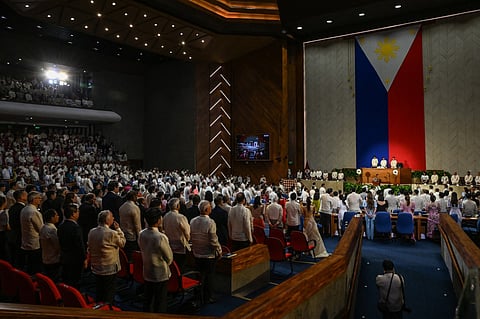
Manila: Filipino business leaders are raising the alarm.
They say the House of Representatives-approved 2027 budget amounting to ₱7.2-trillion ($383.47 billion) carries “deeply troubling” trillion-peso insertions.
Lawmakers, including the president's own son Sandro, are apparently sidelining President Marcos Jr.’s development agenda and diverting calamity funds meant for the public toward their own pet projects.
It includes scrapping funding earmarked to build the Manila Subway, which has so far hit roughly 60% progress.
Filipino congressmen are now facing a backlash.
Budget watchdogs employing line-by-line scrutiny of the General Appropriation Bill (GAB) are up in arms alongside business leaders.
They highlighted behind-the-scenes realignments, also known as "insertions".
The GAB, say the watchdogs, is supposed to contain details of each line item — a road, a building, bridge, health service.
Instead, they found more than ₱1 trillion ($15.7 billion, the equivalent of about 80 Boeing 777s) worth of "insertions", which in the past were used as a backdoor for "tongpats", or kickbacks.
Worse, it showed a low-effort exercise on the part of Filipino lawmakers: the GAB contains scandalous items, including "farm-to-market" roads geolocated in waters off Brunei, Indonesia, Africa and offshore Philippines.
Get it: Fast, verified news for FREE ... download the Gulf News app — simply click here
A joint statement published Oct. 29 by the Makati Business Club (MBC) called on Congress to scrap every “insertion” in the proposed ₱7.2-trillion 2027 budget that lacks a technical basis.
“We find this (reductions in infrastructure and social services) deeply troubling.”MBC, MAP, PCCI and a host of other business and civic groups
Its signatories include the MBC, the Management Association of the Philippines (MAP), the Philippine Chamber of Commerce and Industry (PCCI) and a host of other business groups.
What the watchdog found, and who testified: The People’s Budget Coalition (PBC) co-convenors testified before the Senate finance committee on Monday (Oct. 26): Adolfo Jose “AJ” Montesa and Kenneth Isaiah Abante told senators that over ₱1 trillion of the 2027 budget allocations are red flags. That breaks down into ₱210 billion in “soft pork,” ₱695 billion in “hard pork” and ₱112 billion in “shadow pork.”
“We find this deeply troubling,” the groups stated.
The MBC page lists 27 organisations and explicitly labels the list “in progress.”
Manila Bulletin reported late on Thursday (Oct. 29) that more groups signed the petition, bringing the pro-scrutiny coalition total to 35 groups.
The statement identified the signatories, but they did not formally designate coalition leaders.
What the groups actually flagged
The coalition said the House-approved General Appropriations Bill (GAB), House Bill 10858, added more than ₱180 billion in "allocations" for the Department of Public Works and Highways (DPWH) through the Budget Amendments and Review Subcommittee.
Independent watchdogs said they had found additions covering approximately 6,212 projects, bringing the project count to 16,270.
Many additions appeared as lumpsums.
They are listed for projects like "multipurpose buildings", access and bypass roads without published project lists or named proponents, the coalition cited.
Those are the groups’ assertions.
Co-convenor Kenneth Abante said the amounts were to be channeled through DPWH district engineering offices, but they also attributed them to the lawmakers representing the districts.
For example, the district that topped the list is Ilocos Norte's 1st District — at ₱4.375 billion. That district is represented in the 318-seat House by Sandro Marcos, son of President Marcos Jr.
Civil society groups have called out them out.
While the figures do not establish that lawmakers personally proposed the projects or that corruption occurred, and the watchdog's statement is not itself an official audit establishing that every added project is improper, calls for transparency have emerged.
Civil society groups called for the bicameral budget deliberations to be livestreamed.
'Dagdag-bawas'
What's troubling to the business groups is the "dagdag-bawas" (add-subtract) phenomenon, i.e. "additions" they claimed were financed partly through "reductions" to:
| Program or allocation | Reduction cited by the coalition |
|---|---|
| Foreign-assisted projects | ₱130 billion |
| Calamity funds | ₱9.5 billion |
| EDSA Busway | ₱1.76 billion |
| Health programs| | ₱4.9 billion |
The watchdogs said their job was done with the help of AI to find discrepancies.
The figures attributed to the business group's joint statement are not independently reconciled against every line of the executive and GAB, the House's budget versions.
The listed reductions also should not be assumed to account for the entire ₱180-billion addition.
Ten troubling examples
Documentation gap. Nearly 7,000 House-added projects worth ₱190 billion had no published project attachments.
Public works insertions. About 6,200 DPWH projects worth ₱172 billion, many of them "multipurpose buildings".
Projects plotted at sea. More than 350 farm-to-market roads worth nearly ₱6 billion, some with coordinates in the Celebes Sea and the Philippine "Benham" Rise.
Buildings on the wrong continents. Some buildings appeared to plot to Algeria and Nigeria.
Irrigation costs. More than 200 new irrigation projects worth over ₱7 billion, some with questionable cost estimates. The watchdogs also compared allocations of ₱50–200 million for AI-equipped solar irrigation to bidding documents putting the panels at ₱30,000–40,000 (overpriced).
Health facilities. More than 180 health facilities worth over ₱2 billion were added while overall health facilities funding was cut.
"Ayuda" by referral. The House nearly doubled five aid programs from ₱72 billion to ₱137 billion. Aid often requires a lawmaker’s "guarantee letter" (GL), which makes people asking for financial aid beholden to the incumbent.
Cuts to foreign-assisted projects. About ₱27 billion from the Laguna Lakeshore Road, nearly ₱20 billion from the Metro Manila Subway and ₱15 billion from the North-South Commuter Rail. Numerous Filipino business groups cried foul over these cuts.
Cuts to safety nets. ₱10 billion from pension and gratuity, and ₱7.75 billion from the disaster risk reduction council’s fund.
Missing paperwork at DPWH. Senetor JV Ejercito said only 1,418 of 16,244 projects in the proposed DPWH budget came with "supporting documents".
'Unsupported projects'
Business and civic organisations have urged Congress to strip technically unsupported projects from the proposed 2027 national budget.
They warned that infrastructure additions and cuts to essential programs could damage public trust and investor confidence.
The groups directed their appeal to Senate President Sherwin Gatchalian, House Speaker Faustino Dy III, Senate finance committee chair JV Ejercito and House appropriations committee chair Mikaela Angela Suansing.
“Foreign-assisted projects are the country’s most rigorously prepared infrastructure — backed by feasibility studies, financing commitments, and international procurement standards,” the statement said.
“Raiding calamity funds in a country that is exposed to disasters is indefensible.”
The coalition called for 5 key changes:
The groups are not seeking to block passage. Instead, they are calling to:
Remove additions without feasibility studies or detailed engineering designs, alignment with agency master plans and implementing-agency validation.
Restore the cited reductions unless Congress publicly justifies them.
Remove provisions allowing agencies to modify or replace projects after enactment.
Publish amendments — including locations, amounts, funding sources, justifications and proposing legislators — before specified Senate and bicameral milestones.
Allow no new bicameral items and livestream the conference proceedings.
They explicitly support a timely budget, oppose a reenacted budget and argue that technical scrutiny can be completed within the legislative calendar.
Transparency demands
MAP had already issued an Aug. 27 statement demanding disclosure of congressional and bicameral amendments, including their proponents, amounts and purposes.
It also called for public money to be traceable from appropriation through procurement, implementation, completion and audit.
The DBM’s Aug. 27 presentation independently confirms that the executive’s proposed 2027 budget totals ₱7.2 trillion — ₱407 billion, or 6%, above the 2026 budget.
It described “implementation readiness, fiscal discipline and demonstrable public benefits” as priorities.
That document establishes the executive’s baseline and stated principles; it does not independently validate the coalition’s calculations of later House changes.
In a separate Oct. 29 development, the presidential palace Malacañang appealed for Congress to preserve projects proposed by Marcos.
Why it matters
The dispute affects infrastructure quality, public transport, disaster readiness, health services and investor confidence. Public documentation can distinguish justified amendments from questionable allocations, but the coalition’s warning alone does not establish that every added project is unlawful.
What’s next
Watch Senate revisions, published project details and bicameral negotiations. The coalition wants unsupported items removed, reductions justified and sessions livestreamed. Confirm the evolving signatory count before publication and track whether its demands produce documented changes.


