Philippines ‘ghost projects’: Lacson, Cayetano trade corruption claims as bitter Senate feud reaches new heights
Senators trade ‘ghost project’ barbs as budget insertions face fresh scrutiny
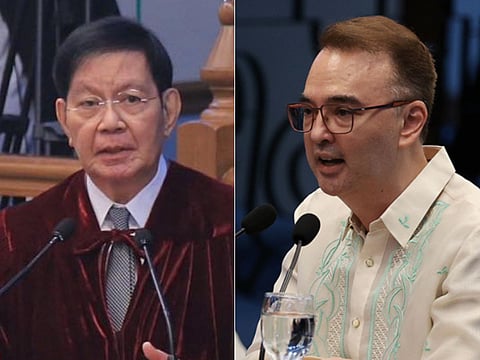
Manila: A war of words between Senators Panfilo Lacson and Alan Peter Cayetano escalated over the weekend, with each accusing the other of questionable wealth and corruption in one of the most bitter public exchanges between two senior Philippine lawmakers in recent years.
Get updated faster and for FREE: Download the Gulf News app now - simply click here
Lacson on Sunday (July 19, 2026) said Cayetano “belongs in the Payatas, Quezon City jail” over alleged corruption, responding to Cayetano’s claim that the net worth of both Lacson and Sen. Erwin Tulfo had more than doubled.


The accusations, made through social media posts and public statements, come amid heightened political tensions following the 2025 midterm elections and renewed scrutiny of lawmakers’ finances and the use of public funds amid accusations of widespread kickbacks.
“My integrity is my first and last line of defence and I will fight to defend it with all my might. Sen Cayetano has crossed the line by attacking it.
“As of this morning, I'm still counting informants and witnesses, directly or through intermediaries, willing to provide information and evidence to put him in his proper place — the Payatas, QC jail,” Lacson told local media.
Dispute over wealth and budget allocations
Cayetano, who has millions followers on Facebook, had alleged that the declared wealth of Lacson and Tulfo had increased significantly, raising questions about the source of their assets.
Lacson rejected the accusation, saying his assets were legally acquired through decades of investments, including real estate and private business ventures.
“My integrity is my first and last line of defence,” said Lacson, a former Philippine National Police (PNP) chief, adding that Cayetano had “crossed the line” by questioning his honesty.
Cayetano behind ₱6.79B budget insertions: Lacson
Lacson then turned the allegations back on Cayetano, accusing him of securing ₱6.79 billion worth of budget insertions under the 2025 General Appropriations Act (GAA).
Lacson claimed that 68 of the 70 projects funded through those allocations had already been implemented, representing about ₱6.715 billion in government spending.
Lacson is going for Cayetano’s jugular alleging the existence of “ghost projects” in Taguig City, Cayetanos’ political stronghold.
Lacson did not publicly present evidence to support the claim.
Cayetano has not publicly responded to those specific allegations.
On Sunday night Politico_Ph quoted Senator Panfilo Lacson saying his camp has identified an alleged “bagman” for Senator Alan Peter Cayetano. That claim has not been independently verified.
It arrives amid deep divisions in the Senate during the impeachment trial of Vice President Sara Duterte, and it is unclear how — if at all — it will affect Senate dynamics or the proceedings.
Cayetano, who served as foreign minister under former President Rodrigo Duterte (the vice president’s father), is a prominent figure in the same political circle, which adds political sensitivity to the allegation.
Lacson cites past attacks against him
In a separate social media post, Lacson recalled earlier allegations made against him by the late retired military intelligence chief Victor Corpus and businessman Ador Mawanay, who had accused him years ago of involvement in illegal drugs and maintaining secret foreign bank accounts.
Lacson said both men later withdrew their allegations and apologised.
“I didn’t back down and proved them wrong,” he said, describing integrity as the greatest legacy left to him by his parents.
A familiar pattern in Philippine politics
The latest exchange underscores a recurring feature of Philippine politics, where corruption allegations frequently become weapons in public disputes among rival politicians.
Such accusations often emerge during periods of political realignment, budget deliberations, impeachment trials or election campaigns.
Many such allegations amount to mudslinging — never resulting in formal criminal charges or convictions.
The controversy also highlights longstanding concerns over the use of so-called budget “insertions” — appropriations added during or after congressional budget deliberations.
While lawmakers argue these allocations fund local infrastructure and development projects, watchdog groups have repeatedly called for greater transparency.
Public-interest groups in the Philippines warn that opaque budget amendments can increase the risk of misuse of public funds, a concern echoed by the World Bank.
Opaque budget amendments and exceptional outlays bypass standard legislative scrutiny and weaken checks and balances.
Without transparency, these modifications create environments vulnerable to rent-seeking, hidden debts, and a high risk of corruptive practices or the misuse of public funds.
The International Monetary Fund (IMF) also warned the IMF emphasises that deviations from approved budgets weaken fiscal discipline and lead to a loss of aggregate expenditure control.
Both the WB and the IMF that opaque amendments distort the allocation of resources and reduce financial flexibility, directly facilitating the misuse of public funds.
Successive administrations have also faced allegations involving ghost projects, referring to government-funded programs that allegedly exist only on paper or were never fully implemented.
Investigations by the Commission on Audit and the Office of the Ombudsman have uncovered such schemes in various agencies over the years, though each allegation requires independent verification.
No formal charges
Neither Lacson’s allegations against Cayetano nor Cayetano’s claims regarding Lacson’s wealth have resulted in formal criminal complaints or findings by the Office of the Ombudsman, the Commission on Audit or the courts.
As the spat intensifies, the exchange reflects broader rivalries within the Philippine Senate, where personal attacks and corruption allegations have increasingly spilled into social media, adding another layer of polarisation to an already contentious political landscape.


