PIA plane crash survivor Zafar Masud (3rd form left) with Aziz Merchant, President of Ismaili Centre in Dubai (4th left) at the event in Dubai.
Meet Zafar Masud: Pakistani banker who survived PIA plane crash
Masud shares lessons on survival, resilience, living deliberately during a talk in Dubai
Last updated:
3 MIN READ
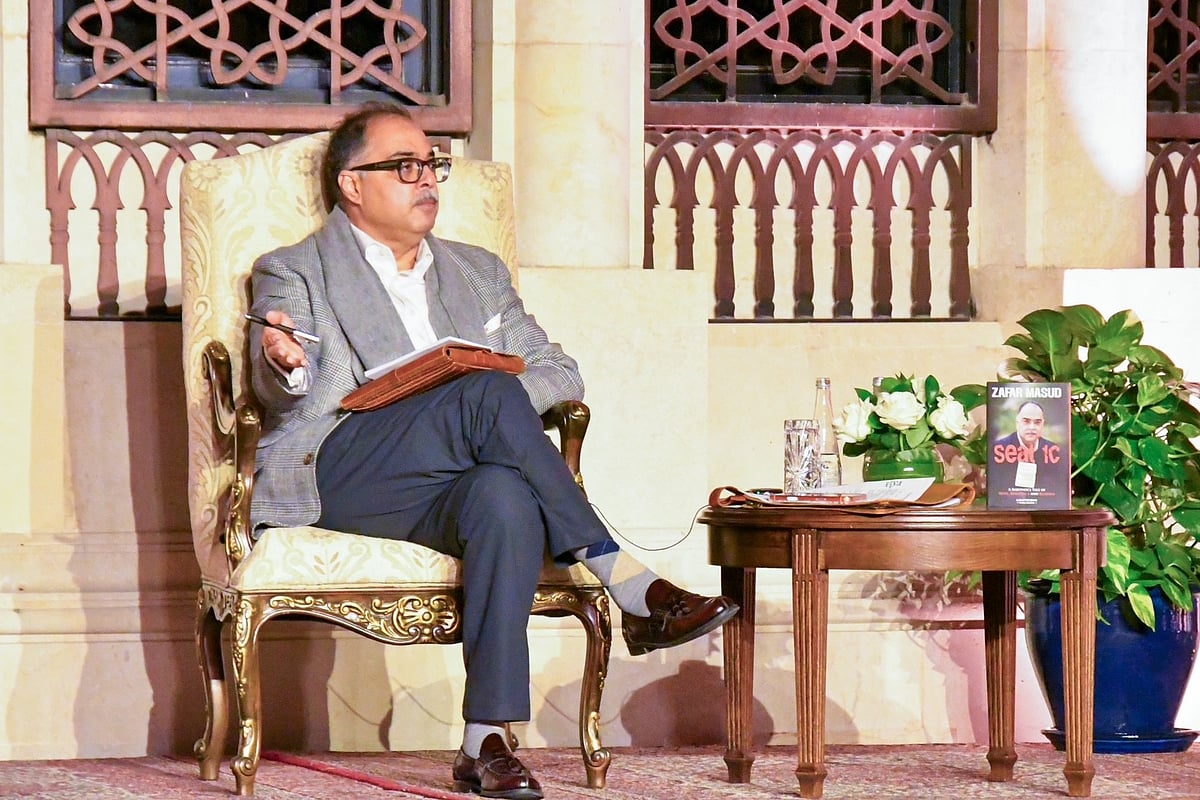
PIA plane crash survivor Zafar Masud during a talk about his book at the Ismaili Centre in Dubai.
Dubai: In the blink of an eye, life can change forever. For Zafar Masud, that moment came aboard PIA flight 8303.
Masud, one of only two survivors of the tragic PIA flight crash in on May 22, 2020, captivated an audience of business leaders, professionals, and community members during a deeply personal book talk in Dubai.
Masud recounted that journey at the Ismaili Centre Dubai during a book talk hosted in collaboration with the Pakistan Association Dubai. The occasion marked a discussion of his internationally acclaimed memoir, Seat 1C: A Survivor’s Tale of Hope, Resilience and Renewal, a story less about tragedy and more about the clarity, purpose, and resilience that emerged in its wake.
Final seconds
“The most remarkable thing in those final seconds was not fear, but an almost disorienting calm. The mental clutter of ambition and planning vanished. Time narrowed, and I saw, with startling clarity, how provisional everything we take for granted actually is,” Masud said.
Masud’s memoir, which has sold thousands of copies internationally and been translated into Spanish, with Urdu and other translations underway, is rooted in reflection rather than spectacle. Writing it forced him to confront truths that no leader wants to face, the limits of control, the fragility of even the most rigorous systems, and the unpredictability of life itself. Masud is a Pakistani banker who is the chief executive officer of the Bank of Punjab since April 2020.
Mastery to meaning
“The crash shifted my focus from mastery to meaning, from trying to dominate outcomes to learning stewardship through uncertainty,” he explained.
Surviving when almost everyone else did not come with complex emotions. “Survival is not something you celebrate lightly. It is something you carry. The memory of those who did not survive demands humility and restraint. I do not dwell on why I lived, but on how I should live differently with attentiveness, responsibility, and purpose,” he reflected.
Masud also emphasised the importance of vulnerability in leadership, openly sharing his experiences with therapy and support systems. “Leaders set the emotional temperature of organisations. Denying our humanity quietly weakens institutions. Openness builds trust and resilience,” he said.
The central lesson
The central lesson of Seat 1C resonates beyond the extraordinary circumstances of a plane crash. “Life is not postponed. We live as though meaning will begin after the next milestone, promotion, or achievement. Crisis shows us that postponement is an illusion. Every moment demands our presence, empathy, and intentionality,” he explained.
For Masud, surviving the crash transformed both his professional and personal outlook. Professionally, he focuses on institution-building rather than personal gain. Personally, he prioritises presence, service, and meaningful connections. Leadership, he said, is less about control and more about responsibility during uncertainty.
Rare glimpse
The evening at the Ismaili Centre Dubai brought together members of Dubai’s business, professional, and cultural communities, offering a rare glimpse into the mind of a man who stared death in the face and returned not with bitterness, but with purpose. Through Seat 1C, and the reflections he shared, Masud continues to inspire readers worldwide, showing that even after unimaginable loss, humans possess an extraordinary capacity to rebuild, reflect, and live with gratitude, courage, and renewed meaning.
“Crisis does not define you, but it reveals you. Pain can become a teacher if we allow it to be. Reflection is not weakness, it is how disruption becomes growth,” he told the audience.
Network Links
GN StoreAbout Gulf NewsTerms & ConditionsReach by GNSitemapContact usPrivacy PolicyGN FocusHave your sayWork with usAdvertise with usGulf News epaperPrinting Services
Download our app
© Al Nisr Publishing LLC 2026. All rights reserved.