Basant returns: How Punjab is bringing back its biggest festival safely in Pakistan
This is why Lahore’s iconic kite-flying festival is returning, what it means for culture
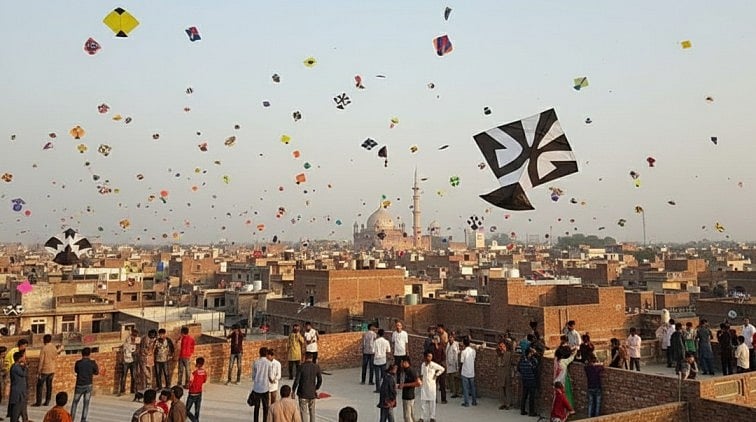
Dubai: For decades, Basant was the moment when Lahore looked up together.
Every spring, rooftops filled with families, music drifted through the old city, and the sky turned into a moving mosaic of colour as kites danced in the air. More than a festival, Basant was Punjab’s largest cultural celebration, deeply woven into Lahore’s identity. Its disappearance left not just empty skies, but a cultural silence.
For decades, Basant was not just a date on Lahore’s calendar, it was a global rendezvous.
Every spring, as winter faded, Pakistanis living abroad planned trips home specifically for Basant, timing annual leave around the festival rather than Eid. Flights filled from the Gulf, Europe, North America, and Southeast Asia as overseas families returned to experience what many called Lahore at its most alive.
Now, after about 20 years of ban and silence, Basant is set to return in February 2026 under a strict safety framework, reviving memories of a festival that once drew the world to Punjab. Basant will be celebrated on February 6, 7 and 8, 2026 within the limits of Lahore district.
More than Eid for many Lahoris
In Lahore, Basant often carried more public energy than Eid festivals.
While Eid was celebrated behind closed doors with family, Basant belonged to the streets and rooftops. Entire neighbourhoods became open-air gatherings. Music, food, laughter, and competition spilled into public space, creating a rare sense of shared celebration that cut across class, age, and background.
For overseas Pakistanis, Basant offered something Eid abroad often could not: collective cultural immersion. It was not just about tradition, it was about being part of a city-wide moment.
Why Basant matters to Punjab and Lahore
Basant marks the arrival of spring, but in Punjab it grew into something far larger. It combined sport, celebration, craft, and community. Yellow clothes symbolised blooming mustard fields, food traditions came alive, and neighbourhoods competed in friendly kite battles.
Lahore, in particular, became synonymous with Basant. The festival once put the city on the global cultural map, drawing visitors, media attention, and economic activity. For many, Basant represented joy, resilience, and shared belonging — rare moments when social divides faded beneath a common sky.
Why it was banned
From 2005 onward, Basant was repeatedly banned after fatal accidents caused by metal- and chemically-coated kite strings. Motorcyclists, pedestrians, and even children were injured or killed, turning celebration into tragedy. Courts and provincial administrations upheld bans for years, making Basant’s return one of Punjab’s most sensitive cultural decisions.
The challenge was clear: could Basant ever return without repeating the dangers that ended it?
What’s different this time
Punjab’s answer is the Punjab Kite Flying Ordinance 2025, a sweeping regulatory framework aimed at reviving Basant in a controlled and enforceable way.
Under the new rules:
Basant will be celebrated in Lahore on February 6, 7, and 8, 2026, following official notification by the government
Kite flying will only be allowed with permission from Deputy Commissioners
All kite and string manufacturers must be digitally registered, using an e-Biz app and online portal
Each kite will carry a QR code linked to the seller, creating traceability
Nylon, plastic, metal-coated and chemical strings are strictly banned, with zero tolerance
Only approved “pana” string is allowed; spools (charkhis) remain banned
Children under 18 are prohibited from flying kites, with fines imposed on parents or guardians
Violations by adults can lead to 3—5 years in prison and fines up to Rs2 million
Red zones
To further reduce risk, Lahore has been divided into 40 Red Zones, identified due to past fatal incidents. CCTV cameras in Safe City areas will provide round-the-clock monitoring, while joint teams of police and traffic wardens will manage security and movement during the festival
Motorcyclists will be required to install safety wires, and strict limits have been set on kite and guddi sizes.
More than culture: the economic impact
Officials say the ordinance is not just about safety, it is also about formalising a hidden economy.
For years, Basant supported thousands of livelihoods: kite makers, paper dyers, bamboo cutters, string producers, wholesalers, and seasonal vendors. The ban pushed this entire value chain underground, without regulation, taxation, or safety oversight.
By enforcing registration and QR-coded products, the government aims to improve production safety standards, create documented, legal income for cottage industries, and expand the provincial tax base.
A cultural return
Punjab’s leadership has framed Basant’s revival as both a cultural correction and a test of civic responsibility. Senior officials have stressed that while the government has created the framework, the festival’s future depends on public compliance.
For Lahore, Basant’s return is not just about flying kites again. It is about reclaiming a lost part of the city’s soul carefully, consciously, and collectively.
Network Links
GN StoreDownload our app
© Al Nisr Publishing LLC 2026. All rights reserved.