Indian Para-military force soldiers march during the Republic Day parade celebrations in New Delhi on Monday.
EXPLAINER
Republic Day 2026: What stood out at India’s biggest military and cultural show?
New weapons, modern warfare displays and cultural performances mark parade
Last updated:
3 MIN READ
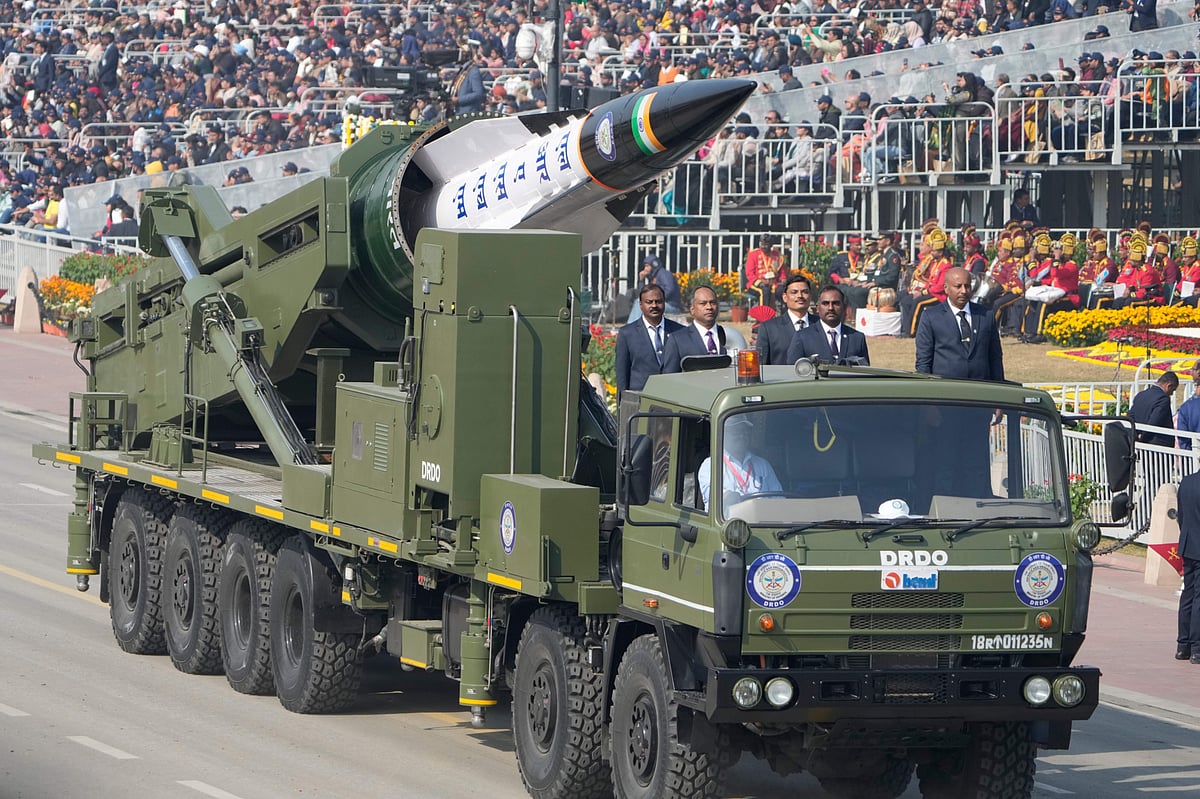
The Defence Research and Development Organisation drive with a model of long range anti ship missile during the Republic Day parade celebrations in New Delhi on January 26, 2026.
AP
Dubai: India showcased its growing military strength, indigenous defence technologies and rich cultural heritage during the 77th Republic Day Parade at Kartavya Path, blending cutting-edge weapon systems with vibrant performances marking 150 years of the national song Vande Mataram.
From hypersonic missiles and submarine technologies to battlefield formations, aerial security shields and mass cultural choreography, this year’s celebrations underlined both India’s security preparedness and unity in diversity.
What were the key defence showcases this year?
The Defence Research and Development Organisation (DRDO) unveiled several major indigenous systems, led by the Long Range Anti-Ship Hypersonic Missile (LR-AShM).
The missile can strike both stationary and moving naval targets at hypersonic speeds, reaching up to Mach 10 and maintaining an average of Mach 5 through its flight. Designed with fully Indian-made avionics and sen-sors, it follows a low-altitude, highly manoeuvrable path that makes it difficult for enemy radars to detect.
DRDO also showcased submarine technologies including the Integrated Combat Suite for underwater war-fare coordination, the Wire Guided Heavy Weight Torpedo for anti-ship and anti-submarine missions, and the Air Independent Propulsion system that allows submarines to remain submerged longer and operate si-lently.
What was new about the Indian Army’s presentation?
For the first time, the Army displayed a complete “Battle Array” — a real-time-style sequence of modern warfare operations.
The display began with surveillance and reconnaissance units, followed by tanks, infantry, artillery, missile systems and air support, reflecting how battles unfold in reality.
Key platforms included T-90 Bhishma tanks, the indigenous Arjun Main Battle Tank, BMP-2 combat vehi-cles and the Nag Missile System Mk-2.
Air support featured Apache attack helicopters, the Prachand Light Combat Helicopter, and the Dhruv heli-copter fleet.
The Army also showcased robotic dogs, unmanned ground vehicles, autonomous platforms and advanced drone warfare systems, highlighting the growing role of technology in modern combat.
Several new weapons and units — including the 155mm ATAGS artillery gun, long-range rocket launcher Suryastra, loitering munitions and new battalions — made their first public appearance.
How was India’s cultural heritage celebrated?
Around 2,500 artists performed a massive choreographed dance to Vande Mataram, marking 150 years since the national song was written by Bankim Chandra Chattopadhyay.
Dancers in traditional costumes from across India showcased folk and classical forms, reflecting the coun-try’s unity and diversity.
Chief Guest President of the European Commission Ursula von der Leyen is being received by Prime Minister Narendra Modi during the national flag hoisting at Kartavya Path.
The parade’s theme, “Swatantrata Ka Mantra - Vande Mataram”, traced the song’s role from the freedom struggle to a modern symbol of national pride.
President Droupadi Murmu, Prime Minister Narendra Modi and European leaders including Ursula von der Leyen and Antonio Costa were among those present.
Indian Army's armoured vehicle displays drones during India's 77th Republic Day parade at Kartavya Path in New Delhi.
What security measures were put in place?
The Indian Air Force created a multi-layered aerial shield over Delhi.
Around 20 fighter jets — including Rafales, Su-30s and Mirage 2000s — conducted combat air patrols and remained on high alert for rapid response.
Netra AEW&C and AWACS aircraft monitored airspace, while Mi-17 helicopters carrying commandos stood ready to counter drone threats.
-- With IANS and ANI inputs

A Senior Associate Editor with more than 30 years in the media, Stephen N.R. curates, edits and publishes impactful stories for Gulf News — both in print and online — focusing on Middle East politics, student issues and explainers on global topics. Stephen has spent most of his career in journalism, working behind the scenes — shaping headlines, editing copy and putting together newspaper pages with precision. For the past many years, he has brought that same dedication to the Gulf News digital team, where he curates stories, crafts explainers and helps keep both the web and print editions sharp and engaging.
Sign up for the Daily Briefing
Get the latest news and updates straight to your inbox
Network Links
GN StoreAbout Gulf NewsTerms & ConditionsReach by GNSitemapContact usPrivacy PolicyGN FocusHave your sayWork with usAdvertise with usGulf News epaperPrinting Services
Download our app
© Al Nisr Publishing LLC 2026. All rights reserved.