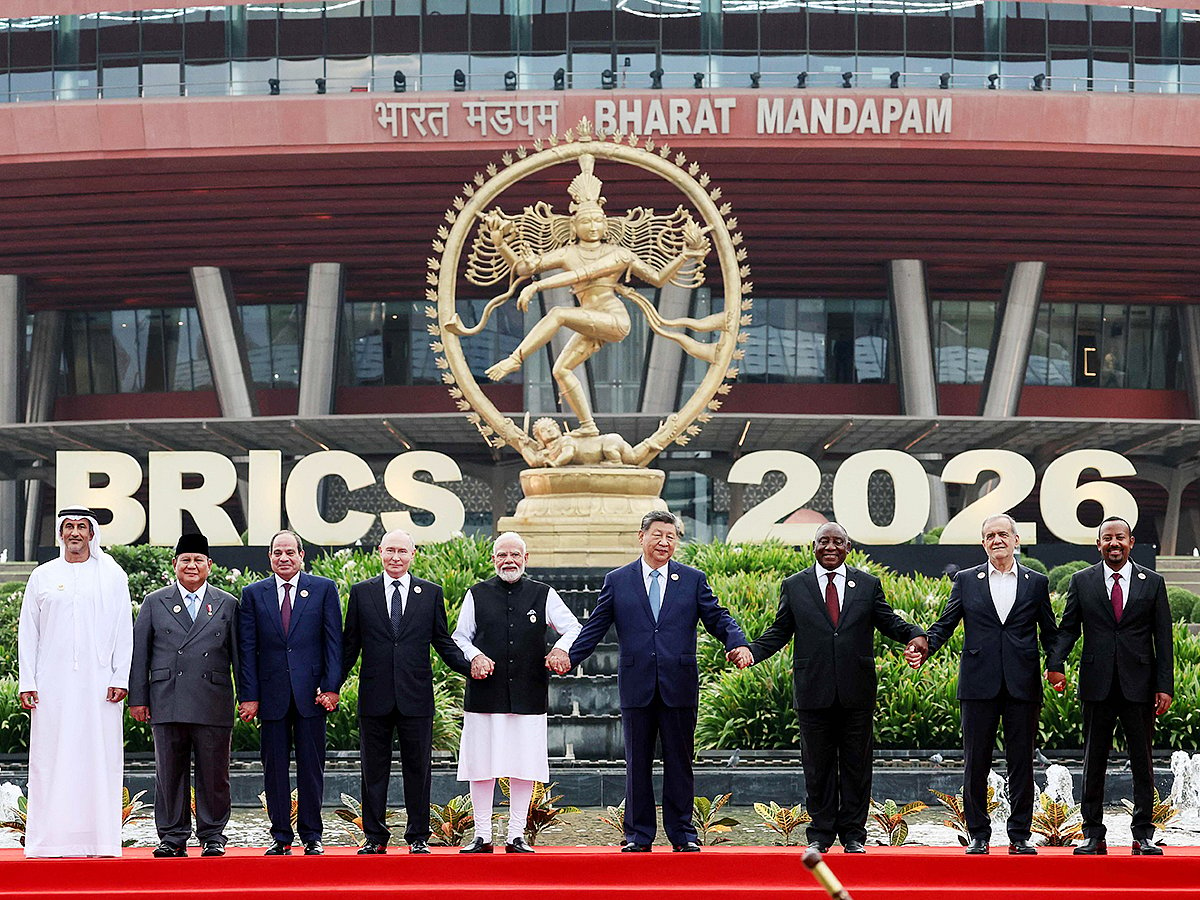
Indian Prime Minister Narendra Modi, center, reacts with Russian President Vladimir Putin, left, and Chinese President Xi Jinping during the BRICS summit in New Delhi, India, Saturday, September 12, 2026.
New Delhi: Members of the 11-nation BRICS group including China, Russia, Iran and India called for calm in the Middle East at a summit in New Delhi on Saturday, overcoming earlier divisions to issue a joint statement.
Chinese President Xi Jinping, who joined Russian, Iranian, Indian and other leaders in the Indian capital, told the summit that the Middle East war "does not serve the common interests of the international community".
Foreign ministers of the BRICS grouping failed to agree on a joint statement when they met in New Delhi in May, with Iran, Saudi Arabia and the UAE divided over the war that began with US-Israeli strikes on February 28.
But leaders issued a statement on Saturday after intense diplomatic efforts by host India, as the bloc seeks to bolster its global influence and address conflict, trade turbulence and energy security.
Get updated faster and for FREE: Download the Gulf News app now - simply click here.
"We express deep concern over the continued escalation of tensions in Middle East/West Asia," the joint statement said, adding the countries "call for exercising maximum restraint, as well as avoiding actions that could further aggravate the situation".
BRICS was created in 2009 as a forum for major emerging economies seeking greater influence in institutions dominated by Western powers.
"We have to transform this pyramid of privilege into a platform of partnership," Indian Prime Minister Narendra Modi told Xi, Russian President Vladimir Putin, Iranian President Masoud Pezeshkian and other leaders.
Modi, opening the two-day summit, called for a system "where every country has a voice, every member has a stake and humanity's development is at the centre of every effort".
He told leaders that BRICS nations "represent 50 per cent of the world's population, 40 percent of global GDP and more than 25 percent of global trade".
But finding balance in the bloc is a tough diplomatic task.
India maintains cordial relations with Iran and Israel, but is also careful to strike a delicate balance in its ties with Washington.
Iran's Pezeshkian attended the summit shortly after warning that the Middle East does not need the United States to be a "regional policeman", with the two countries at war and tensions threatening the vital Strait of Hormuz.
India has navigated the energy crisis caused by the US-Iran war in part by turning to Russia, despite Moscow's war in Ukraine and pressure from Washington and other Western capitals.
Modi embraced Putin before talks on Friday. Putin, who last visited India in December 2025, is one of New Delhi's most important strategic partners.
Network Links
GN StoreAbout Gulf NewsTerms & ConditionsReach by GNSitemapContact usPrivacy PolicyGN FocusHave your sayWork with usAdvertise with usGulf News epaperPrinting Services
Download our app
© Al Nisr Publishing LLC 2026. All rights reserved.