BRICS Summit 2026: Xi, Putin and Pezeshkian head to India as Iran, Ukraine wars test unity
Iran and Ukraine wars loom large as expanded 11-member bloc struggles to bridge divisions
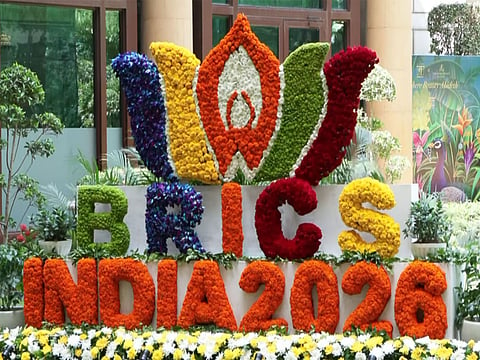
Dubai: India will host some of the world’s most powerful leaders this weekend as Chinese President Xi Jinping, Russian President Vladimir Putin and Iranian President Masoud Pezeshkian converge on New Delhi for a BRICS summit overshadowed by wars in the Middle East and Ukraine and growing strains within the expanded 11-member bloc.
The 18th BRICS Summit, hosted by Prime Minister Narendra Modi on September 12 and 13, comes as the grouping seeks to strengthen its global influence while confronting increasingly divergent interests among its members.
Putin and Pezeshkian are expected to arrive in New Delhi as early as Friday and both are due to hold talks with Modi, AFP reported.
China on Thursday formally confirmed Xi’s attendance, ending days of diplomatic suspense over whether the Chinese leader would make the trip.
“At the invitation of Prime Minister of the Republic of India Narendra Modi, President Xi Jinping will attend the 18th BRICS Summit in New Delhi from September 12 to 13,” China’s Foreign Ministry announced.
Xi is also expected to meet Modi on the sidelines, according to Indian diplomatic sources cited by AFP.
Xi returns after seven years
It will be Xi’s first visit to India since 2019 and marks the biggest step yet in a cautious thaw between the two Asian neighbours following the deadly 2020 Galwan Valley border clashes.
Ties have warmed recently, with flights, visas and high-level contacts gradually being restored, although disputes over their Himalayan frontier, trade and strategic rivalry remain.
“An India-China bilateral would be very important,” Pradeep Taneja, a China-India expert at the University of Melbourne, told AFP.
What is BRICS?
BRICS is a grouping of major emerging economies that seeks greater influence for developing nations in global economic and political institutions.
It began with Brazil, Russia, India and China, with South Africa joining in 2010. It has since expanded to 11 members, adding UAE, Egypt, Ethiopia, Iran, Saudi Arabia and Indonesia.
BRICS Summit at a glance
When: September 12-13
Where: New Delhi
Host: Indian Prime Minister Narendra Modi
Security: Around 15,000 Delhi Police personnel
Extra forces: About 200 paramilitary companies deployed
Key leaders: China’s Xi Jinping, Russia’s Vladimir Putin and Iran’s Masoud Pezeshkian among those attending
Key issues: Iran war, Ukraine, trade, investment and global financial reform
Big bilateral: Modi-Xi talks expected as relations between India and China gradually thaw
Why this summit matters: The expanded BRICS has greater global weight, but wars and competing interests are testing its ability to stay united.
Iran war poses major BRICS test
But the Middle East conflict is expected to be one of the summit’s most difficult issues.
Pezeshkian’s trip will be his first to India as Iranian president and comes as the war threatens to expose divisions within the expanded BRICS grouping.
“The Gulf conflict is going to be the central fault line this time during the BRICS summit,” Harsh V. Pant of India’s Observer Research Foundation told AFP.
BRICS began with Brazil, Russia, India and China, with South Africa later joining. It has since expanded to include Egypt, Ethiopia, Indonesia, Iran, Saudi Arabia and the UAE.
Reuters reported that leaders from China, Russia, Iran, South Africa, Egypt and Indonesia are among those attending, along with UN Secretary-General António Guterres.
Can 11 members find common ground?
Expansion has increased BRICS’ economic and geopolitical weight but has also made consensus more difficult.
“The war in Iran will provide a stern test of the (expanded) group’s cohesion,” Shilan Shah of Capital Economics told AFP.
The divisions were already apparent when BRICS foreign ministers failed to agree on a joint statement at their meeting in New Delhi in May.
Negotiators are now seeking common ground ahead of the leaders’ summit, with the wording of any declaration on the Middle East expected to be closely watched.
Ukraine also on agenda
The Ukraine war will provide another complicated backdrop.
Russia remains one of India’s most important strategic partners and a major energy supplier. Putin last visited India in December 2025 and met Modi again in Bishkek this month.
India has simultaneously maintained engagement with Kyiv. Foreign Minister Subrahmanyam Jaishankar visited Ukraine this month, where President Volodymyr Zelensky thanked India for its commitment to ending the war, AFP reported.
India has also maintained relations with both Iran and Israel while seeking to preserve its partnership with Washington, putting New Delhi’s diplomatic balancing act in the spotlight.
Beyond the wars, trade, investment, financial cooperation and reform of global institutions are expected to feature prominently.
India is also pushing a proposal to link central bank digital currencies across BRICS countries to facilitate cross-border payments, Reuters reported.
Delhi prepares for summit
New Delhi has stepped up security ahead of the arrival of the leaders, with traffic restrictions imposed across central districts.
Delhi Police have urged residents to cooperate with the arrangements, while Friday has been declared a city holiday, AFP reported.
For Modi, the summit brings Xi back to India after seven years, Putin to the negotiating table and Iran’s president to New Delhi while his country is at war.
For BRICS, the bigger test is whether its expanded membership can find common ground as conflicts increasingly divide the countries it has brought together.
-- With IANS inputs


