Braille, belief and the bench: How Thanya Nathan made history in Kerala
Self-study, Braille and resolve drive young advocate’s historic judicial achievement
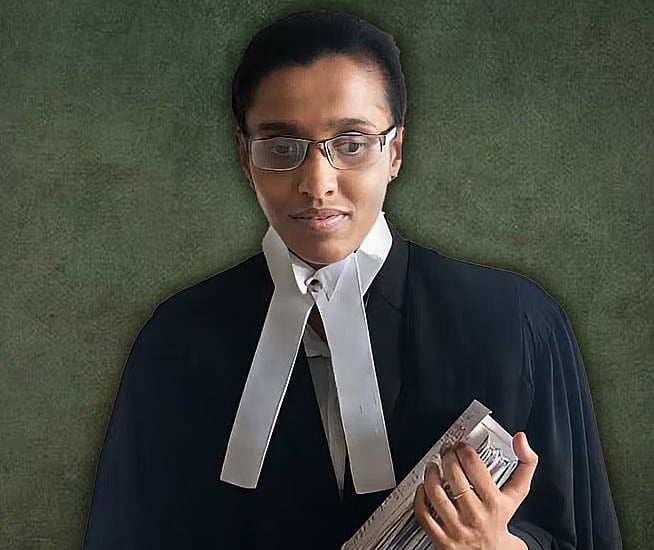
Dubai: In a moment that quietly reshapes the idea of who can occupy India’s courtrooms, 24-year-old Thanya Nathan C from Kannur is set to become Kerala’s first judge with a visual disability — a milestone born from persistence, self-belief and a judiciary slowly opening its doors wider.
Thanya’s achievement is not merely about clearing a competitive examination. It is about navigating a system where, until recently, many aspirants with visual impairments were unsure whether they would even be permitted to sit for judicial service exams.
That uncertainty changed after a landmark Supreme Court ruling in 2025 affirmed that visually impaired candidates could not be deemed “unsuitable” solely due to disability. For Thanya, the judgment did more than clarify the law — it transformed what once felt impossible into something worth pursuing.
“When the Supreme Court allowed persons with disabilities to enter judicial service, I saw a new opportunity open up,” she said, reflecting on the turning point that shaped her decision, according to Indian media reports.
A dream that came late — but with force
Interestingly, the ambition to become a judge arrived only after Thanya had already stepped into the legal profession. Having enrolled as an advocate in August 2024, she began practising law in Thaliparamba, handling both civil and criminal matters under advocate Sunilkumar K.
Brief overview
▪ Who she is: Thanya Nathan C, 24, a law graduate from Kannur, Kerala
▪ What she achieved: Topped the Civil Judge (Junior Division) exam under the benchmark disabilities category
▪ Why it matters: Set to become Kerala’s first judge with a visual disability
▪ Turning point: Supreme Court ruling cleared the way for visually impaired candidates in judicial services
▪ Preparation style: Self-study while actively practising as an advocate
▪ Study challenge: Limited accessible legal material, relied on digital tools and Braille notes
▪ Exam support: Provided a scribe and separate room for dictation
▪ Professional belief: Courtroom practice seen as essential to judging
▪ Larger significance: Seen as a milestone for accessibility and inclusivity in the judiciary
▪ Her message: Never doubt capability — consistency and effort matter most
It was inside the courtroom, not outside it, that the idea took hold. “I started thinking about the judgeship exam only after I began practising,” she explained. “Earlier, there were too many uncertainties. If the system itself does not allow you to write the exam, how can you dream about it?”
Yet once the path appeared viable, she committed herself fully — without stepping away from active practice.
Studying without coaching, without shortcuts
Unlike many judicial service aspirants, Thanya chose not to join a coaching institute. Leaving court, she believed, would have meant losing touch with the very procedures central to judging.
“You can read bare Acts endlessly,” she said. “But ultimately, judging is about courtroom procedure and practical application. I was not ready to give that up.”
Her preparation became an exercise in discipline. Days were spent in court. Nights were reserved for study.
The larger obstacle, however, lay elsewhere: Access to study materials.
For visually-abled students, textbooks and printed guides are abundant. For Thanya, learning depended almost entirely on digital resources and screen-reading software. Braille texts, especially for higher legal education, remain scarce.
“One page of a regular book can become four or five Braille pages,” she noted. “Converting entire legal texts is practically difficult.”
While materials for older laws were relatively accessible, the introduction of new criminal statutes — the Bharatiya Nyaya Sanhita, Bharatiya Nagarik Suraksha Sanhita, and Bharatiya Sakshya Adhiniyam — posed fresh challenges.
“The structure was different. There were very few resources. I had to rely on the bare Acts and build my own notes,” she told The Indian Express.
Throughout her preparation and legal practice, Braille remained her anchor. She drafted arguments, recorded key points, and organised thoughts through Braille notes, supplementing them with digital reading tools.
“If documents were not digitally readable, I depended on assistance at the office,” she added.
The examination experience
During the examination, authorities provided accommodations including a scribe and a separate room — arrangements essential for candidates dictating answers.
“It is not as easy as it sounds,” Thanya said. “You must continuously dictate clearly while processing the questions.”
Despite the pressures, she maintained a strikingly calm perspective on results.
“I was prepared for both outcomes,” she said. “If I cleared it, I would become a judge. If not, I would continue as an advocate — which is itself a noble profession.”
The role of family and support systems
Behind her quiet resolve stood an unwavering support system: Her parents, sister, and professional mentors.
Her family comprises her father Jagannathan, who works in the Gulf, mother Babitha, who is a homemaker, and elder sister Thara.
“They never put pressure on me,” she said. “Choosing the judiciary is perhaps the biggest decision in life. Anything could happen. Their acceptance gave me confidence.”
Her mother described the success as deeply emotional.
“We guided her, but everything else she did on her own,” she told The News Minute.
Accessibility beyond infrastructure
While Thanya acknowledges recent progress — including greater digitalisation and the gradual move toward paperless courts — she believes accessibility is as much about mindset as it is about physical infrastructure.
“We can build infrastructure, but unless people adopt a broader approach, inclusivity will not fully work,” she observed.
Simple barriers, such as stair-only courtrooms, can exclude not only advocates but also litigants with disabilities, she pointed out.
Technology, in her view, holds transformative potential.
“If orders and records are available digitally, persons with disabilities become less dependent on others,” she said.
A message to others
For students and young professionals with disabilities, Thanya’s advice is direct and emphatic: “Never think you are not capable. The door is open. What matters is initiative, hard work, and consistency.”
Her journey — from learning Braille in a specialised school for the blind in Kannur to topping the judicial service examination under the benchmark disabilities category — now stands as both personal triumph and institutional signal.
Kerala’s judiciary will soon gain not just a new judge, but a powerful reminder that ability, not limitation, defines the pursuit of justice.

Sign up for the Daily Briefing
Get the latest news and updates straight to your inbox
Network Links
GN StoreDownload our app
© Al Nisr Publishing LLC 2026. All rights reserved.