After S-400 success, India eyes S-500 missile deal ahead of Putin visit
Putin’s Dec 4-5 trip to see talks on next-generation missile defence, energy, trade
Dubai: After the successful battlefield deployment of the Russian-built S-400 air defence system during Operation Sindoor, India is now preparing to move a generation ahead.
According to NDTV, the S-400’s performance — tracking and neutralising aerial threats at extended ranges and integrating seamlessly into India’s layered air defence network — has prompted New Delhi to explore the acquisition of the S-500 Prometheus, a system regarded as one of the most advanced strategic air and missile defence platforms in the world.
Unlike the S-400, which provides theatre-level protection against aircraft, drones, and cruise missiles within a 400-km envelope, the S-500 introduces national-level defensive capability across multiple domains — air, ballistic missile, and near-space threats.
The system is designed to intercept incoming targets at altitudes of up to 180–200 km, extending India’s protective shield well into the exo-atmospheric layer.
S-500: A strategic leap, not a simple upgrade
The S-500 is not merely the successor to the S-400; it represents a dramatic change in mission profile. The S-400 uses 48N6 and 40N6 missiles, while the S-500 brings in 77N6-N and 77N6-N1 hit-to-kill interceptors capable of neutralising high-speed ballistic and hypersonic threats.
While the S-400 supports regional air defence, the S-500 supports strategic city- and infrastructure-level protection. It is designed to engage a broader spectrum of targets, including long-range ballistic missiles, and has been touted — though unverified — as capable against future hypersonic glide vehicles.
S-400 vs S-500: Capability comparison
S-400 TRIUMF
Range: Up to 400 km
Intercept altitude: Up to 30 km
Targets: Aircraft, drones, cruise missiles
Missile types: 48N6, 40N6
Role: Theatre air defence
Coverage: Regional / sector protection
Mission: Tactical & operational threats
S-500 PROMETHEUS
Range: 500–600 km (est.)
Intercept altitude: 180–200 km (near-space)
Targets: Aircraft, drones, cruise missiles, long-range ballistic missiles, potential hypersonic threats
Missile types: 77N6-N, 77N6-N1 hit-to-kill kinetic interceptors
Role: National air, missile & space defence
Coverage: Strategic cities, command nodes, nuclear and critical infrastructure
Crucially, NDTV reports that while the S-400 deal was a straightforward purchase, the S-500 is being pitched as a co-production arrangement, pairing an Indian partner with Russia’s Almaz Antey to manufacture key components in India. That would make it one of the largest defence industrial collaborations between the two countries.
Diplomatic momentum ahead of Putin visit
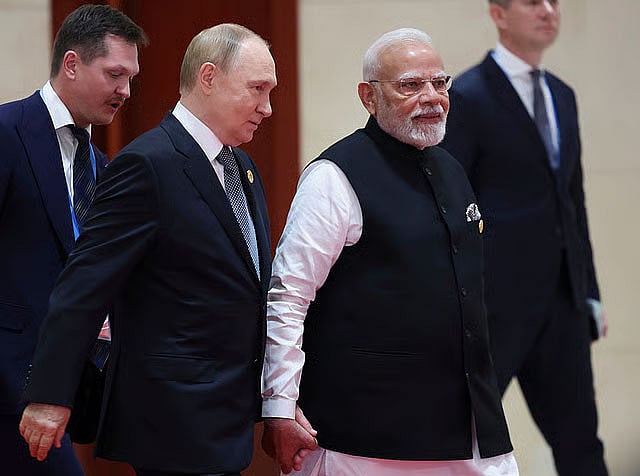
The potential S-500 negotiations come as Russian President Vladimir Putin prepares to arrive in India on December 4–5, a trip Moscow says will “return to the tradition of annual high-level summits.”
According to ANI, Kremlin spokesperson Dmitry Peskov said Russia is “proud to have been shoulder to shoulder with India during its historic growth,” calling New Delhi “a very friendly partner” whose approach to global affairs “rests on a deep historic background of mutual understanding.”
Timeline: Major India–Russia defence milestones (2000–2025)
2000: Strategic Partnership signed in New Delhi
2004: Aircraft carrier deal (INS Vikramaditya) signed
2006: BrahMos cruise missile becomes operational
2010: Fifth-gen fighter (PAK-FA/FGFA) proposal
2012: Kudankulam Unit-1 commissioned
2016: INDRA tri-service exercises begin
2018: India signs $5.43b S-400 deal
2020: AK-203 rifle JV launched in Amethi
2021: First S-400 deliveries and deployment
2022: Rupee-ruble payment system expands
2024–25: S-400 success in Operation Sindoor
2025: Proposed S-500 co-production talks during Putin visit
Peskov highlighted the BrahMos missile programme as proof of what long-term defence co-development looks like, adding that Russia is ready to expand “a variety of very complicated systems” jointly with India.
Separately, Russian First Deputy Prime Minister Denis Manturov told ANI that the visit will “give new momentum” to strategic cooperation, as officials meet at an India-Russia Forum to explore bilateral trade expansion, joint investments, and high-technology collaboration.
Energy, trade and local currency push
Russia also intends to pursue local currency payments to shield bilateral trade from external pressures, with Peskov noting that “nearly all” India-Russia trade is already conducted in national currencies. Moscow will also propose a forum of importers during the visit to increase purchases of Indian equipment, food products, raw materials and services.
Manturov said Russia expects ties with India over the next decade to remain “resilient, dynamic and deeply rooted in long-standing friendship,” especially in scientific research, nuclear power, defence co-development and emerging high-tech sectors.
As Putin returns to New Delhi, the S-500 is emerging as the centrepiece of a potential next-generation strategic partnership — one that would give India not just air defence, but air, missile, and near-space dominance for the first time.

Sign up for the Daily Briefing
Get the latest news and updates straight to your inbox
Network Links
GN StoreDownload our app
© Al Nisr Publishing LLC 2026. All rights reserved.